War

Latvia: Russia could exploit superiority in drones to threaten the Baltic States by 2028

According to the commander of the Latvian Armed Forces, Kaspars Pudāns, Russia has gained an advantage in drone warfare due to its ability to rapidly produce and adapt them on a large scale

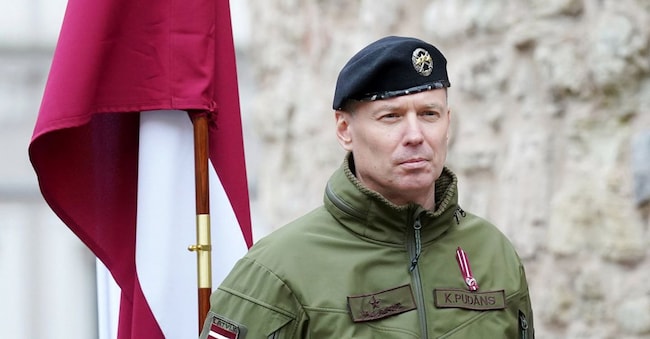
Il generale lettone Kaspars Pudāns.

3' min read

Translated by AI
Versione italiana

3' min read

Translated by AI
Versione italiana

Russia has gained a significant advantage in drone warfare over the NATO countries and may attempt to exploit a favourable strategic window by the end of 2028 to exert military pressure on the Baltic States. This is the warning issued by General Kaspars Pudāns, commander of the Latvian armed forces, in an interview with the Financial Times.

According to the military summit in Riga, the strength of Moscow lies not so much in the technological superiority of unmanned systems as in the ability to produce them in large quantities and to adapt them quickly to the operational needs that emerge on the battlefield.

Loading...

"Their advantage is the scalability of drones," said Pudāns. "They are able to replenish stocks quickly and have very large numbers on a large scale."

The general's analysis comes as European countries accelerate programmes to rearmake and strengthen the defence capabilities on the eastern flank of the Atlantic Alliance. However, according to the Latvian commander, many of the major modernisation programmes of European armies will not produce concrete effects until 2029.

"If I were in the Kremlin, I would say that if we have to do something, we should do it by the end of 2028," he said.

Concerns relate in particular to Estonia, Latvia and Lithuania, which are considered among the Alliance's most vulnerable areas due to their geographical proximity to Russia and the logistical difficulties that a defence of them would entail in the event of a crisis.

Other European security officials also believe that the Kremlin may be tempted to act before the Western military build-up fully kicks in. A senior defence official from a frontline NATO country noted that, from the Russian perspective, there may be incentives to move sooner, both due to uncertainty about the evolution of US policy after the Trump presidency and increased European military spending.

The war in Ukraine today represents the main laboratory of military innovation. Both sides deploy thousands of drones on a daily basis, ranging from low-cost models intended for tactical attacks to long-range autonomous systems capable of striking targets hundreds of kilometres from the front line.

According to Pudāns, the experience accumulated by Russian forces on the ground allowed for continuous experimentation and rapid refinement of new technologies. "Both Ukraine and Russia have a different sense of urgency," he explained. "They are innovating and developing new solutions faster and testing them directly on the battlefield."

The advantage gained in the field could prove relevant in a possible confrontation with NATO. Alliance forces, in fact, have fewer drones and much less operational experience. In a recent British army exercise simulating a conflict in Estonia, commanders assumed that drone stocks would be exhausted in less than a week.

Pudāns also warns against underestimating the nature of future conflicts. "I do not believe that either Russia or Ukraine started this war with the intention of fighting in this way," he noted, referring to the transformation of the conflict into a war of attrition characterised by the massive use of unmanned systems.

Although NATO maintains an overall conventional superiority, especially in the air sector, the general believes that the Alliance still needs to catch up in defence spending, industrial capacity expansion and the deployment of new military capabilities along the eastern front.

At the moment, the Latvian commander points out, Russia does not have the necessary forces for a large conventional invasion while the military engagement in Ukraine continues. However, a different scenario could quickly emerge should the conflict come to an end.

More immediate, however, appears to be the threat of hybrid operations, including sabotage, cyber attacks and disinformation campaigns. "We live under the assumption that some form of aggression could occur as early as tonight," Pudāns concluded.

Copyright reserved ©
Loading...

Brand connect

Loading...

Newsletter

Notizie e approfondimenti sugli avvenimenti politici, economici e finanziari.

Iscriviti