
25 May 2025
Conclusion of the Festival of Economics. Nobel laureate Heckman: Trump's strategy on tariffs is without logic
In Trento, the president of Confindustria was interviewed by the editor-in-chief of Sole 24 Ore Fabio Tamburini: 'Either we change pace on certain types of attitudes or risk deindustrialising Europe'.
For feedback, please contact
english@ilsole24ore.com
 Aggiungi Il Sole 24 Ore
ai preferiti su Google
| 25 May 2025
Duties, Europe
| 25 May 2025
The 20th edition of the Trento Festival of Economics came to an end
The XX edition of the Trento Festival of Economics, organised by the 24 ORE Group and Trentino Marketing on behalf of the Autonomous Province of Trento, with the contribution of the Municipality and the University of Trento, ended this afternoon after four intense days of events.
It was a special edition, celebrating 20 years of the Festival and 160 years of Sole 24 Ore. An extraordinary opportunity for reflection and discussion on the theme: 'Risks and fatal choices. Europe at the crossroads'. Over 300 events animated the initiatives of the Festival, the Fuori Festival, the Economie dei Territori and the Incontri con l'Autore. There were 650 national and international guests, including 100 from the national and international academic world, 45 economists, 6 Nobel Prize winners, 66 representatives of institutions, 17 Government Ministers and 61 representatives of the economic and financial business community. A highly topical theme, chosen by the event's Advisory Board, chaired by the editor-in-chief of Il Sole 24 Ore and chairman of the Scientific Committee Fabio Tamburini and comprising Elena Beccalli, Marco Fortis, Paolo Magri, Emma Marcegaglia, Giulio Sapelli and Giulio Tremonti. An impressive programme that attracted the interest of 52 Business Partners and 7 Media Partners (Il Sole 24 Ore, Radio 24, Radiocor, De Telegraaf, ElEconomista.es, Financial Times, Sky Tg24). 368 journalists were accredited.
"We will carefully evaluate over the next few days, together with the 24 ORE Group and Trentino Marketing," said the President of the Autonomous Province of Trento, Maurizio Fugatti, "the data of this 20th edition, but it seems clear to me that the Trento Festival of Economics confirms its ability to stimulate a very high level of debate, given the value of the speakers, on the most burning international issues that are crucial for the future of the world. It is a pluralist event, where different ideas and proposals are often compared in an attempt to find concrete solutions to the complexity of the problems we will have to face. For Trento and Trentino it is undoubtedly a source of pride to be able to host this Festival, which attracts a diverse audience, including many young people. My thanks go to all those who have worked with great passion, competence and professionalism over the last few days to realise the Festival'.
'This edition has been a great festival. They have been great days, not only for the 24 ORE Group, but for Trento and for the people of Trento, and I think I can say that in these four days we have also done a little bit for the country's agenda,' stressed the director of Sole 24 Ore, Radiocor and Radio 24 and Chairman of the Festival's Scientific Committee, Fabio Tamburini, adding: 'In these days we have brought very high level contributions to the debate on the future of Europe, so much so that we can say that the new slogan of the Festival of Economics is: Trento and the people of Trento caput mundi.
The President of the 24 ORE Group Maria Carmela Colaiacovo said: "For me, this is the first edition of the Festival as President of the 24 ORE Group and I was particularly pleased to touch upon the capacity of the 24 ORE Group, in synergy with Sistema Trentino, to contribute to the economic and social debate in our country. A capacity that is rooted in the history of our newspaper, which has chosen to celebrate its 160th anniversary right here in Trento. A precise choice because the Festival perfectly represents our vision of information that is not limited to reporting and informing, but that creates opportunities for discussion, dialogue and collective growth. What we do in Trento is to create value for the country and contribute to the growth of a widespread and aware economic culture."
"The future of the Festival is to become even more important, to broaden its international scope even more, and probably to extend its duration given the many topics addressed," said Federico Silvestri, CEO of the 24 ORE Group, who went on to emphasise the "great satisfaction for the work done with the Trentino institutions, with the entire 24 ORE Group, and also for the involvement of the citizens, the tourists who came and above all the young people to whom we gave a responsible role this year: we invited them to actively participate in the Festival by proposing topics and themes of interest to them. We invited them to actively participate in the Festival by proposing topics and issues of interest to them. They were therefore the protagonists of several panels that dealt with even complex topics, and I must say that the response was truly significant'. For Silvestri, the large participation in the Festival is dictated by the fact that 'people need to understand, I would say that even our guests - important opinion leaders - not only come here to bring their experience, but also discuss with each other, and they do so not only publicly in the debates, but also in the streets and in the various meeting places that the city of Trento offers, and so there is intense discussion to understand where the world is going'.
"It was an edition," said Maurizio Rossini managing director of Trentino Marketing, "in which 650 national and international speakers were able to dialogue with a large audience that crowded the squares and halls of the festival. An opportunity for the entire Trentino community and many visitors from outside the province to share different points of view, ideas and visions that characterise these days of debate and in-depth analysis. I believe that the great participation we encountered again this year is an aspect to be emphasised: in the more than 300 events that started on Thursday morning, we recorded a great heterogeneous influx of spectators, from families to sector experts, from the very young to students - more than 1,200 from high schools -, evidence of a true 'festival people' that grows edition after edition, that is passionate and in-depth. Thanks to all the people, institutions and police forces who, with professionalism and passion,' Rossini concluded, 'have made a decisive contribution to the success of this twentieth edition.
The deputy mayor of Trento, Elisabetta Bozzarelli, emphasised the success of the Festival, with the many sold out theatres and with a lively city, with all its most beautiful buildings open. The Festival formula works because it is able to bring together Nobel laureates with comedians, politicians with journalists, students and economists, and I think this plurality is very positive for the city. Designing the present or trying to look beyond our everyday? This is the issue that I think is decisive for our future. Inhabiting the planet with less arrogance, less superficiality, and trying to imagine a new balance, a new generational, environmental and geographical equity. Trento has chosen this path. I wish the Festival every success in the years to come in continuing to be a place of exchange, a place of many points of view and a richness of critical principle.
The Rector of the University of Trento Flavio Deflorian, emphasised that the Festival was the result of a choral work. 'I do not know if the answers to the questions posed by the Festival have arrived, but certainly many questions have arrived. And asking the right questions is very important. Competence is not only in the answers, but also in asking the right questions, and this is one of the characteristics of the Festival and I hope it will be the same in future editions. We must continue to question ourselves.
| 25 May 2025
'Il Sole 24 Ore believes a lot in this Festival, so much so that it decided to celebrate its 160th anniversary here'. This was said by
Maria Carmela Colaiacovo, president of the 24 Ore Group, at the end of the Trento Festival of Economics, organised by the 24 Ore Group together with Trentino Marketing, emphasised the work done by the "great organisational machine". The president thanked "in particular the director Tamburini and Federico Silvestri (Ad of the group)", emphasising that it had been given "proof" of the ability "to be able to organise a choral event", adding that "success only occurs when one works like this". Moreover, Colaiacovo indicated that it should be remembered "the great contribution that this Festival has given and is giving to the economic and financial education of this country, because it is truly a very important contribution that should not be underestimated: finding so many young people, so many people who can very lightly come, ask questions, approach, have stimuli, grow, and this is truly the most important part of the Festival".
Ask the editorial team
Have questions or feedback about this article? Contact our editorial team.
| 25 May 2025
Fugatti: Trento Festival continues to grow, important edition
"This was an important Festival. When at the beginning we talked about a popular Davos, which means being able to talk about the big scientific issues, being able to convey them to the common people, I think this happened. I think it is a cultural shift for the Festival'. This was said the President of the Autonomous Province of Trento, Maurizio Fugatti, taking stock of the Trento Festival of Economics, organised by the 24 Ore Group together with Trentino Marketing on behalf of the Autonomous Province of Trento and with the contribution of the Municipality of Trento and the University of Trento. "We are here to provide information, not only for those who know the rules of economics, and therefore those who deal with it, but to be able to convey these messages to the citizens, and I must say that I also saw a lot of participation, I also saw that people were asking for information, asking questions, and therefore this is part of that attempt to bring to the grassroots the desire to convey information related to the economy," Fugatti added, concluding that "it is a Festival that continues to grow. I would like to congratulate the entire organisation, first and foremost the director Tamburini, Sole 24 Ore, our organisational machine and therefore Trentino Marketing, the Press Office, all those who have worked and a thank you to the Police Force because having a dozen ministers here in three days means being able to manage the territory, therefore Local Police and Police Forces'.
| 25 May 2025
Silvestri: the Trento Festival will become even bigger and more important
"The future of the Festival is to become even more important, to broaden the international scope that does exist, probably to extend its duration a bit because we have seen that by putting so many interesting topics, perhaps one more day should be considered". He declared
Federico Silvestri, CEO of the 24 Hours Group, taking stock of the Trento Festival of Economics, organised by the 24 Hours Group together with Trentino Marketing on behalf of the Autonomous Province of Trento and with the contribution of the Municipality of Trento and the University of Trento on the last day of the 20th edition. "I take home a great satisfaction of having completed a year of work, the work done with the Trentino institutions, with the entire 24 Hour Group, and also, I must say, the involvement of the citizens, of the tourists who came, and above all of the young people to whom we gave a responsible role, asking them to take an active part in the Festival, proposing topics and even in some cases developing them; therefore some of the young people were the protagonists of panels that dealt with even complex topics, and I must say that the response was truly significant'. For Silvestri, the large participation in the Festival is dictated by the fact that 'people need to understand, I would say that even our guests - important opinion leaders - not only come here to bring their experience but also to discuss with each other, this is a very interesting aspect We have seen it publicly in the debates but those who have been here in Trento have also seen it in many locations, in the streets, and so there is intense discussion to understand where the world is going'.
| 25 May 2025
Festival of Economics closes, Tamburini: 'Formidable'
"I take home an extraordinary satisfaction because once again this edition has been a great Festival, with formidable days, not only for the Sole 24 Ore Group, but for Trento, for the people of Trento, and I think I can say that we have also made the country's agenda a little bit this week. We have begun to do so because the celebrations will last until the end of the year and they will be long, important celebrations, because 160 years do not pass in a flash'. This was said by Fabio Tamburini, editor-in-chief of Il Sole 24 Ore, Radio 24 and Radiocor, and chairman of the Scientific Committee of the Trento Festival of Economics, which concludes today with a ceremony at the Teatro Sociale. "When at the beginning we talked about a popular Davos, which means being able to talk about the big issues and being able to convey them to the common people, I think this happened. It is also, I believe, a cultural transition for the Festival,' commented the President of the Autonomous Province of Trento, Maurizio Fugatti. A 'critical' Festival, and we really like to think that we can continue along this path in the coming years. In my opinion, this edition was really beautiful. In some respects even surprising. The participation was incredible, even from early in the morning, people really want to come, there is a very fond festival people,' said Trentino Marketing CEO Maurizio Rossini. "I take home a great satisfaction, seeing a year's work done with the Trentino institutions and the entire 24 Hour Group come to fruition, and also I must say the involvement of the citizenship of the tourists who came, especially the young people, whom we gave a task of responsibility, we asked to take an active part, proposing topics and even in some cases developing them," said the CEO of the 24 Hour Group, Federico Silvestri.
| 25 May 2025
Nobel Heckman: Italy's vitality real, problem is talent drain
"The vitality of the Italian economy is real, it has been said in many conversations even here in Trento". This was said James Heckman, Nobel Prize winner for economics in 2000 and director of the Center for the Economics of Human Development at the University of Chicago, on the sidelines of one of the panels of the Trento Festival of Economics, organised by the 24 Ore Group together with Trentino Marketing on behalf of the Autonomous Province of Trento and with the contribution of the Municipality of Trento and the University of Trento. "Italians are leaders in many fields, in fashion, in industry, in technology. Think for example of Fiat, today Stellantis, which bought Chrysler years ago: Sergio Marchionne, an Italian, had brilliant ideas and made Chrysler much more productive,' Heckman said, explaining that 'Italians are intelligent, brilliant people. However, what Italy lacks is the ability to retain its talent, which ends up going abroad: 'Many young people and many Italian scholars go abroad, teaching in US or British universities. This is because there is a lack of adequate incentives for research, which drives the brightest minds away. Many Italian scholars hold important positions in foreign universities, they have higher salaries, the opportunity to do research,' Heckman said. The economist closed with a joke: 'Maybe now things will change, maybe with Trump in the White House they will prefer to return to Italy, I think it is a possibility'.
| 25 May 2025
Piantedosi: armouring the Strait Bridge from criminal interests
'Blocking the Strait Bridge from criminal interests'. This was stated by Interior Minister Matteo Piantedosi at the Trento Festival of Economics. According to Piantedosi, "this very demanding and challenging work" will require us to be "absolutely inflexible with respect to the possible meddling of criminal circuits in the construction of the bridge over the Strait of Messina".
| 25 May 2025
EU, Phelps: 'In crises governments act on spending and taxes, not just rate cuts'
When there is a threat that could lead to a loss of employment and income levels, 'governments should increase public spending and cut taxes despite the prospect of creating fiscal deficits for a certain period of time, of unspecified duration. I agree that a policy of easy money is not enough'. This was emphasised by Nobel Prize winner for Economics, Edmund Phelps, in his lecture at the Festival of Economics entitled 'Jean-Paul and I: Collaborations and some differences 1984-2022' in which he discussed the points of contact and divergence between his economic theory and that of French economist Jean-Paul Fitoussi, who passed away in 2022. Phelps' position is expressed in the context of the controversy over fiscal austerity (which exploded in the years of Europe's sovereign debt crisis) that was at the centre of the debate among economists at the time of former Greek Finance Minister Yannis Varoufakis' proposal to use large fiscal deficits to stimulate consumption and finance increased public spending.
Phelps recalled that, at the time, his objection to Varoufakis was related to the fear that the increase in public debt would lead to an increase in consumption by people at the expense of savings with a consequent deterioration of the welfare level. A key factor in the disagreements over Varoufakis' proposal, according to the American Nobel laureate, was related to the issue of time, i.e. the duration of such policies and their ability to produce results in a predictable timeframe.
| 25 May 2025
Perrazzelli: not regulating cryptocurrencies is 'diabolical', risks euro erosion
Crypto-assets 'should not be understood in a diabolical way, it is diabolical not to regulate them'. This is the summary of the thought of the former deputy director general of Bankitalia, Alessandra Perrazzelli, speaking at an event at the Festival dell'Economia (organised by the 24 Ore Group together with Trentino Marketing). "The subject of crypto-assets," she explained, "is an area in which it is necessary to know well and understand the use made of them" because "cryptos do not respect geographical boundaries".
Europe 'is regulating these activities, there is the MiCa and there are a series of other regulations in the pipeline' in the light of the ever greater integration of these instruments in traditional finance, but, warns the Milan Polytechnic lecturer, there are risks: 'Banks and financial institutions that take them on in their capital, or that hold them as a deposit for clients, must however have enough hay in the hay because, if we then want to convert them, we need real money, otherwise it is like going to the casino and placing bets'. Europe, which is also regulating these activities, is 'very dependent on American technology' and, therefore, as the EU 'we have to develop technology related to finance. Governments must keep this in mind'.
Another issue is that of the effects on the stability of our single currency: "The issue of Europe's strategic autonomy and the euro's monetary sovereignty is decisive, because the expansion of these stablecoins, which have the dollar underneath, can erode the value of the euro, causing it to become less of a world reserve currency and less of a tool in international payments.
| 25 May 2025
Nobel Acemoglu, progress and wages do not always go together
- "Productivity grows, but not wages. Without rules and public vision, few will gain. And democracy risks being left behind'. These were the words of Daron Acemoglu, Nobel Prize winner for economics 2024 and one of the ten most cited economists in the world, during the Trento Festival of Economics organised by Gruppo 24 Ore and Trentino Marketing. During an interview, Acemoglu started from an observation, namely that every day new apps, new devices, new digital wonders are born. "In the last few years they have quadrupled," he says.
But the crucial question remains: who really benefits from all this progress? The issue,' he explains, 'is not so much progress itself, but who governs it and who benefits from it. 'We must not be dazzled: it is true, we can call it a productivity train, but history teaches us that the benefits are not automatically distributed'. Acemoglu cited emblematic examples of innovations that have transformed the economy over the years, but without improving wages. 'Even today,' he says, 'the same thing happens: productivity grows, but this does not mean that incomes grow as well'. According to Acemoglu, automation is a 'necessary step, but it cannot be left to itself. It must be governed, not suffered. If you want shared prosperity, you need active policies, otherwise the benefits will remain concentrated.
In the past, Acemoglu recalls, companies often pushed automation to reduce labour costs, squeezing wages'. Today, artificial intelligence, in itself, is not a sufficient driver of GDP. "We cannot remain glued only to Ai. Machines must serve humanity, not the other way around,' he observes. The United States,' the Nobel Prize winner continues, 'has not yet defined an effective regulatory framework. The European Union, on the contrary, has done a lot, but we need more innovation, not just regulation. A final provocation: 'In Silicon Valley today there are a lot of Europeans. They innovate there, not here. That should give us pause for thought'.
| 25 May 2025
Lisa Fitoussi: My father and Phelps agree on virtuous deficit and excess EU rules
The French economist Jean-Paul Fitoussi, who died in 2022, and the American Nobel Prize winner Edmund Phelps would have agreed for a Europe not suffocated by an excess of rules but "under democratic control" and to recover economic justice "would have proposed a minimum European tax on multinationals, a compulsory minimum social coverage and a fund for social and territorial innovation". This is the view of Lisa Fitoussi, professor of law at Sciences Po and daughter of the economist (for at least 15 years among the French prime minister's economic advisers as well as lecturer at the Institute of Political Studies in Paris and president of Ofce), in her speech at the Festival of Economics in the panel that preceded the lecture 'Jean-Paul and I: collaborations and some differences 1984-2022' given by Phelps. Lisa Fitoussi traced an imaginary dialogue between her father and the 2006 Nobel Prize winner for Economics on Europe, which is 'at a crossroads' in the face of social fragmentation, geopolitical decline and the moral collapse of capitalism.
The two economists, who in addition to collaborating on many important works have had a 'rare and deep' friendship,' Lisa Fitoussi continued, 'would defend the idea of a 'virtuous deficit' by proposing a number of tools to relaunch Europe: the exclusion "of strategic investments from the calculation of the deficit, the creation of a European Treasury that would issue Eurobonds to finance common goods, an integrated defence force with a common budget under parliamentary control, and a coordinated and strengthened macroeconomic policy to weigh in front of the United States and China in regulation, industrial policy and innovation."
| 25 May 2025
AI, Nobel Acemoglu: 'The role of humans must remain central'
'The future belongs to the young, not to artificial intelligence'. It sounds like a simple joke, but the one expressed by Nobel Prize winner for economics 2024 Daron Acemoglu at the end of the 'lecture' on the 'endless struggle between power and progress in the age of artificial intelligence' at the Festival of Economics, is less obvious than one might at first think. Although artificial intelligence is already among us, it is beginning to determine ideational, productive, even personal life paths, just think of its use in personnel selection. It follows that the 'struggle' has only just begun. The ongoing process is very fast. For some time, Acemoglu has been insisting on two paths: artificial intelligence (AI) as an 'advisor' to people or an 'autonomous agent' that replaces humans in decision-making.
"We see the impact of AI agents in some services such as marketing for example, we are not yet at a truly 'revolutionary' stage and whether it will be so depends on the model chosen: whether it will bring automation of simple tasks or reduce them, whether it will help the electrician deal with very complex problems in real time, or whether it will take power away from people, it will decide for us," says Acemoglu. AI agents are an evolution of chat bots (automatic responses to users, such as online help, assistance responses): they can also act, they can autonomously perform tasks on behalf of a user by continuously learning from accumulated experience.
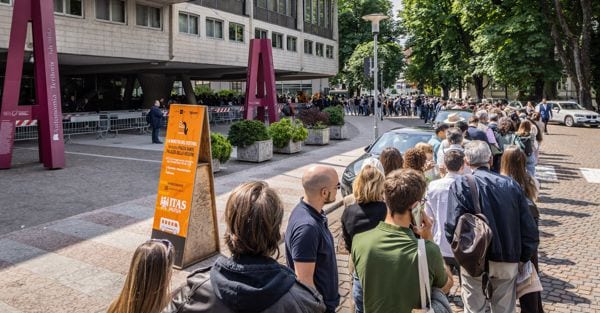
La lotta infinita tra potere e progresso nell’era dell’intelligenza artificiale Nella foto: fila fuori dall'evento
The Turkish economist naturalised in the United States declares himself "very concerned" about the prospect of an 'invasion' of unregulated artificial intelligence into people's education: "Our future as human beings depends on education, of course AI can improve it by making teachers more productive, to make education more widespread, to automate teaching, all this is useful, but chat bots without human supervision certainly do not teach critical thinking to students, they do not always give reliable information". They also create or consolidate 'bad habits': Acemoglu alludes to the risk of weakening the research done by people, the drive for learning that comes from experience and confrontation. (Antonio Pollio Salimbeni ).
| 25 May 2025
Gardini (Confcooperative): 'Poverty worsens, work is a priority'
"Today the certain element is worsening poverty. And the ability to spend has become impoverished: the dynamics of wage increases have not followed the dynamics of the cost of living'. The president of Confcooperative, Maurizio Gardini, highlights as an emergency 'a situation of worsening weakness, which is worrying especially the middle class'. It must be put at the centre, he warns, the issue of "the adequacy of salaries, of the need to recognise in the pay envelope, in the pockets of Italians, more money than today". At the Trento Festival of Economics, Gardini hoped for a cut in the tax burden on the average hundred as leverage: "A reduction from 33% to 31% alone is not resolving the problem, but it would be an important element. Then 'we need to go further', today it is necessary - he warns - 'to restore more value to work and insert a magic word: productivity'.
It has to be 'created and shared by also increasing wages, by also increasing welfare'. A pact is needed: 'a productivity-wage exchange', there is 'the need to create more value in order to redistribute it'. Everyone's commitment is needed. In the dialogue between social partners and in the dialogue with the government. What priorities should be put on the table? 'Work. The top priority can only be work. We absolutely must build a table of relations, passing through the contractual tables, starting from the tables at Palazzo Chigi where there must be an assumption of responsibility on the part of the trade unions, which must have a less ideological and more proactive vision, but also a commitment on the part of the business organisations, and of the public administration, which must review the rates when contracts are renewed. We must dictate strategic framework lines'.
| 25 May 2025
Ciriani (FdI): more sharing, Fedriga will ensure more dialogue
'It's a crisis that I frankly did not want. It has been resolved and if everything clears up I'm happy about it'. This is the comment by the Minister for Relations with Parliament Luca Ciriani on the crisis that has just ended in Friuli Venezia Giulia, expressed in an interview with Messaggero Veneto in which he does not retrace his steps but does not stir up controversy either. "Those who know me know that I'm not used to talking a lot, I make few statements, I don't like controversy of any kind. And if I have spoken, it is obviously because there was a reason,' and 'I can only confirm what I said on the point, but I don't want to go back and stir up controversy again. What I said I cannot, nor do I want to, deny: I hope, however, to be able to look ahead, to have a new phase of sharing on choices. Sharing also means co-responsibility and this applies to everyone'. Healthcare 'is always the most difficult part to manage', which is why 'it is necessary to explain, to share, to convince the territories: if local administrators do not understand the reforms, whether they be the oncology reform or the closure of a birth point, we risk doing wrong. Hence the appeal of these months: let us talk before deciding, we must convince ourselves first among ourselves, involving local authorities and territories'.
On Friday's majority summit, Ciriani states that 'as FdI's regional coordination, we have asked that the president himself interpret the next steps. It will be up to 'the president to ensure that we are all on the same line, with the same responsibility and informed in the same way. If this happens, we will be even stronger and more united than before'. No ambition to take the regional delegation on health. I hope 'that after all this situation we can return to the climate that characterised relations with the president in the past, which were always cordial and marked by collaboration', but he has not yet heard from Fedriga; instead he heard from Meloni 'before and after Thursday's meeting in Rome'. But on the content he would not speak. Criticism on the third mandate as he did yesterday in Trento: "Fugatti has jubilated the vice president of FdI, he has betrayed an electoral pact that foresaw the ticket with Gerosa herself: it was a reprisal because we have decided to challenge the law". The appeal 'will provide clarity. At that point we will decide: we are for the limit of mandates'. And on Fvg: 'We have to wait for the Consulta to clarify: the legislature ends in 2028 and the Constitutional Court may take three, five, seven months to express its opinion. There is plenty of time to do things in order'.
In Veneto: 'The Consulta has expressed itself clearly', also 'Parliament, twice, clearly'. "We are convinced we can express valid candidates, the League believes it can go ahead, legitimately claiming a sort of tradition of government in Veneto. In the end we will find a unitary candidate: we will choose the best path together'. If it were FdI's turn, Raffaele Speranzon 'would be an excellent president, but we also have other very valid candidates'. And in Fvg? He doesn't think of himself: 'I'm a minister, I couldn't be more satisfied than this'.
| 25 May 2025
Mediobanca: Maranghi, great pain if it is taken over by Mps
"I am clearly on Mediobanca's side insofar as, being affectively and historically linked to certain figures who are no longer there, it would be a great sorrow if that place were to be conquered by the forces that are assaulting it". Piero Maranghi, entrepreneur, manager, publisher, director of Sky Classica and son of Vincenzo, former managing director of Mediobanca and historical "dauphin" of Enrico Cuccia, in a brief interview with Radiocor, speaks out against the ops launched by Mps.
"We have to ask ourselves whether it is pertinent that the 700 billion of assets under management in the belly of Generali end up in the orbit of a government and two private citizens," that is, Caltagirone and Delfin, he adds on the sidelines of his speech at the Festival of Economics in Trento, a historical-musical excursus on the Ricordi family, the impresario Domenico Barbaja and Giuseppe Verdi. "I don't think so, I think it's not a healthy thing," he concludes, stressing that if Mediobanca's takeover of Banca Generali were to go through, the Leone company would remain "more independent".
| 25 May 2025
Defence, Camporini: EU looks to NATO model, priority to defragment industry
The European army is a chimera and perhaps not even necessary, but the creation of a European defence system, on the Nato model, must be the objective to look at by aligning industry first of all, so as to reduce the fragmentation of platforms and products, and supply mechanisms. This is what emerged in the debate"First defence investments or first the European army?" at the Trento Festival of Economics, organised by the 24 Ore Group together with Trentino Marketing. "The prospect of a common European army is not only very long-term, but it is not even indispensable. We can replicate the NATO model, which does not have its own army but a very well articulated and effective command and control system that uses the contingents that the individual countries make available - explained Vincenzo Camporini, former Chief of Defence Staff - The important thing is that the individual countries have all the necessary capabilities and that these can be integrated. One difficulty is the fragmentation of the European defence industry: each individual country tends to have systems produced in its own country and this does not allow for economies of scale. European military spending is therefore inefficient: we need to take decisive action to stimulate collaborations, convince the most reluctant countries and with them the CEOs of industrial groups'.
"Finding an agreement on joint procurement is essential both to have scale and to allow some countries to have the necessary equipment, but next to it there is the political issue of the strong links between national defence industry interests and their governments,' added Francesco Nicoli, lecturer at the Politecnico di Torino and fellow of the Bruegel think-tank. 'But the moment is very particular for the defence sector: there is a very high demand for which national industries are not sufficient and technological innovation is very fast. AI and new weapons systems are creating a huge space for very advanced start-ups that do not yet have connections with national governments: building a joint procurement system that is dedicated to new entrants and innovative technologies would allow the EU to start building a new market from the bottom'.
| 25 May 2025
Cottarelli: Trump's announcements on duties are for negotiation
"Trump's announcements must also be seen in terms of negotiation". This was said by Carlo Cottarelli, director of the economic and social sciences education programme at the Università Cattolica del Sacro Cuore, on the sidelines of the Trento Festival of Economics organised by the 24 Ore Group and Trentino Marketing on behalf of the Autonomous Province of Trento. "I don't think," he added, "that he will ever put in 50% duties, so let's calm down and see what he is going to do. It certainly won't be an easy negotiation but I believe there will be an agreement in the end. The main problem of the US is not Europe but China'.
| 25 May 2025
'Only 8 per cent of micro enterprises use artificial intelligence'
"Today only 8% of micro enterprises use artificial intelligence tools, but the potential for growth is enormous, provided that companies are supported along the way". This was stated by Paolo Zanolli, president of the Young Entrepreneurs of the Tertiary Sector of Confcommercio Trentino, during the panel 'Leadership and Artificial Intelligence: balance between technology and human value', as part of the Trento Festival of Economics organised by the 24 Ore Group. Among the main reflections that emerged was the need to accompany businesses - especially SMEs - towards a conscious use of AI, starting from sustainable and accessible applications. Category bodies such as Confcommercio can act as a bridge between innovation and the territory, facilitating the transition and promoting an entrepreneurial culture open to change. "Whoever leads a company must know how to create vision, generate trust and stimulate curiosity. Leadership, today more than ever, is measured by the ability to integrate technology and humanity,' Zanolli added.
Then there is the risk of technological convenience: relying too much on AI can generate an impoverishment of critical thinking: 'The real challenge is not to fall into the negative loop where we delegate too much and give up freedom of thought,' commentedNadio Delai, sociologist and business executive. Finally, the lawyer Giuseppe Vaciago pointed out that 'the more AI improves, the harder it will be to stop using it: we will need real 'brain gyms' to keep the ability to think outside the box alive'. The debate also touched on regulatory issues related to the use of artificial intelligence. 'China has already introduced the obligation to report AI-generated content,' recalled Vaciago. 'In Europe it will happen from August 2026. The European AI Act aims not only to regulate the use of technologies, but to do so by placing ethics and the protection of fundamental rights at the centre'.
| 25 Maggio 2025
Ultima giornata del Festival dell’Economia di Trento, chiude Orsini
Giornata conclusiva del Festival dell’Economia di Trento, la manifestazione organizzata dal Gruppo 24 Ore e Trentino Marketing per conto della Provincia autonoma, giunto alla ventesima edizione. A chiudere i lavori sarà il presidente di Confindustria Emanuele Orsini. Ancora folta la presenza di premi Nobel per l’economia che affronteranno i temi legati alle politiche commerciali americane ed al clima di incertezza globale. E’ prevista la presenza del ministro dell’Interno Matteo Piantedosi che parteciperà ad un incontro sul tema ’Povertà, concentrazione di ricchezza, immigrati e sicurezza’. I lavori delle quattro giornate del Festival dell’Economia di Trento sono state incentrate sulle scelte ed i rischi per l’Europa dopo il ritorno di Donald Trump alla Casa Bianca. Per il ventennale del Festival, la città di Trento ha tenuto a battesimo la prima delle iniziative ideate per festeggiare i 160 anni de Il Sole 24 Ore, che culmineranno a novembre. Non poteva che essere la città del Festival dell’Economia a dare il via ai festeggiamenti del quotidiano economico finanziario più longevo d’Italia, nato nel 1865 con la testata Il Sole.
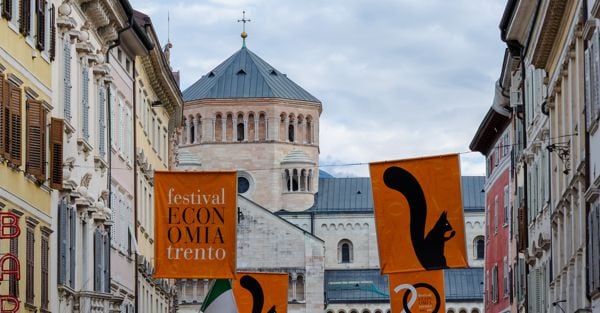
COLORE Nella foto: Via Belenzani con stendardi festival

