Domestic helpers and carers

Increasing number of elderly people but decreasing regular domestic work: -7.6% in 2023

According to a report by Inps and New Collaboration, in 2023 there were 833,874 regular domestic helpers and carers, almost 70,000 fewer than in 2022, which had already marked a decrease of 7.3 per cent on 2021

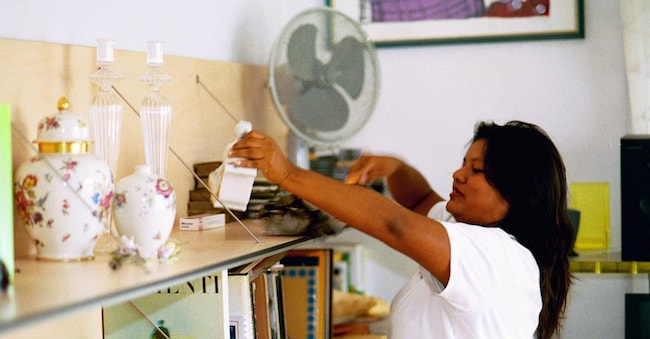
COLF STRANIERA COLLABORATRICE DOMESTICA DONNA PULIZIE EXTRACOMUNITARI (Mimmo Carulli, MILANO - 2002-08-28) p.s. la foto e' utilizzabile nel rispetto del contesto in cui e' stata scattata, e senza intento diffamatorio del decoro delle persone rappresentate

3' min read

3' min read

The progressive ageing of the population drives the demand for domestic work, but the undeclared workers benefit. The Inps recorded a drop in the number of contributing domestic workers in 2023: they were 833,874, down 7.6% on 2022 (-68,327 workers). It should be noted that 2022 was also archived with a drop on the previous year (-7.3%). The last two years bucked the trend compared to 2020-2021, when in the wake of Covid the regularisation of labour relations was almost a necessity to allow domestic workers to go to work during the lockdown, but also thanks to the push of the Relaunch decree that regulated the emersion of irregular labour relations (Decree no. 34 of 2020).

A report by Inps and Nuova collaborazione on the evolution of domestic work in Italy 50 years after the first national contract shows that the decline in regular domestic work since 2022 is similar between males and females, although the gender composition shows a clear predominance of females: the weight of females in the total is 88.6%.

Loading...

From domestic helpers - 10.5%, for carers - 4.4%

In 2023, the number of carers showed a decrease of -4.4% compared to the previous year, affecting almost all areas of origin, with the largest decrease affecting workers from North America (-21.1%). More important was the decrease in domestic helpers (-10.5%), which particularly affected workers from North Africa (-33.0%) and East Asia (-26.2%), while the smallest decrease was recorded by those from the Philippines (-4.5%).

By type of employment, domestic helpers prevailed, accounting for 50.4 per cent of all workers in 2023, compared to 49.6 per cent for carers; ten years ago, domestic helpers accounted for 59.2 per cent of workers.

The domestic helpers type is prevalent among Italian workers and almost all foreign workers, with the exception of those from Eastern Europe, Middle East Asia, North Africa and Central America, where the carer type prevails.

Foreign workers predominate: almost 7 out of 10

The composition of workers by nationality shows a strong prevalence of foreign workers, who account for 68.9% of the total in 2023, a share that confirms the downward trend that began in 2022. In the last year, in fact, the number of foreign workers decreased by -8.3% compared to 2022. Italian workers also fell by -5.8%.

With respect to the area of origin in 2023, Eastern Europe continues to be the geographical area from which most domestic workers come with 297,373 workers, or 35.7% of the total number of domestic workers, followed by 259,689 workers with Italian citizenship (31.1%), workers from South America (8.1%) and East Asia (5.8%). Ten years ago, the share of Eastern European workers was 45.4% against 23.4% of Italian workers.

In the geographical distribution, 30.7% are employed in the North West

.

In the geographical distribution of domestic workers, the North-West stands out with 30.7%, followed by the Centre with 27.6%, the North-East with 19.9%, the South with 12.2% and the Islands with 9.6%. At the regional level, Italian domestic workers decreased in all regions, especially in Molise (-11.6%), Calabria (-11.2%) and Campania (-9.5%), as did foreign domestic workers, who recorded the largest decreases in Calabria (-13.1%), Apulia (-12.5%) and Campania (-12.3%).

The most common salary bracket is at least 13,000 euro per year

.

The analysis of data on wages in 2023 shows that the largest number of domestic workers earn EUR 13,000 and more per year (144,039 workers or 17.3% of the total). The same situation occurs for both females (17.4%) and males (16.2%). This is followed by the annual salary class of between EUR 1,000 and EUR 1,999 (76,725 workers).

Females on average have a higher salary than males, in fact under EUR 5,000 per year 41.6 per cent of male domestic servants, compared to 37.7 per cent of females.

Savia, president of Nuova collaborazione: use tax leverage to bring out undeclared work

For Alfredo Savia, president of Nuova collaborazione, fiscal leverage must be used to encourage the emergence of undeclared work, 'contributory contributions are a valid tool to push towards the regularisation of domestic helpers and carers'.

However, there are no interventions in this direction, with the exception of the Cohesion Decree - the conversion is scheduled by the Senate on 25 June - which provides for total exemption from paying social security and insurance contributions for 24 months in the limit of EUR 3,000 per year in the case of hiring or converting domestic workers to indefinite term for the benefit of a small group of people, namely the elderly aged 80 years and over who receive the accompanying allowance. However, the amendment by Senator Paola mancini (Fdi) with the correct determination of the financial coverage did not pass the 0examination of the Budget Committee of Palazzo Madama.

Copyright reserved ©
Loading...

Brand connect

Loading...

Newsletter

Notizie e approfondimenti sugli avvenimenti politici, economici e finanziari.

Iscriviti