

Elections in Israel and the US are having an impact on the crisis with Iran. Meanwhile, half the Middle East is adopting the NATO model
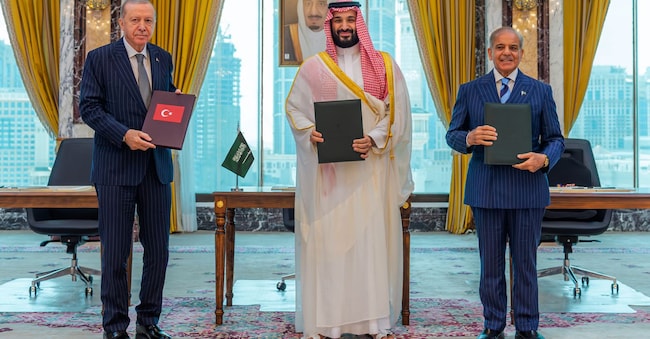
There are no winners in a war in the Strait of Hormuz, and domestic political dynamics slow down and derail agreements. Pakistan, Turkey and Saudi Arabia have signed a historic pact pledging mutual support in the event of attacks. Note that Ankara is a member of NATO

The only thing worse than losing a war is failing to bring it to an end. Donald Trump has announced, on at least two dozen occasions, a surrender agreement that was supposed to reduce Iran to a failed state. Since the start of military operations at the end of February, the US administration’s demands have shifted from the maximum possible – namely, the closure of Tehran’s nuclear programme, the dismantling of its missile arsenal and an end to support for proxies in the region – to the bare minimum, namely the reopening of the Strait of Hormuz to free navigation. And even on this point, Iran now holds a strong and decisive advantage. Whatever agreement may be reached in the coming months, Iran will be able to use that waterway as an economic and strategic asset, introducing some form of transit fee – something that would have been unthinkable just a few months ago. The economic consequences are already significant and will be felt most acutely with the onset of winter. Whilst it is true that the price per barrel remains at around $80, the cost of petrol in America has consistently exceeded $4 per gallon – an average of 35 per cent higher than last year – whilst the price of diesel is higher than the average over the four years of Joe Biden’s presidency.
Washington’s red line
Around a fifth of the world’s energy used to pass through Hormuz. Today, the number of ships passing through in a week can be counted on the fingers of one hand. But it is the legal status of the Strait that is the focus of all diplomatic efforts and military pressure. In the last few hours, Iran and Oman have announced that they are close to reaching an agreement on the joint management of the Strait’s waters. Once guaranteed by Qatar and Pakistan – the other two negotiators in this crisis – this agreement could be submitted to Washington for review. According to initial reports, the two neighbours would share responsibility for managing the shipping lanes: every incoming vessel would be subject to inspection by Tehran, whilst Oman would handle outgoing traffic. The thorniest issue remains, of course, that of the payment of a transit fee, which the US regards as a sort of red line. What we know so far is that the text provides for a form of financial contribution, intended to ensure the future clearance of mines from the main shipping lane and the environmental protection of the Strait. Something similar already exists elsewhere in the world, off the coast of Malaysia, where a foundation wholly owned by the government collects a toll from shipping companies transiting the Molucca Strait to ensure the safety of shipping and protect the local flora and fauna. Faced with this prospect, the United States and Europe seem, for the most part, to be mere spectators, stunned and passive. Meanwhile, Beijing has already made it known that it is keen to engage in dialogue with Oman, provided that the passage of oil tankers and gas carriers to and from the Persian Gulf is restored as soon as possible.
Upcoming election campaigns
Now that foreign policy options have all but run out, the entire Middle East crisis must be viewed through the prism of domestic politics. The mid-term elections in the United States are the key variable and will dictate the next moves. It is clear that the electorate is beginning to show signs of nervousness and unease over the Administration’s decisions and over inflation that shows no sign of abating. The Republican Party is showing its first cracks, whilst the Democrats are taking refuge in extreme polarisation, promoting candidates with clear socialist leanings. Vice-President JD Vance – perhaps the most critical of this war and the least convinced of the special relationship with Netanyahu – has, for the time being, faded from view. In contrast, Marco Rubio is actively involved, present at virtually every table where progress can be made in unblocking negotiations with Tehran. The race to succeed Trump has already begun, and the two front-runners know that their coexistence will become increasingly difficult as time goes on. Domestic politics is the overriding factor at this stage in Iran too. Whilst it is true that the conflict has swept away the moderate wing and definitively handed the reins of power to the Guardians of the Revolution, a stable structure within the power hierarchy is still lacking. Unconfirmed reports of a gradual deterioration in the health of Supreme Leader Khamenei are further unsettling internal relations, particularly within that section of the establishment which considers the current President Pezeshkian too soft and unsuited to governing during such a delicate phase. In the coming weeks, the first priority will be to verify the rumours regarding the Supreme Leader’s health and, subsequently, his ability to reappear in public to exercise direct control and authority – whilst being fully aware, of course, that any movement on his part could turn into a death trap.
27 October 2026 is the date now set for the general election in Israel. In just over two months’ time, the Jewish state will have to come to terms with the fact that it is virtually impossible for the United States to guarantee sufficient support for the possible resumption of military operations. The US has all but exhausted its stocks of Patriot and THAAD missiles and has halted the transfer of these technologies to Israel. The allocation of nearly $100 billion requested by the White House from Congress could be used to replenish about half of these stocks, but production times – even if accelerated to the maximum – will still take four to six months. It is therefore more likely that Netanyahu will wish to focus his efforts on holding ground in southern Lebanon and in Gaza, presenting himself to voters as the sole bulwark against the resurgence of Islamism, Iranian aggression and anti-Semitism around the world, especially now that the majority of Democratic candidates for the US Congress are openly pro-Palestinian.
This domestic factor will also be the dominant one in Europe, where governments are at a loss as to how to deal with rising energy prices and resurgent inflation. Unable to play any diplomatic or military role – apart from its willingness to undertake a possible mine-clearing operation in the Strait of Hormuz, which the Iranians would in any case be unlikely to accept – Europe can only continue to diversify its external supply sources, now concentrated on four routes (Norway, North Africa, the Caucasus and liquefied natural gas from the United States) and domestic sources, with a growing emphasis on renewables and nuclear power.

