
Live
Electoral law gets final approval. Meloni: ‘Now Italians will be able to choose everything.’ Opposition protests: ‘It’s a scam’
The majority held firm on the secret ballot. No rebels. This is the third parliamentary reading following the amendments made by the Senate, which introduced preferential voting with fixed list leaders (after the amendment introducing them had been rejected by the Chamber of Deputies in July) and raised the number of signatures required for parties not represented in Parliament to stand in the elections. On Monday, the announcement was made that appeals would be lodged with the Constitutional Court
For feedback, please contact
english@ilsole24ore.com
 Aggiungi Il Sole 24 Ore
ai preferiti su Google
Summary by key points
- The ruling party and the opposition were all present for the vote
- Arianna Meloni: the new electoral law restores the sovereignty of the people
- Donzelli: the Consulta is a more serious matter than the factions within the PD
- Appeals to be announced on Monday; ‘the aim is for the Constitutional Court to rule before the vote’
- Tajani: Fazzolari has his own ideas, but for Forza Italia, the vote must take place at the end of the parliamentary term
- Meloni: Italians will now be able to choose everything, even their MPs
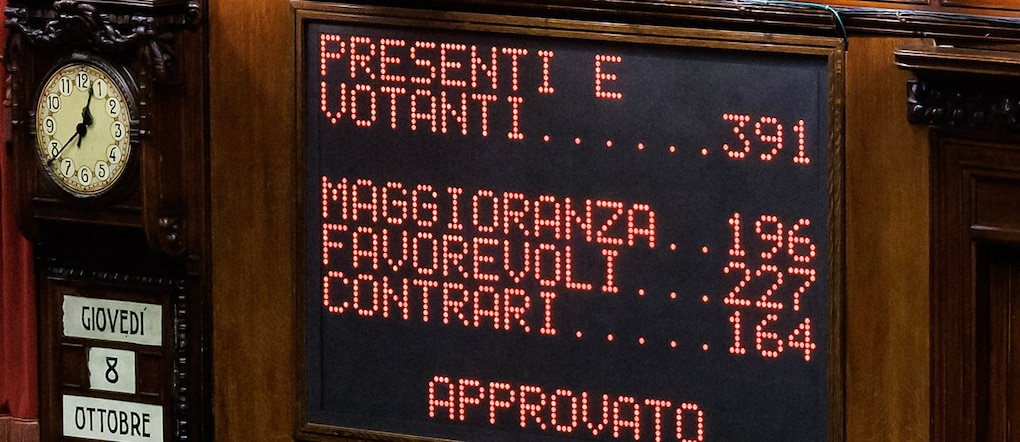
- The Chamber of Deputies has given its approval with 227 votes in favour; the electoral reform is now law
- Schlein: the majority is being blackmailed; you’re afraid of the vote
- Many ministers were present in the Chamber during the explanations of vote
- Conte: a freedom-destroying law dictated by opinion polls and Vannacci’s paranoia
- Bonelli: Meloni has a Plan B – in the event of a deadlock or a revision, the Consulta will reach an agreement with FnV
8 October 2026
New electoral law approved: a round-up of the day’s events
The new electoral law is passed. Having survived three votes of confidence and two secret ballots unscathed, the ‘Stabilicum’ or ‘Melonellum’ receives the Chamber’s final approval at its third reading with 227 votes in favour and 164 against, amidst applause from the centre-right in the chamber and protests from the opposition, who were waving placards reading ‘fraudulent law’. President Meloni was not present at Montecitorio but celebrated on social media. “To those who hoped to see the centre-right divided, today we respond with facts: we are united, united in purpose and determined,” she wrote. The nightmare of ‘franchi tiratori’ – who, in July, thanks to the secrecy of the ballot, had brought down the majority on preference votes – has been averted. Giovanni Donzelli, one of the architects of the reform, reiterates: “Italia is entering the Third Republic” with a “democracy free from paralysis and political blackmail”.
The day began at 10.30 am with the final explanations of vote on the bill. All the centre-left leaders took the floor in front of the government benches, which were fully occupied. Schlein pointed the finger at Meloni, calling her ‘the first female Prime Minister who “has done away with gender equality – in other words, since she arrived, who cares about the others?”’. Before the Democratic Party secretary spoke, M5S leader Giuseppe Conte had condemned the ‘bogus preferences’ of the new law, arguing that with fixed list leaders, ‘more than 80 per cent of the members of the next Parliament will be decided by the party secretaries’. Meanwhile, Angelo Bonelli had denounced the Prime Minister’s ‘Plan B’: ‘If it were to come down to a deadlock or an amendment to the electoral law by the Constitutional Court – and we were therefore to move to a proportional system – Meloni would strike a deal with Vannacci, and she would never tell the Italians about it.’
8 October 2026
PD: Unprecedented ploys in the Chamber to make the vote open
‘The images currently circulating, showing the tactics employed by some MPs to make their vote in favour recognisable, are a very serious matter which confirms, once again, the mistrust and internal divisions within the majority. The secret ballot serves to guarantee MPs’ freedom of conscience and must not be turned into a test of loyalty to the party line. If an MP uses rolled-up pieces of paper or other devices to reveal their secret vote, we are faced with an issue that cannot be dismissed as a mere curiosity of the Chamber. It is unheard of that, at the very moment when MPs’ freedom to vote should be safeguarded to the utmost, measures are being put in place to monitor it and make it identifiable’. This statement was made by Andrea Casu, a Democratic MP and floor whip for the PD group. The reference is to reports of a rolled-up piece of paper inserted into the left-hand side of the voting panel – the ‘yes’ side – by some centre-right MPs prior to the vote.
8 October 2026
The ruling party and the opposition were all present for the vote
The majority groups voted as a united front. From the attendance records – which, of course, do not show how individual MPs voted, as it was a secret ballot – one can nevertheless see the level of participation. As for Fdi, out of 118 MPs, all took part in the vote except for one who was on official business, namely Giorgia Meloni. Forza Italia was present in full: 52 out of 52. In the Lega, three out of the 55 Carroccio MPs did not take part: one was on official business – Minister Giancarlo Giorgetti – whilst Antonio Angelucci and Paolo Formentini were ‘unjustified’. All eight members of Noi Moderati also took part in the vote. Turnout was also very high amongst the opposition parties. All PD MPs took part in the vote: 68 out of 68. In the Five Star Movement, there was just one ‘unexcused’ absence – Susanna Cherchi – so 47 out of 48 voted. All 10 members of AVS voted, as did all 7 members of Italia Viva.
Il tabellone della alla Camera dei deputati l’esito del voto finale sul ddl legge elettorale, Roma, Giovedì 8 ottobre 2026 (Foto Roberto Monaldo / LaPresse) LAPRESSE
Ask the editorial team
Have questions or feedback about this article? Contact our editorial team.
8 October 2026
Ciriani: the new electoral law is intended to bring stability to Italia
“The new electoral law that Parliament has today definitively approved serves to bring stability to Italia, because it guarantees governability and a clear majority chosen by the Italian people, without any more backroom deals struck after the vote. Whoever wins will govern for five years, and the public will choose between parties or coalitions that will be required to be transparent even before the election, setting out their government programme and naming the candidate for Prime Minister who will be put forward to the President of the Republic.” This was stated on social media by the Minister for Relations with Parliament, Lucia Ciriani.
8 October 2026
Molinari: The League stands united, as always, and remains consistent
“Today’s vote confirms one simple thing: the League is cohesive, united and consistent. We have a clear line and we support it with conviction, without divisions and without ambiguity. Now let’s get on with working on the issues that really matter to Italians: the economy, employment, security, autonomy, energy and housing.” So said Riccardo Molinari, the Lega’s parliamentary group leader in the Chamber of Deputies
8 October 2026
Arianna Meloni: the new electoral law restores the sovereignty of the people
“Today marks the definitive end of the era of governments born of political backroom deals; today, consistency and transparency in politics have triumphed. Today the centre-right has won; today the muddle of the ‘broad coalition’ has lost.” This was stated on social media by Arianna Meloni, head of the political secretariat of FdI. “Parliament,” adds the sister of Prime Minister Giorgia Meloni, “has given final approval to the electoral law: voters regain the right to choose their MPs; citizens regain the right to know, before the vote, what the coalitions will be, what the manifestos will be and who the prime ministerial candidates from each bloc will be. Sovereignty returns to the people.”
8 October 2026
Bonetti (Az): the Constitution has been betrayed, women have been humiliated
‘This is the first time in the Republic’s 80-year history that a constitutional right guaranteed by law has been abolished, deliberately setting Italia back to a level unworthy of a European democracy. This government, the first led by a woman, has been determined to create a Parliament in which women are superfluous, subjugated and treated as bargaining chips. It has stripped them of a right and today promises, in return – as always happens when men perpetrate violence against women – benevolent concessions.” This is the view of Elena Bonetti, MP for Azione.
8 October 2026
Fratoianni: the scandalous right wing is pushing through an electoral law to serve its own interests
“Giorgia Meloni is using her majority to change the electoral law just a few months before the election. It is an absolute scandal, and she is doing it in an attempt to stay in power. She is doing this by trying to introduce the office of prime minister, and she is doing it in defiance of the real problems facing Italians – from rising utility bills to stagnant wages.” So said Nicola Fratoianni of AVS, speaking to reporters in Piazza Montecitorio.
8 October 2026
8 October 2026
Donzelli: the Consulta is a more serious matter than the factions within the PD
“It’s not as though everything the PD gets wrong is unconstitutional. The Constitutional Court is a rather more serious matter than the PD’s factional divisions.” This was stated by Giovanni Donzelli, Head of Organisation at Fdi, regarding the announced appeals to the Constitutional Court concerning the electoral law that has just received final approval from the Chamber of Deputies. Are there no concerns about what the Court might decide? “There is never any fear. Whatever the Court decides, we will respect and recognise it. If there are appeals, the Court will rule and we will listen to it calmly, confident that we have produced a sound law, including from a constitutional point of view.”
8 October 2026
Appeals to be announced on Monday; ‘the aim is for the Constitutional Court to rule before the vote’
Immediately following the approval of the electoral law, an announcement has been made regarding the lodging of appeals: on Monday 12 October at 1.00 pm in the Press Room of the Chamber of Deputies, a press conference will be held with lawyer Pietro Adami and Professors Enrico Grosso and Roberto Zaccaria, representatives of the Network for a Free and Equal Vote, who ‘will outline the process of the legal challenges against the electoral law with the aim of securing a ruling from the Constitutional Court before the election’. In a sort of relay, the MPs who led a strong opposition to the law in the Chamber of Deputies and the Senate will hand over the task of continuing the opposition to representatives of civil society in the judicial arena. The following will therefore also take part in the initiative: Simona Bonafè (PD), Maria Elena Boschi (IV), Riccardo Magi (+EU), Alessandra Maiorino (M5S) and Filiberto Zaratti (AVS). Grosso, who is responsible for coordinating the content, will summarise the main grounds for unconstitutionality
8 October 2026
Tajani: Fazzolari has his own ideas, but as far as Forza Italia is concerned, the vote must take place at the end of the parliamentary term
“A general election in June? Why on earth? Fazzolari is quite right to have his own views, but I believe we should hold the election at the end of the parliamentary term; that is Forza Italia’s position.” This was how Deputy Prime Minister and FI leader Antonio Tajani responded to a question about the statements made by Undersecretary Giovanbattista Fazzolari, following the final approval of the electoral law.
8 October 2026
The 2027 Electoral Law: what is the ‘Stabilicum’? How will we vote and what will change?
 by Emilia Patta

The main change introduced by the Stabilicum – or Melonellum, if you prefer – finally approved by the Chamber of Deputies, is the abolition of the single-member constituencies provided for by the Rosatellum and the introduction of a proportional representation system with a 3 per cent threshold and majority bonus for the coalition that secures more than 42 per cent of the votes. The bonus is allocated not as a percentage, but as a fixed quota of 70 members of the Chamber of Deputies and 35 senators, up to a ceiling of 220 members of the Chamber of Deputies – that is, 55 per cent of the seats – and 113 senators, or 56.5 per cent. These percentages more or less fall within the constitutional threshold of 55 per cent, which safeguards the election of institutional bodies responsible for safeguarding the constitution – namely the President of the Republic and the judges of the Constitutional Court and the High Council of the Judiciary – and prevents the ruling majority from amending the Constitution on its own.
8 October 2026
Meloni: Italians will now be able to choose everything, even their MPs
“With the final approval of the new electoral law, when Italians go to the polls again, they will be able to choose everything: the party, the coalition, the manifesto, the candidate for Prime Minister and – once again – their own MP. The centre-right is reintroducing the preferential vote, which has been absent for over thirty years, giving citizens back the power to choose directly who represents them.” So said Prime Minister Giorgia Meloni following the final approval of the electoral law. “Stable governments and greater participation mean more continuity, more accountability and a greater ability to provide concrete answers to Italians.”
8 October 2026
New electoral law: how preferential votes work with fixed list leaders
by Emilia Patta
An important aspect of the new electoral law is the reintroduction, after 23 years, of preferential voting for the selection of elected representatives. On closer inspection, however, these are only partial preferences, given that the list leaders are fixed and that preferences can only be expressed by ticking a box next to a name – up to a maximum of three, starting from the second candidate on the list – with the requirement to alternate between genders if more than one preference is given.
8 October 2026
Opposition protest in the Chamber of Deputies: ‘fraudulent bill’
Opposition MPs staged a protest in the Chamber of Deputies as the electoral law was given final approval. MPs from the PD, M5S and AVS held up various placards bearing the slogans “NO to the Scam”, “Fraudulent Law”, “With Meloni, diesel at 3 euros”, “With Meloni, wages at a standstill”, “With Meloni – healthcare and more weapons”.
8 October 2026
The Chamber of Deputies has given its approval with 227 votes in favour; the electoral reform is now law
The Chamber of Deputies has approved the electoral reform by 227 votes in favour and 164 against. The majority stood firm on the secret ballot. This is the third stage of the parliamentary process following the amendments made by the Senate, which introduced preferential voting with fixed list leaders (after the amendment introducing them had been rejected by the Chamber of Deputies in July) and increased the number of signatures required for parties not represented in Parliament to stand for election
8 October 2026
A ‘militarised’ chamber, with colonels and ploys to secure a ‘Yes’ vote
Just a few minutes before the secret ballot on the electoral law, the ‘militarisation’ of the Chamber of Deputies is taking shape, with Fdi colonels occupying the highest seats in the chamber and some Fi MPs having inserted rolled-up pieces of paper into the voting panels, which were already set to ‘Yes’.
8 October 2026
Donzelli: the reform will put an end to the spectacle of the Left squabbling amongst themselves
‘It would be unfair to say that you’ve only been concerned with electoral law; you’ve also been busy squabbling amongst yourselves over who would be the candidate for Prime Minister. The major issues that have preoccupied the Left are: should we discuss the Prime Minister or the manifesto first? Only to then decide, ‘Yes, let’s discuss the manifesto first’, but to carry on arguing about the primaries – ‘primaries yes, primaries no’ – for the Prime Minister. I say this for the sake of your voters: they do not deserve this spectacle. ‘Thanks to this electoral law, this farce can come to an end.’ Giovanni Donzelli addressed these words to the centre-left benches, speaking on behalf of Fdi in the Chamber of Deputies during his explanation of vote on the electoral law.
8 October 2026
Chamber heats up over Donzelli’s speech; protests from the opposition
Tensions rose in the Chamber of Deputies in the run-up to the vote, during Giovanni Donzelli’s speech on behalf of FdI regarding the electoral law. His speech sparked several outcries from the opposition benches, whilst his FdI colleagues applauded him
8 October 2026
Schlein: The majority is being blackmailed; you’re afraid of the vote
‘I have listened to my colleagues’ speeches and I can understand the embarrassment. Because today you are being asked to vote on precisely the same provision (on fixed-list candidates followed by preferences, ed.) that you rejected on 14 July, and you are voting for it out of fear of the voters’ judgement. I can understand the embarrassment, and I ask you: what has changed since 14 July, when you rejected the very same provision that you are being forced to vote on today under the threat of a vote of no confidence and an early election? Fear. You’ve kept us pinned down for five months, talking about nothing but electoral law; from June to October, you’ve done nothing but try to secure your hold on power.’ Elly Schlein said this in her explanation of vote on the electoral law.
8 October 2026
Benigni (Fi): put an end to political manoeuvring; whoever wins should govern
‘The goal we set ourselves from day one was to ensure stability, governability and representation. The reform is a step in the right direction: a healthy return to a two-party system, in which the winner governs and the loser goes into opposition. Enough of political manoeuvring, enough of ‘backroom deals’, enough of majorities formed without the voters’ knowledge.” So said Stefano Benigni, MP and national deputy secretary of Forza Italia, speaking during the final vote on the electoral law.
8 October 2026
Many ministers were present in the Chamber during the explanations of vote
A large contingent from the Government is present in the Chamber of Deputies, whilst the final votes on the electoral law are taking place. Present, amongst others, were the Minister for Relations with Parliament Luca Ciriani, the Minister for Reforms Elisabetta Casellati, the Minister for Culture Alessandro Giuli, the Minister for the Environment Gilberto Pichetto, the Minister for Tourism Gianmarco Mazzi, the Minister for Birth Rates and the Family Eugenia Roccella and the Minister for Health Orazio Schillaci.
8 October 2026
Conte: a freedom-destroying law dictated by opinion polls and Vannacci’s paranoia
“A law drafted with an eye on the polls.” This is how M5S leader Giuseppe Conte described the electoral reform whilst speaking in the Chamber during the explanations of vote. “The Vannacci hysteria is now dictating your political actions,” he added, addressing the majority, branding the law as “a freedom-destroying and anti-democratic piece of legislation”. And he continued: “Let us remember when Giorgia Meloni said that the rules of the game cannot be decided by votes of confidence,” he went on. “You have tabled three votes of confidence, and you might as well put lookouts in place to monitor the vote.”
8 October 2026
Bonelli: Meloni has a Plan B; in the event of a deadlock or a revision, the Consulta will reach an agreement with FnV
“We are faced with this utterly unconstitutional electoral law: you talk about giving power to the people, but I say to those listening to us, ‘they’re taking it away from you’.” Angelo Bonelli made these remarks whilst speaking in the Chamber of Deputies during the explanations of vote on electoral reform. “We are faced,” he added, “with an electoral law that should be a common ground for everyone, yet it is the tool of a majority that is imposing itself in an authoritarian manner out of fear of losing. I think that, in reality, Giorgia Meloni knows full well that this law is unconstitutional; she pushed it through by telling that 50 per cent who will not return to Parliament, ‘I guarantee you your salary for the next 11 months’, and you will vote for it because you have lost your dignity, but there is a Plan B: if there is a deadlock or the Constitutional Court amends the law, Giorgia Meloni will go and strike a deal with Vannacci; you need to be aware of this, and so all the more reason why the centre-left must prepare itself with an environmentalist and progressive programme’
8 October 2026
Rampelli: the electoral law is a carbon copy of what happens in local councils
Rampelli, it’s a carbon copy of what’s happening in the local councils
‘This electoral law is, in fact, modelled on the one currently in force for local councils and regions. I am puzzled by the reactions of the centre-left; if they believe what they say, they must propose the abolition of the direct election of mayors. In local elections, citizens vote for the party, the coalition, the councillor and the mayor, and – thanks to the majority bonus and the threshold – they end up with stable governments. This is exactly what our electoral law provides for. Perhaps the Left prefers political intrigues and technocratic governments. It is true that preferential votes only count to a limited extent, but it seems to me that those who level accusations at us have never actually considered the issue of preferential voting. As the old saying goes, ‘the best is the enemy of the good’. This was stated by Fabio Rampelli, Vice-President of the Chamber of Deputies and member of Fratelli d’Italia, during a live appearance on the programme ‘Coffee Break’ on La7.
8 October 2026
Boschi: ‘You can change the law, but you’ll lose anyway’
‘After falling behind in July, you tabled three motions of confidence in three days. It doesn’t shock me; it’s allowed, and we’ve done it ourselves. What does shock me, however, is your hypocrisy. Because I remember very well Giorgia Meloni in 2017, during the Rosatellum debate, calling on the President of the Republic. At least back then, part of the opposition voted; Forza Italia voted for the Rosatellum. Now only the majority will vote for it, without a single vote from the opposition. But Meloni has changed her stance on many things. There’s just one thing she hasn’t: boycotting the participation of other women. So go ahead and vote for this law yourselves. You can change every electoral law in the world, but you’ll still lose. Because over the years you haven’t improved the lives of Italians, but only your own and those of your friends.’ So said Maria Elena Boschi, leader of the IV group in the Chamber of Deputies, in her explanation of vote on the electoral law.
8 October 2026
Ziello (FnV): it’s designed solely to secure seats; it’s impossible to vote for it
‘This measure is only about safeguarding the positions of a select few’, ‘a seat in the next parliament’. “There isn’t this level of media attention when it comes to measures such as the high cost of energy, the high cost of fuel and the cost of the weekly shop.” “We have reached the conclusion of a battle which, unfortunately, Futuro Nazionale has lost, and yet won. If these mixed preferences exist, it is solely thanks to General Vannacci, who reminded the centre-right of the promises made in previous years. In the original text, dear Donzelli (Head of Organisation at Fratelli d’Italia, ed.), there was no mention of preferences at all.” This was stated by Futuro Nazionale MP Edoardo Ziello in his final voting statement on the electoral law. ‘We lost’, however, ‘because’ in this law ‘there is a WOK drift that has also infected the centre-right’, for example, ‘gender alternation and locked-in list leaders. Thanks to Donzelli, there are some centre-left leaders who, unlike Futuro Nazionale, will not have to collect signatures to stand for election.” “Because of these ‘Donzelli-isms’, we are forced to vote against it; with this content, it is impossible for a right-wing party to fall in line with the centre-right.” And it is a mistake to claim that FnV votes with the left – that is not the case; you are all following Vannacci.”
8 October 2026
Elections, Fazzolari: a vote in June will allow the electoral cycle to return to normal
“If the electoral law is passed – in other words, if we don’t hold an election straight away because the government falls – there are two options: September, when the term naturally expires, or June.” This was the response from Giovanbattista Fazzolari, Under-Secretary to the Prime Minister, when interviewed by *Il Foglio* and asked when the election would take place. “The second option would allow us to return to the normal electoral cycle and enable the new government to draw up the budget bill with a degree of calm.” Holding an election in the autumn “would mean repeating what this government found itself having to do in 2022, with the first budget drawn up in a matter of days and without giving Parliament the usual time to scrutinise it”. Both scenarios remain on the table; it depends on the stability of the majority, and the decision, he points out, “is not up to us”.
8 October 2026
The SVP is voting ‘yes’: it does not weaken the representation of linguistic minorities
The South Tyrolean People’s Party votes in favour of the electoral law. Dieter Steger, a Member of Parliament representing the linguistic minorities within the Mixed Group, announced this in the Chamber during the final explanations of vote. “I can assure you that the safeguards have been strengthened and the commitments honoured. This electoral law does not weaken the representation of linguistic minorities. The SVP is voting in favour. We have not asked for privileges, but for safeguards,” he added.
8 October 2026
Casellati: things are looking good, but never put your hand in the fire
‘I have a good feeling about it, but I’d never stake my life on it.’ This was stated by the Minister for Reforms, Elisabetta Casellati, before entering the Chamber of Deputies, where the final voting declarations on the electoral law are about to begin. ‘Saying one thing and then doing another is not fair. I’ve been on the receiving end of it, but I don’t approve of it,” she added. As for the legal challenges brought by those who believe the reform does not fully comply with the Constitution, the minister stated: “This law upholds the provisions of the Constitution and is in line with the rulings of the Constitutional Court.”
8 October 2026
Speeches in the Chamber are set to begin, with the final vote at 12.30
Debates on electoral reform have begun in the Chamber of Deputies. The final vote, to be held by secret ballot, is not expected until at least 12.30, and the benches are still partly empty. Representing the government at present are, amongst others, Ministers Elisabetta Casellati, Eugenia Roccella, Orazio Schillaci and Gianmarco Mazzi.
8 October 2026
Everything is ready for the final vote, with speakers ranging from Schlein to Conte
Everything is ready in the Chamber of Deputies for the final vote – by secret ballot – on the electoral law. The final voting statements are scheduled to begin at 10.30: all centre-left leaders elected to the Chamber of Deputies are registered to speak, from Elly Schlein (PD) to Giuseppe Conte (M5S), from Angelo Bonelli (AVS) to Riccardo Magi (+EU). But other parties have also sent their leading figures to Montecitorio: speaking last for FdI will be Giovanni Donzelli, for Iv Maria Elena Boschi, and for Azione Matteo Richetti
8 October 2026
Magi: the battle shifts from Parliament to the courts
‘Today we are moving from the arena of political struggle to that of the courts, with appeals being lodged with the courts and, consequently, the Constitutional Court. Unfortunately, when this happens, it always marks a defeat for politics, but there is this habit, towards the end of a parliamentary term, on the part of those in power to manipulate the rules. I very much hope there will be surprises from this morning’s vote, but the chances are very slim, and I find it telling that, in the passing of an electoral law that will definitively nail the lid on parliament’s coffin, there have been indecent forms of intimidation directed at MPs from the majority – with video recordings in the chamber, party leaders acting as observers, and ministers saying they will monitor MPs’ votes. This is extremely serious: in a democracy, it is parliament that oversees the government, not the other way round.’ This was stated by +Europa secretary Riccardo Magi on the programme ‘Omnibus’ on La7.
8 October 2026
Electoral law: final vote in the Chamber of Deputies today
Electoral law, final act. Today is the day the Chamber of Deputies is set to give its final approval to the ‘Stabilicum’, with explanations of vote and the final vote scheduled to take place by secret ballot no earlier than 12.30 pm, broadcast live on TV. All eyes are on potential rebels within the majority. But bookmakers reckon it is unlikely the bill will be defeated following Giorgia Meloni’s “threat” of early elections should it be rejected in the secret ballot. Is she calm? “I always am,” said the Prime Minister on the sidelines of the Med9 summit in Split
Yesterday, the Chamber gave the green light to the third and final confidence vote, the one tabled by the government on Article 3: 228 in favour, 144 against and 3 abstentions. No major upheaval within the majority. Immediately afterwards came the approval of Article 8 of the bill, concerning voting rights for those living away from home and carers, with 214 votes in favour and none against. The opposition abstained (126 votes) on this part of the text. All the motions on the agenda – around forty in total – tabled by the opposition were also rejected. The government had expressed some support, subject to rewording, including a proposal by Riccardo Magi on digital signature collection, but in the end the proposals did not pass in the Chamber. By contrast, the motions tabled by the ‘Vannaccians’ of Futuro Nazionale on preferential voting and gender equality were met with opposition from the outset.

