
Electoral law: deadlock within the ruling coalition over the issue of preferential votes
Two hours of talks between the sherpas, but Fdi fails to win over its allies. The vote in the Chamber is postponed by a week. The opposition is up in arms: ‘It’s unconstitutional’

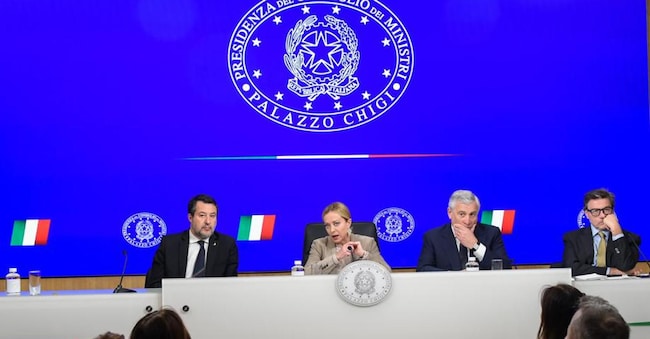
There is a deadlock over the electoral law. A two-hour summit in Via della Scrofa last night between the majority’s ‘sherpas’ failed to untangle the issues, starting with the preferential voting system championed by Giorgia Meloni and her allies, which continues to meet resistance from Antonio Tajani’s centre-right group and, above all, Matteo Salvini’s League. The leaders would have been prepared to hold a video conference had there been any sign of an agreement, but the differences remained too wide.
Nor does the Belgian model convince the allies, even though it offers voters a choice: to vote for a party by accepting the list of candidates on the ballot paper, or to tick the name of the candidate they wish to vote for. This is a compromise solution that does not appear to undermine the control exercised by party leaderships: according to the Democrat Dario Parrini, only 10 per cent of MPs in Belgium were elected on the basis of individual preferences, thereby overriding the parties’ recommendations.
There were, however, two reasons that prompted the Prime Minister and the leadership of Fratelli d’Italia – starting with the party’s chief of staff, Giovanni Donzelli – to press their allies to find a mechanism to overcome the dual closed lists in multi-member constituencies for the proportional quota and in single-member constituencies for the blocks of 70 MPs and 35 senators that are triggered as a majority bonus if the 42 per cent vote threshold is exceeded: on the one hand, the fire from the right by Roberto Vannacci, who continues to rail against closed lists; on the other, the fear that the Constitutional Court might intervene with an additional ruling, imposing a preference voting system in the event of a pre-emptive appeal against the ‘Melonellum’ or ‘Stabilicum’, whichever you prefer to call it.
A pre-emptive challenge that is now a certainty, given the line agreed upon just hours ago by the leaders of the centre-left. ‘We have agreed to mount a joint opposition with amendments seeking to repeal the bill. We must stand together against it and be ready to appeal to the Constitutional Court,’ says M5S leader Giuseppe Conte, also proposing a name for the progressive ‘movement’ (‘Alliance for the Constitution and Democracy’). And PD Secretary Elly Schlein echoes him: “This bill already contains a foretaste of the ‘premierato’ system, namely the mandatory nomination of the Prime Minister at the time the government programme is tabled, which precisely betrays the original intention. On the other hand, Meloni was crystal clear yesterday about what the real objective is: the objective is the Quirinale, and that is another good reason to try to stop this electoral law. They are obsessed with power.”
The fact is that the plenary vote on the reform, which is due to be on the agenda from next Tuesday, could in the meantime be postponed by a week. According to reports from parliamentary sources within the majority, in fact, the disruption to rail services expected on 7 July (including strikes and engineering works on the line), combined with the broad-based rally scheduled for the following day in Naples, is said to have prompted the centre-left to request a change to the timetable, which is due to be discussed today at 2 pm at the group leaders’ meeting. Schlein couldn’t resist a quip: is the debate being postponed because of the train strike? “I can’t help thinking that perhaps this is Salvini’s way of expressing his dissent.”


