
Electrolux: marathon negotiations at the Mimit, but an agreement is still a long way off
The Government is open to identifying social safety nets and measures to support the negotiations, such as expansion contracts

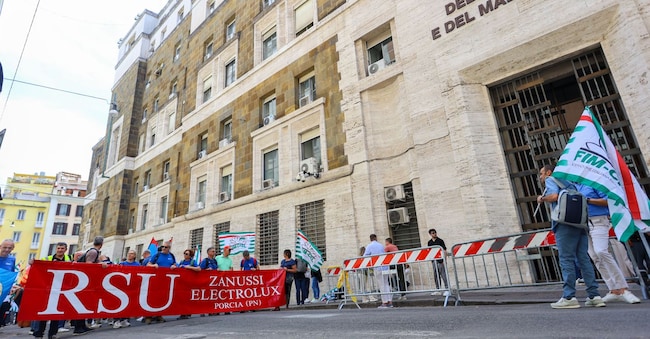
Negotiations on Electrolux are continuing round the clock at the Mimit, with the aim of establishing the framework for an agreement. However, late into the evening, the parties were still far apart on resolving the dispute, which began in the spring with the announcement of 1,700 redundancies and the closure of the Cerreto d’Esi site.
At the last meeting, the multinational had presented new figures on redundancies and staff departures, and indicated a willingness to review certain production lines. For the trade unions, Fiom, Fim and Uilm, it is crucial that any departures are entirely voluntary and incentivised, and that a certain level of employment is maintained – one that is significantly broader than that which would result from the 1,041 redundancies (excluding Cerreto), bringing the total to 1,190. As regards Porcia, the willingness to increase the share of washer-dryer production from 30 per cent to over 50 per cent represents an initial sign of a shift away from the deindustrialisation scenario initially proposed, laying the foundations for a broader long-term perspective. At this stage, a comprehensive package of social safety nets and active labour market policies would also be required. Another issue on which the trade unions are unwilling to compromise is the closure of the Cerreto d’Esi site, where cooker hoods are manufactured: the trade unions are calling for production to continue until a new investor is found.
For its part, the Government would be willing to consider whether to reintroduce ‘expansive solidarity contracts’, as Giampietro Castano, head of the Mimit Crisis Unit, explained – according to trade union sources – whilst emphasising, however, that this is not the only suitable tool for protecting jobs. Expansion contracts – the use of which had been proposed by trade unions in previous meetings – link staff departures from a company to a yet-to-be-defined number of young people joining the workforce. The measure was in place in Italia until 2024. It has not been funded since then. At the Ministry of Enterprise and Made in Italy, officials are examining the availability of the resources needed to refinance the measures required to steer the negotiations towards a conclusion, which appears less certain than anticipated.
Barbara Tibaldi, national secretary of Fiom Cgil and head of the household appliances sector, explains that ‘the first few hours of negotiations have not resolved the central issue, namely safeguarding production, workers and the Cerreto d’Esi site. We must ensure generational renewal and job security, and that production at Cerreto is not relocated elsewhere. We will continue for as long as necessary’.
“The expected responses have not yet materialised. At the conclusion of the technical meeting, the positions expressed by company management remain far removed from any prospect of an agreement,” summarises Massimiliano Nobis, national secretary of Fim Cisl. “During today’s technical committee meeting, the company did not show the necessary flexibility to reach an agreement,” continues the trade unionist. “We have strongly called for a reduction in redundancies, which remain very high for both white-collar and blue-collar staff. We have called for specific investments in production and, above all, have sought assurances regarding the continuity of production and employment at the Cerreto d’Esi plant and for the entire industrial supply chain. There are still no concrete answers on the key points of the negotiations. We are now entering the political negotiations phase: we hope that, at this level of discussion, the company will finally begin to address the substance of our demands, offering real guarantees for employment and the revitalisation of the production sites’.

