
Electrolux withdraws its unilateral redundancies: new plan with voluntary redundancy schemes and social safety nets
Minister Urso called another meeting on 29 October and confirmed the EU’s support for Italy’s strategy. Following the presentation of the plan, he spoke of a fresh start to the negotiations

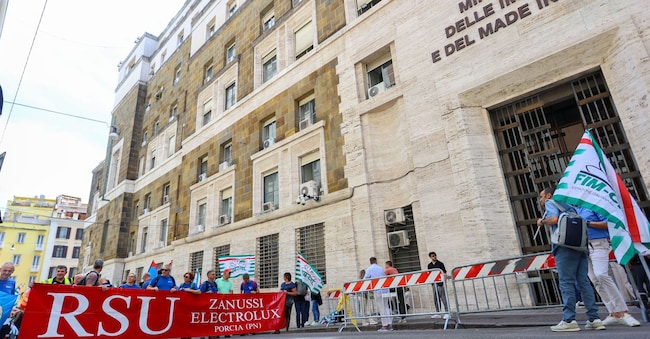
In the end, the multinational Electrolux has decided to revise its plans for Italia. At a meeting at the Mimit with the trade unions, it explained that it would withdraw the unilateral redundancies. This is a crucial development both for workers’ representatives and for Minister Adolfo Urso, who has just returned from a long series of meetings in Brussels in support of Italian industry, including the household appliances sector. The multinational is withdrawing the unilateral redundancies and its initially very hardline approach. Redundancies will, however, remain; but in the new plan, the company proposes to manage them through incentives for the voluntary departure of 1,250 people – comprising 600 white-collar staff and 650 blue-collar workers – over three years. The transition will also be managed through the use of the extraordinary redundancy fund. This will be accompanied by a review of production and product ranges. Following the presentation, Minister Urso explained that the Government is ready “to support the new recovery plan, using all available measures – including extraordinary ones – which we will implement through the forthcoming Budget Bill”.
The reindustrialisation of Cerreto d’Esi
Little is set to change at the Cerreto d’Esi site: the closure has been confirmed, but Electrolux has put forward a plan for reindustrialisation and a more sustainable transition. Minister Urso explained that ‘we must safeguard all Electrolux plants in Italia, including the one in Cerreto d’Esi, whilst protecting employment levels. There must be no redundancies or unilateral decisions’, Urso stressed. For the time being, according to the multinational’s plan, the site will continue production. In recent days, however, the trade unions have denounced the transfer of production from Cerreto to Poland. Subsequently, the most appropriate social safety net measures will be utilised, and periodic checks will be carried out on the progress of the projects. In collaboration with the adviser Vertus, Electrolux has embarked on a process involving a feasibility study and will set up a working group with the support of local authorities and the social partners. Among the measures to be used to redeploy staff, outplacement schemes will also be offered.
The strike
In the meantime, however, an eight-hour strike has begun, with workers staging a sit-in outside the Electrolux factory in Cerreto d’Esi (Ancona), as part of the protest against the announcement that the factory is to close. It is a decisive day for the 170 workers at the plant who are at risk of losing their jobs following the Swedish multinational’s announcement that it is closing the site. A delegation of workers and trade unionists set off for Rome overnight to follow the negotiations. Most of the workers at the site are aged between 45 and 50; finding new employment locally will not be easy for them.
Investments
To support the new products, 90 million has been earmarked for investment. In particular, the multinational has mentioned further products for Italia: BI-range fridges for Switzerland, premium-range gas hobs; for ovens, the expansion of the Steam Crisp and pyrolytic ranges; for washing machines, the focus will be on 12 kg models and the Professional range; for washer-dryers, production will be limited to the top-of-the-range models; whilst dishwashers will be produced exclusively for Europe. There will be a joint commitment to support the competitiveness of Italian products by placing household appliances on the European agenda through the review of the CBAM and energy costs, alongside greater organisational efficiency. This is the approach the multinational proposes to take, in collaboration with the Ministry and the trade unions, to safeguard its presence in Italia, even in a highly challenging environment.
EU support
Minister Urso, however, encouraged the multinational company, pointing out that, during the meetings in Brussels, the Italian position had made an impression in Europe. ‘Sejourné confirmed to me in writing a few hours ago that they are ready to take action, based on the guidelines set out in our non-paper, which has also been endorsed by Germany, France, Spain, Poland and Slovakia,’ said Urso. “This allows the company to change its strategy, because we can guarantee a different regulatory framework to support European production. For this reason, I hope there will be a fresh start, with a different plan – one very different from the one that had been presented to us, which they had deemed unacceptable. What is needed now – and what is possible – is a new, sustainable and acceptable recovery plan.”

