

Emergency rooms: +1.5 mln accesses in 2 years and patients still 'without a network' in the area
Increasing admissions, 'tokenists' still in the field and traffic jams on the wards, but with no direction to link up with RSAs, community hospitals and hospices, and citizens sitting on stretchers for days on end: the complaint of emergency specialists
by Barbara Gobbi
 Aggiungi Il Sole 24 Ore
ai preferiti su Google
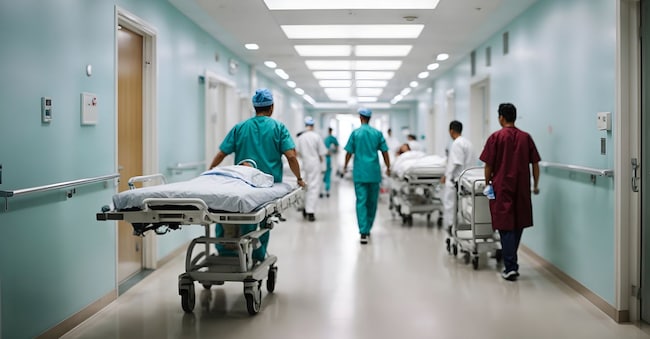
Accesses to emergency rooms are expected to increase by 1.5 million in two years, between 2023 and 2025, and by 750 thousand patients in 2024-2025 alone: this is the latest estimate, in the absence of official data, drawn up by the Society of Emergency-Urgency Medicine (Simeu) on the basis of a flash survey just carried out on a sample of facilities. The flash analysis reveals an average patient 'stationing' in the emergency room of 23 hours - but with facilities that record the dramatic figure of four days for so-called boarding on a stretcher, i.e. waiting for the person to be placed in a ward or facility on the territory. And it is precisely on the connection with this 'setting' of care that the most new - never before evaluated - and decidedly worrying data emerges: only a little more than a third of hospitals (36%) declare that they have a real and constant collaboration - based on company protocols and joint management - with centres such as RSAs or community hospitals or palliative care facilities. On the contrary, for 64 per cent of those interviewed by Simeu, dialogue is 'sporadic or completely absent. With social services, the figure improves but falls short of the mark: the proportion of emergency rooms claiming effective cooperation stops at 50 per cent, while the other half experience a condition of 'operational isolation'.
Without a director
If it is the Scientific Society itself that specifies that the data presented have the value of a sample and will have to be further evaluated in the future, the early warning bells are loud. Even just looking at the latest data, at a time when the reorganisation of care on the territory wanted by the National Plan for Recovery and Resilience (Pnrr) should by now be almost complete. As Simeu President Alessandro Riccardi emphasises, 'integration between emergency rooms and social care facilities is the pillar on which the future of the National Health Service must rest. It is essential to define realistic indicators and accurate detection systems: without real continuity of care, the pressure on emergency areas is bound to become unsustainable'.
"On the one hand, the territory is insufficient, and on the other hand, many discharges, for example from Medicine, which end up in the RSA, could be anticipated directly by the emergency room, but this does not happen where there is no adequate direction from the district directorates in the territory,' explains Simeu past president Fabio De Iaco. 'The non-implementation of the RNRP also reduces the possibilities of receiving patients in the territory, but in addition to this, the issue is that there is a lack of direction that acts as a bridge and allows the co-management of patients between hospital and territory. Those who have patients in the hospital and those who have to take care of them on the territory should talk to each other, but this still does not happen and the patients pay the price'.
Contractors still in the field
The flash-survey shows that only 11% of the hospitals surveyed by Simeu declare sufficient medical staff to guarantee the service, without the need for any kind of supplementation. The remaining 89% report that they supplement the necessary medical coverage through solutions such as the additional services of medical managers or free-professional contracts stipulated at a corporate level. 29% of the facilities surveyed also report continuing to use service agencies, so-called 'tokenists', despite ministerial instructions. In this context, the percentage of patients who are admitted to hospital after admission to the emergency room remains around 13%, confirming previous findings.
Patients on 'stretcher'
When asked whether boarding is a structural problem in the emergency room, 70% of the facilities confirmed that they have to deal with patients on stretchers waiting for a bed on a daily basis; only 30% of the facilities stated that they had no boarding problems.

