Energy, ports and Corridor VIII in the Balkans: the true Adriatic frontier
Italy’s industrial security does not end at the coasts of Puglia or Abruzzo, but extends through Montenegro, Albania, North Macedonia, Serbia and Bulgaria, all the way to the Black Sea. The Italia–Montenegro electricity interconnector and Corridor VIII are analysed as separate infrastructure projects. The former falls within the remit of energy policy; the latter relates to transport, EU enlargement and NATO’s military mobility. However, they must be considered together
by 24Ore NextMed
 Aggiungi Il Sole 24 Ore
ai preferiti su Google
Key points
Italia is shifting an increasing proportion of its energy, logistical and military capabilities across the Adriatic. This is not being achieved through a decision formalised in a single national plan, but through the gradual integration of power cables, ports, railways, roads, substations, digital systems and dual-use corridors. The result could be a new strategic geography: Italy’s industrial security no longer ends at the Apulian coast, but extends through Montenegro, Albania, North Macedonia and Bulgaria, all the way to the Black Sea. The Italia–Montenegro electricity interconnector and Corridor VIII are generally analysed as separate infrastructure projects. The former falls within the remit of energy policy; the latter within transport, European enlargement and, increasingly clearly, NATO’s military mobility. However, they must be considered together. The submarine cable connects the national electricity system to the grids of the Western Balkans. Corridor VIII links the ports of southern Italia to Albania, North Macedonia, Bulgaria and the Black Sea. Both depend on the same conditions: continuity of supply, technological interoperability, efficient border crossings, transport availability, and the maintenance and control of critical nodes. Italia is not merely participating in the construction of two infrastructure projects. It is witnessing the formation of an Adriatic-Balkans-Black Sea operational system.
The Electric Frontier
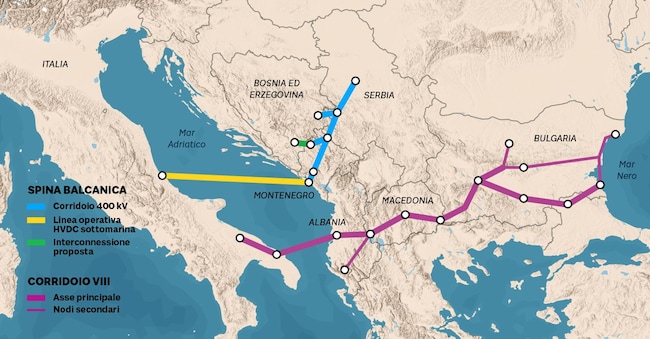
As at 31 December 2025, Terna reported that the Italia–Montenegro direct current interconnector was 445 kilometres long and had a capacity of 600 MW. At the same time, the Italian operator managed 75,905 kilometres of power lines, 926 substations and four control centres, against an estimated national demand of 311 TWh. When compared with the overall scale of the Italian system, 600 MW may seem insignificant. However, its strategic importance becomes apparent during periods of scarcity, when domestic generation is unavailable, when there are significant price differentials, or when the expansion of renewable energy sources makes it necessary to rapidly absorb and redistribute energy. Operationally, however, the cable does not end on the Montenegrin coast. Its usefulness depends on the ability of electricity to reach Lastva via Montenegro’s internal grid and the interconnections with Serbia and Bosnia and Herzegovina. It depends on substations, 400 kV transmission lines, regional hydroelectric generation, the availability of thermal power stations, weather conditions and the safety margins maintained by Balkan grid operators. The infrastructure, which was inaugurated in 2019, does not end operationally at Lastva on the Montenegrin coast. For the electricity to reach the Adriatic, Montenegro’s internal grid, connections with Serbia and Bosnia and Herzegovina, the substations at Pljevlja, Bajina Bašta and Višegrad, available generation capacity and sufficient safety margins are all required. The European Commission regards the Trans-Balkan Electricity Corridor as a Global Gateway regional project linking Serbia, Montenegro and Bosnia and Herzegovina with Croatia, Hungary, Romania and Italia. In 2022, 84 kilometres of 400 kV power line were completed. Further sections towards Bosnia and Herzegovina are still under preparation.
At the heart of the project is the new 400 kV link between Bajina Bašta in Serbia, Pljevlja in Montenegro, and Višegrad in Bosnia and Herzegovina. The Energy Community estimates its maximum capacity at 1,200 MW and its expected lifespan at between sixty and seventy years. However, its completion requires two preliminary projects: the Serbian section between Obrenovac and Bajina Bašta and the Montenegrin line between Čevo and Pljevlja. The stated aim is to make more efficient use of the connection with Italia, integrate more renewable energy and enhance regional security. If fully implemented, the corridor is expected to increase the net exchange capacity between Montenegro and Serbia by 600 MW in both directions by 2030. Between Bosnia and Herzegovina and Serbia, the estimated increase is 300 MW towards Serbia and 500 MW in the opposite direction. Alongside this backbone is the Gacko-Brezna proposal, a new interconnection between Bosnia and Herzegovina and Montenegro approximately 51 kilometres long, with a maximum capacity of 1,330 MW. The project is expected to alleviate congestion, support renewable energy in eastern Herzegovina and western Montenegro, and reduce annual losses by around 5 GWh in Montenegro and 6.4 GWh in Bosnia and Herzegovina. The network that is taking shape is therefore not that of a single cable, but of an energy ring linking Italia, the Adriatic, the Western Balkans and Central Europe.
The hub of the network is Crnogorski elektroprenosni sistem, the Montenegrin operator CGES. As at 31 December 2025, the State of Montenegro held 55.38 per cent of the share capital, Terna 22.09 per cent and Elektromreža Srbije, the Serbian operator, 15 per cent. Terna and EMS together control 37.09% of the company, without exceeding the Montenegrin public majority but acquiring a unique strategic position within the operator itself. CGES also holds a 14.28% stake in the South East Europe Coordinated Auction Office, the regional centre that coordinates the allocation of cross-border capacity. Control of the corridor therefore does not lie solely with ownership of the power lines: it also concerns auctions, capacity calculation, trade scheduling, IT systems and operational decisions. The shareholder can influence investments; however, the technology provider can influence day-to-day operations without holding a single share. The Brezna substation, in the Montenegrin municipality of Plužine, illustrates how finance and technology intersect. On 3 July 2024, the European Bank for Reconstruction and Development approved a state-guaranteed loan of up to 28 million euros, out of a total cost of 35.92 million, to upgrade the substation from 110 kV to 400 kV and connect it to the future Lastva–Pljevlja line. The project is expected to complete Montenegro’s 400 kV ring network, integrate at least 300 MW of new renewable capacity, and reduce losses by approximately 13 GWh per year. CGES currently operates 59 power lines, approximately 1,512 kilometres of grid and 55 substations. On 2 February 2026, CGES signed a contract with the XEnergy consortium. The company, based in Podgorica, is the lead partner; Astor Enerji, based in Ankara, is the Turkish industrial partner. The supply comprises two autotransformers, design, manufacture, factory testing, transport, mandatory spare parts, installation equipment, insulating oil, supervision, commissioning, basic training and an online monitoring system. This is where the hidden dependency comes to light. Montenegro will physically own the transformers, but its actual autonomy will depend on access to the designs, diagnostic systems, configuration files, spare parts, updates and repair expertise. Turkey is a NATO ally but not an EU Member State: a substation financed by a European bank, controlled by a public operator and in which Terna holds a stake can therefore incorporate critical non-EU technology without any legal contradiction.
The energy and logistics bridges
The same logic applies to Corridor VIII. The corridor is not a single railway line running from Italia to the Black Sea. It is a multimodal network comprising Italian ports, maritime links, Albanian terminals, roads, railway lines, airports, border crossings, tunnels, depots, energy networks and digital platforms. The decisive political step took place on 18 February 2026 with the Tirana Joint Declaration signed by the foreign ministers of Italia, Albania, Bulgaria, North Macedonia and Romania. Corridor VIII is the strategic east-west axis linking the Adriatic and the Black Sea. The declaration also refers to the letter of intent signed at the 2024 NATO Summit in Washington for a harmonised military mobility corridor along the same route. Corridor VIII is therefore no longer merely a Balkan development programme. It has become a European security infrastructure. This transformation assigns Italia a special role. Rome does not control the entire route, but it dominates its western end: the ports, the crossing of the Adriatic, a significant proportion of the logistical services, maintenance capabilities, access to European funding and political coordination with the countries through which the corridor passes.