

Enterprises and co-operatives, a collaboration to make obligation an opportunity
Conventions

3' min read
3' min read
Hiring of disadvantaged persons is progressively increasing in the Veneto region thanks to the implementation of Article 14 of Legislative Decree 276/2003, which leads to the concrete result of a stock of contracts ranging between 300 and 600 per year. According to Veneto Lavoro data, there are currently 281 active agreements implementing article 14 (+ 44% compared to 2022) for 20.2 million euros of contracts, involving 560 persons with disabilities, 256 companies and 85 social cooperatives. The most active is the province of Treviso with 89 conventions and 203 disabled people who have found a job.
Here is how the mechanism works. If a company has more than 50 employees, it must employ a number of disabled workers equal to 7% of its total workforce. The social cooperatives, by means of an agreement, have so far employed a quota of disabled persons instead of the companies from which they receive secure work orders (20% of the mandatory quota). In this way, the company is not completely exempted from its obligations, but rather can collaborate with a co-operative to employ candidates with the most complex disabilities. The tool has proved so successful that as of this year it is expanding its range of action in Veneto, which was able to immediately identify its potential, thanks to the new framework agreement in force between the Region, employers' associations and trade unions, and persons with disabilities. The agreement - signed in the presence of the representatives of the employers' associations (Confindustria, Confapi, Confartigianato, Cna, Coldiretti, Confcommercio, Confesercenti, Confcooperative, Legacooperative, Confprofessioni venete), the representatives of the workers' trade unions (Cgil, Cisl, Uil, Cisal, Ugl, Confsal regionali), and the representatives of the associations of persons with disabilities - makes concrete the possibility, introduced with decree-law 137/2020, to extend art. 14 to social enterprises, which can carry out any non-profit activity, with civic, solidarity and socially useful purposes, as well as occupational integration, providing themselves with suitable personnel to follow people with social or labour disadvantages. The training role that the cooperative assumes when it establishes employment relationships and qualifies its employees is also emphasised. In order to do this, the value of the job order must allow the co-op to pay both the disabled persons hired for the execution of the contract and any accompanying staff and to cover production costs. In this regard, since 2021, the Region has trained 890 disability managers between operators of private (79%) and public (21%) companies, cooperatives, employers' associations, trade unions and training and social organisations. Finally, this collaboration between the public, private and third sectors focuses on the needs and requirements of workers with disabilities, enabling them to develop professional skills and to work in a 'tailor-made' environment.
Among the social cooperatives pioneering the use of Article 14 are the Veronese San Marco and Quid and the Treviso-based Ecornaturasì. Dozens of collaborations have been established and dozens of disabled people have found employment in about twenty years of using Article 14.
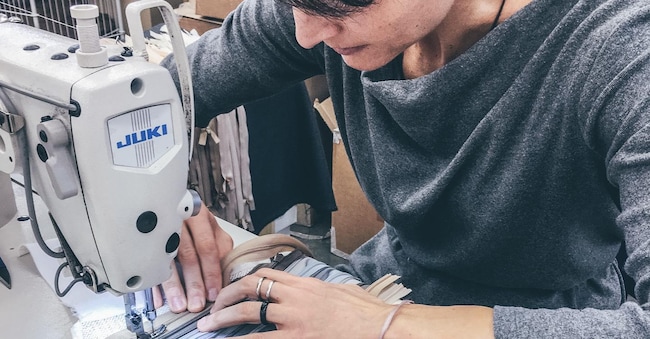
Quid, a company from Avesa, in the Veronese region of Italy, specialising in ethical and sustainable fashion, which works with recycled fabrics and employs fragile people, started collaborating with companies in 2016. It currently employs around 50 people, between already active agreements and those being finalised with a myriad of companies. The collaborations are for one year, but the businesses have the advantage of repeating them in order to fulfil their obligation and promote social sustainability actions. In this way, the disabled person continues to work in the context he is familiar with, performing tasks for which he has received specific training. "Article 14," explains the president and founder, Anna Fiscale, "is a valuable tool, with a view to a win-win collaboration between a for-profit company and a type B social cooperative (it promotes the social and labour inclusion of disadvantaged people, ndr). The tool allows us the employment of fragile resources in a more protected and appropriate context: in our case, the presence of pedagogical and welfare support activities is fundamental. Fragility often manifests itself invisibly: in Quid we guarantee a right to professional development for all'.

