
India-Pakistan escalation after Kashmir attack: mutual expulsions and closed border
Drastically reduced diplomatic representations. New Delhi suspends the Indus Water Treaty. Islamabad closes airspace to Indian companies
3' min read
3' min read
From our correspondent
NEW DELHI - Relations between India and Pakistan are rapidly plummeting to their lowest level in several years, following the attack in the portion of Kashmir administered by New Delhi in which 26 civilians, almost all Indian tourists, lost their lives on Tuesday. In the last 48 hours, the two nuclear powers have further downsized their diplomatic representations, started the process of expelling their respective citizens, closed the only still active border, blocked trade and questioned a number of bilateral agreements. But above all, they started exchanging accusations and threats in tones not unlike those that usually prelude military actions.
The attack in Pahalgam, a tourist resort in the Indian Territory of Jammu and Kashmir, was claimed by the Resistance Front, a group born in 2019 from a rib of Lashkar-e-Taiba (LeT), the formation behind the 2008 Mumbai attacks that New Delhi considers linked to the Pakistani security apparatus. According to the reconstruction of the Indian security forces, a commando allegedly opened fire with assault rifles at a group of tourists. The Indian police named three suspects, including two Pakistani citizens, describing them as LeT members.
New Delhi retaliation
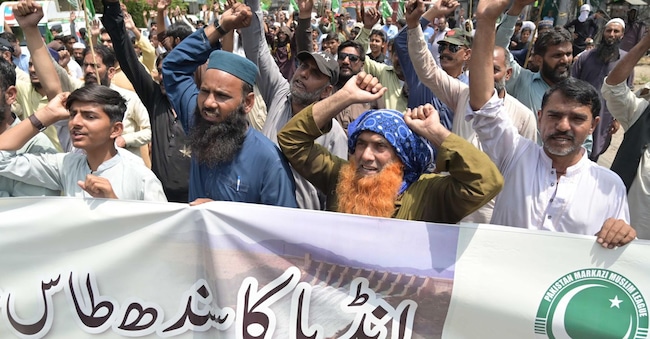
.In an unprecedented move, New Delhi responded to the attack by announcing the unilateral suspension of the Indus Water Treaty, the agreement that has regulated river water management between the two countries since 1960 and which had survived two wars. Any reduction in water flows from India to Pakistan would have serious, though not immediate, consequences for Islamabad's agricultural and energy system. Above all, says a Pakistani government statement, it would be regarded as 'an act of war to be responded to with the utmost force'. For the time being, Islamabad has responded to New Delhi's unilateral decision by closing its airspace to Indian airlines.
The Indian chargé d'affaires in Islamabad is expected to be summoned to the Pakistani Foreign Ministry in the coming hours. After a previous downgrade in diplomatic relations, the two countries are no longer represented by high commissioners - figures that are equivalent to ambassadors among Commonwealth countries - but by diplomats of lower rank and less room for manoeuvre.


