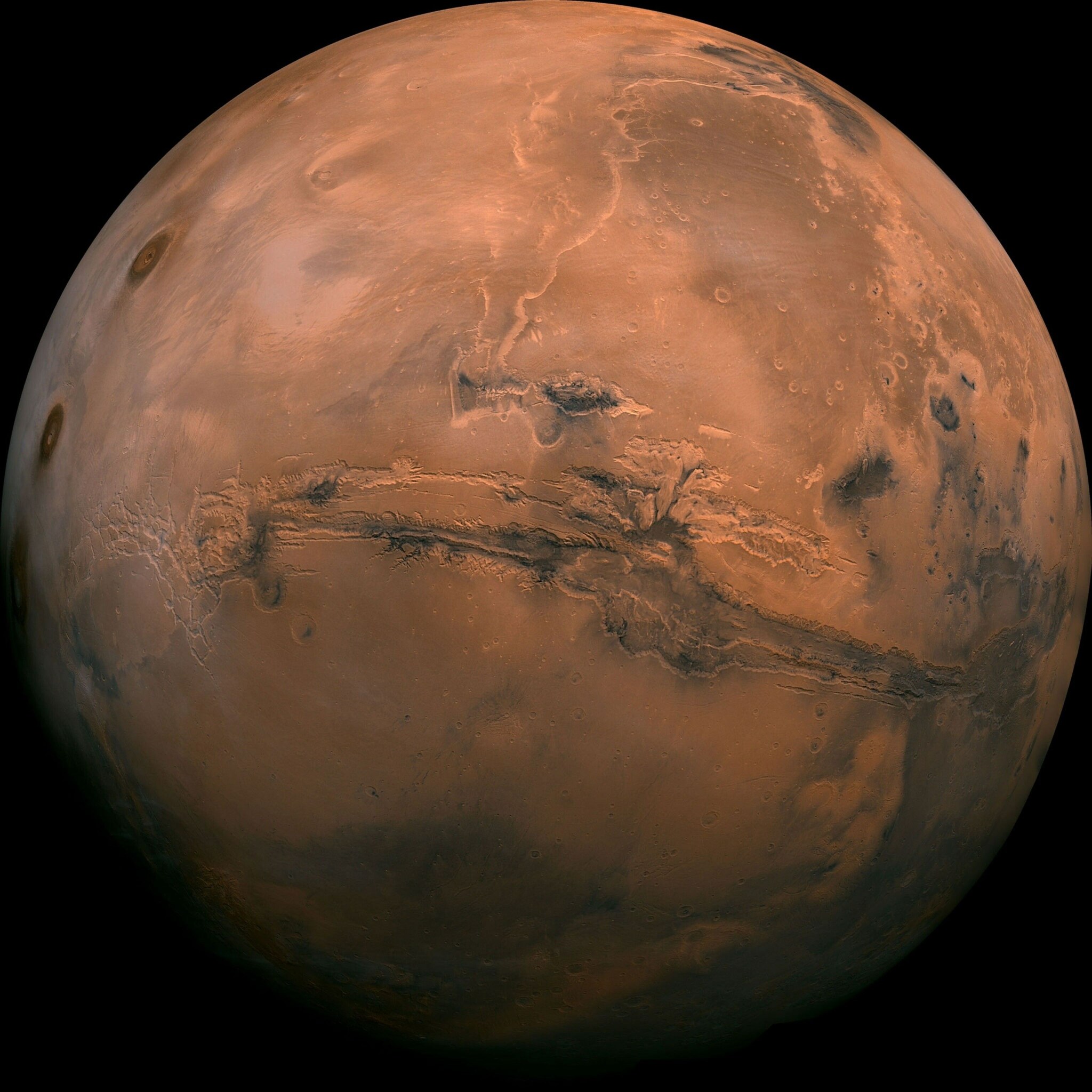
Mission Escapade, how two 'low cost' satellites will explore Mars
The two satellites, Gold and Blue their names, will arrive in orbit around the Red Planet in 2027


Nasa's Escapade mission left for Mars on 13 November. It is interesting for several reasons, obviously for scientific investigation first and foremost, and then because it was carried into orbit by a New Glenn launcher of Blue Origin, Jeff Bezos' space company, which is on its way to becoming a serious competitor to SpaceX, which is Elon Musk's.
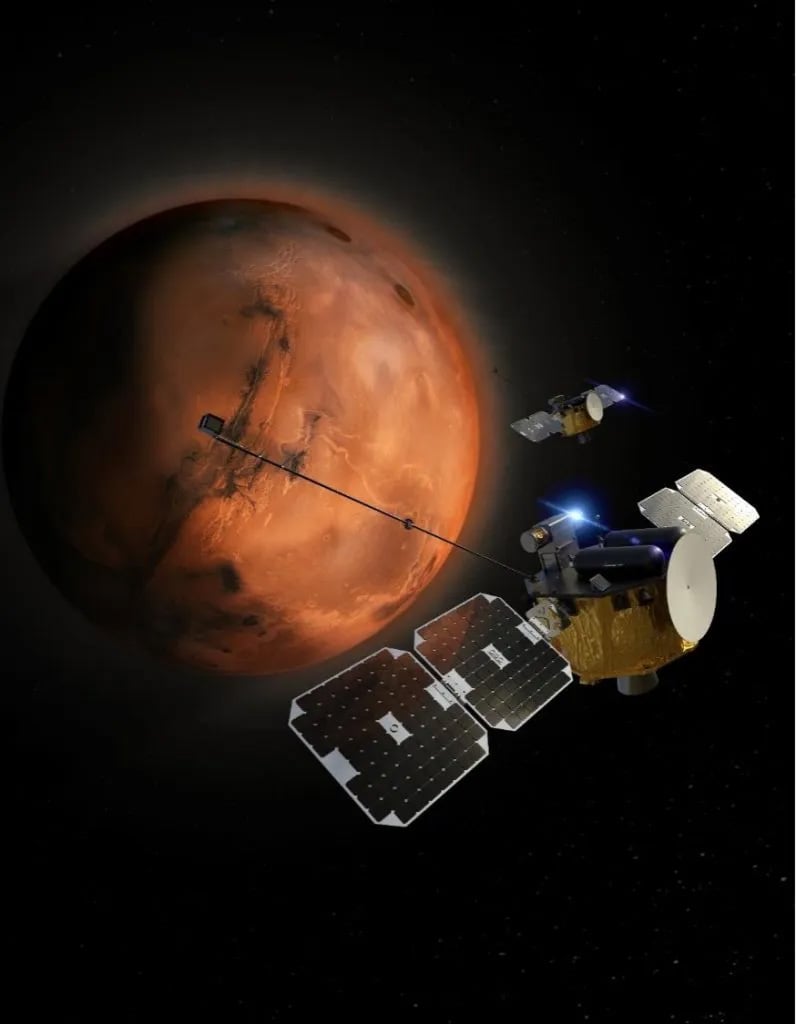
The two small satellites that will arrive in orbit around Mars in 2027, Gold and Blue their names, weigh just over 200 kilos each, without fuel, and will have to study the planet as a pair for the first year but then, for the remaining two planned years, each will go into a different Mars orbit from the other, to survey the entire planet. They cost very little: about 75 million dollars, and this too is an experiment for a new series of super-cheap missions. Let's hope so, because space forgives nothing. They will in any case study the weak Martian atmosphere, between 150 and 10,000 metres above the ground of the Red Planet, and its behaviour in interaction with the solar wind, which is composed of very energetic elementary particles.
This is crucial to understand whether Mars will ever be able to maintain its atmosphere, with the strange phenomena observed such as mini-tornadoes, a few tens of centimetres high, or discharges of electricity, similar to terrestrial lightning, but much less powerful. The question is whether it will be able to maintain it in the future or lose it, a not insignificant question if one thinks of inhabiting the planet, which today only has robots on the ground.
The solar wind blows away the Martian atmosphere
In fact, the Martian atmosphere is very tenuous and the planet does not have a strong magnetic field, as Earth's is, to shield the solar wind, which then works to evaporate and Martian gas molecules. We, on the contrary, are saved by our stronger magnetic field that deflects particles in various directions and what little it manages to penetrate is absorbed by our atmosphere. The solar wind is deadly for animals and plants, so Mars is also problematic for us as an environment. Indeed, it is also problematic because of the composition of the atmosphere, tenuous in agreement, but 95 per cent composed of carbon dioxide and with very little oxygen.
Even though Mars has taken a bit of a back seat to the Artemis project to return to the Moon in recent months, it remains, for people like Elon Musk, a very important, if not the ultimate goal. Musk in fact prophesies, we might say, that if the human species does not soon become a literally interplanetary species, it risks disappearing for various reasons. That is why he wants to bring at least one and a half million Earthlings to live on Mars as soon as possible.