Trade war

EU-US tariffs deal: details and implications of 15% also on cars, drugs and chips. Wine out of the pact

EU and US agree on a new tariff regime with a maximum tariff rate of 15 per cent for many exports. The EU has pledged to purchase 'a steady supply of artificial intelligence chips from the US, destined for European computer centres, worth at least USD 40 billion'. Commitment also to increase arms procurement

by Online Editors

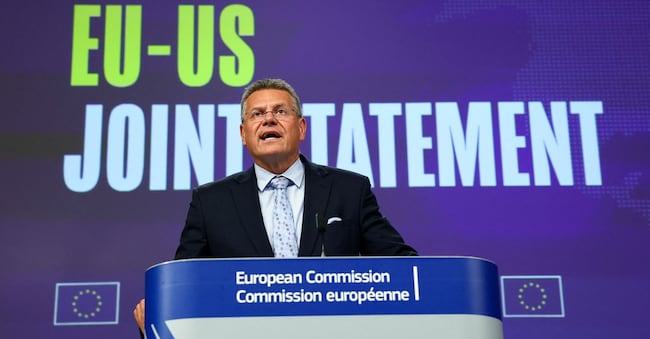
Il commissario europeo per il commercio Maros Sefcovic parla ai media dell'accordo commerciale UE-USA a Bruxelles, Belgio, 21 agosto 2025. REUTERS/Yves Herman

5' min read

5' min read

The EU and the United States agreed on the joint statement on tariffs after the political agreement reached by President Ursula von der Leyen and President Donald Trump on 27 July. This was announced by the Commission.

"The joint statement details the new US tariff regime vis-à-vis the EU, with a maximum and all-inclusive tariff rate of 15 per cent for the vast majority of EU exports, including strategic sectors such as automobiles, pharmaceuticals, semiconductors and timber.

Loading...

Von der Leyen: 'With tariffs stability and security agreement'

"Predictability for our companies and our consumers. Stability in the world's largest trading partnership. And security for jobs and economic growth in Europe in the long term. This EU-US trade agreement benefits our citizens and businesses and strengthens the transatlantic relationship". This was stated by EU Commission President Ursula von der Leyen.

EU, we will work with US to extend 15% tariffs to other goods

In announcing the agreement on the EU-US joint statement on tariffs, the European Commission underlines that 'both sides agree to continue to work ambitiously to extend this regime to other product categories, a key objective for the EU'. This was announced in a note from the EU executive.

EU pledges to increase arms procurement

"The European Union plans to significantly increase its procurement of military and defence equipment from the United States, with the support and facilitation of the US government". This is stated in the joint EU-US statement on tariffs, where it is emphasised that 'this commitment reflects a shared strategic priority: to deepen transatlantic defence industrial cooperation, to strengthen NATO interoperability and to ensure that European allies are equipped with the most advanced and reliable defence technologies available'.

An official of the European Commission, in a briefing with journalists, then points out that 'there are no numbers in the text, so we are not making a specific commitment. We are not committing ourselves to anything specific. We are basically saying that we are increasing our military and defence spending and, of course, the United States being a major supplier of equipment, we expect that, as part of our overall increase in military spending, we will also buy more US equipment, just as we expect to buy a lot more and build a lot more within the European Union'.

Sefcovic, EU digital rules left out of tariffs negotiations

On the Digital Market Act and the Digital Service Act "we kept these issues out of the trade negotiations, focusing on what was clearly the priority, and therefore you will not find any reference to them in the joint statement". "There will be many issues that will be discussed, but to be very clear: regulatory autonomy is absolutely important" and "this has been our position from the beginning to the end of this joint statement". This was said by EU Trade Commissioner Maros Sefcovic at a press conference.

Sefcovic, with US obtained important exemptions, working on others

The one signed with the US "is the most favourable trade agreement the US has ever extended to a partner," Sefcovic said. He emphasised that "where existing tariffs are already 15% or higher, no additional tariffs will be applied. This means that the EU will benefit from significantly lower effective tariffs than other countries".

In addition, 'we obtained important exemptions, zero or no tariffs in relevant sectors. This includes unavailable natural resources such as cork bark, aircraft and aircraft parts, generic drugs and their ingredients, and chemical precursors'. But 'this is only the first step', the EU and US will 'explore exemption of further sectors in the future'.

Finally, 'tariffs on cars and parts will drop to 15 per cent as of 1 August, helping our automotive industry to remain globally competitive'.

The EU and US then intend to 'work together to protect our economies from overcapacity in the steel and aluminium sectors. In practice, we will work together on tariff-rate quota solutions to ensure security of supply in these critical industries'.

Sefcovic: 'Unfortunately, no agreement yet on wine tariffs'

.

"Tariffs on wine, spirits and beer were one of the most important interests of the European Union. Unfortunately, we did not manage to get this sector and this category among the sectors that would continue to be at 'Npf' level" the 'most favoured nation' criterion. This was said by EU Trade Commissioner Maros Sefcovic at a press conference. "Both sides, the US and the EU, are ready to consider other areas": "the doors are not closed forever". As the European Commission 'we will work as hard as we can to spread the sectors' also to wine and spirits, as well as steel and aluminium.

Al via i nuovi dazi ma sui chip Trump minaccia il 100%

EU: 'We will buy at least 40 billion in US chips for Ia'

.

The EU has pledged to purchase 'a steady supply of artificial intelligence chips from the US, destined for European computer centres, worth at least $40 billion'. This was confirmed by EU Trade Commissioner Maros Sefcovic, explaining the details of the joint statement formalising the framework agreement on tariffs reached at the end of July between the EU and the US. "On our side, the Commission will take concrete steps to eliminate tariffs on all US industrial goods, expand market access to the US for fish and agricultural products, and strengthen European energy security through purchases of US liquefied natural gas, oil and nuclear products worth $750 billion by 2028," Sefcovic confirmed.

Confirmed EU investments in the US

The joint EU-US statement on tariffs confirms the EU's commitment to purchase $750 billion (almost 690 billion euros) in US 'LNG, oil and nuclear products' by 2028. It had already been announced at the end of the summit in Scotland between President Ursula von der Leyen and US President Donald Trump. And in addition to the EU's commitment to purchase at least $40 billion (almost €37 billion) worth of US AI chips for its data centres, the document stipulates that European companies will invest $600 billion (€552 billion) in strategic sectors in the US by 2028.

Tariffs: Costa, EU-US declaration ensures predictability and stability for businesses

"The EU-US Joint Declaration on Trade provides predictability and stability for transatlantic economic ties and European businesses. The EU must continue to deepen and expand its global trade partnerships'. This was written by the President of the European Council, Antonio Costa, on X, echoing a post by the President of the European Commission, Ursula von der Leyen, in which she spoke about the concrete results of the declaration. "Predictability for our businesses and consumers. Stability in the world's largest trade partnership. And security for European jobs and long-term economic growth. This EU-US trade agreement delivers concrete results for our citizens and businesses and strengthens the transatlantic relationship," the president wrote.

Palazzo Chigi, on tariffs finally a clear picture for companies

"The EU-US joint statement that formalised today the political understanding reached on 27 July in Scotland between President Von der Leyen and President Trump finally provides the business world with a clear picture of the new framework for transatlantic trade relations." This was stated in a note from Palazzo Chigi.

'This is not yet,' it is emphasised, 'an ideal or final point of arrival, but some important milestones have already been achieved, starting with avoiding a trade war and laying the foundations for mutually beneficial trade relations'.

Trump adviser: EU deal is most important

The tariffs agreement with the European Union 'is the most important of all not only economically, but strategically'. This was said by Donald Trump's god economic adviser, Peter Navarro, speaking to reporters at the White House. "We have a huge trade deficit with the EU, a big threat to our national and economic security. It was a really important mountain to climb and we did it," he added.

"No exemptions on steel and aluminium"

.

Navarro clarified that 'there will be no exemptions or exclusions for tariffs on steel and aluminium'. "During the first term every time we granted an exemption to one of our allies, they completely abused it, that is why we will not do it again," he added.

Copyright reserved ©
Loading...

Brand connect

Loading...

Newsletter

Notizie e approfondimenti sugli avvenimenti politici, economici e finanziari.

Iscriviti