Defence

From the EU to the US to China, here are all the agreements on sixth-generation fighter aircraft

The new aircraft are intended, as reiterated by the government also in parliament, to replace the Eurofighter fleet as of 2035

by Andrea Carli

Difesa, Italia verso il caccia di sesta generazione

5' min read

5' min read

A new, important operational piece in the jigsaw puzzle will lead to the take-off of the sixth-generation fighter in a few years' time. A strategic project for Italian and European defence. After the formal constitution of the government agency Gigo between Italy, the United Kingdom and Japan for the Global Combat Air Programme, the programme for the new fighter aircraft that will replace the Eurofighters from 2035, the agreement has now arrived for the joint venture that for Italy sees Leonardo in the field.

In the background is a project that is as complex (and expensive) as it is strategic: the sixth-generation fighter, a true 'system of systems', an aircraft designed from scratch where the elements are connected by an 'intelligent' network, based on a dedicated cloud architecture, involving artificial intelligence and next-generation datalinks. If, on the one hand, there is no alternative to joining forces in the face of particularly high costs for its realisation, on the other hand, Europe is once again struggling to find a synthesis in this story, so much so that it is moving in groups: one led by the UK, with Italy and Japan (Saudi Arabia could join). The other led by Germany, France and Spain (in which case Belgium could join).

Loading...

'On 13 December,' Leonardo CEO Roberto Cingolani had announced in recent days, 'we will sign the agreement on the Gcap', the Global Combat Air Global with Japan and Great Britain. And so it was. For Italy, which in this way has a good chance of arriving on this market first, the new aircraft are destined, as reiterated by the government also in Parliament, to replace the Eurofighter fleet starting from 2035, with an operational life extended into the last decades of the century. The lead companies for the respective countries are - in addition to Leonardo - Bae Systems (UK) and Mitsubishi (Japan). For Italy, the companies MBDA Italia, Elettronica and Avio GE are also expected to participate, as well as SMEs.
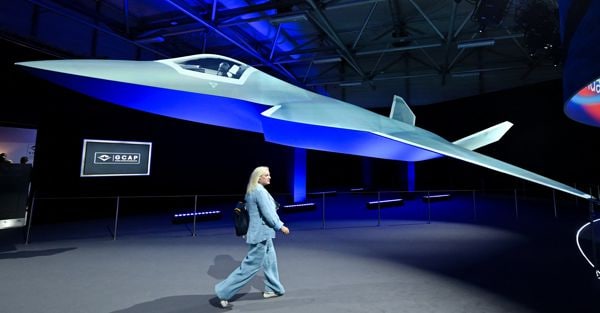
Una persona cammina davanti al progetto concettuale del jet da combattimento di sesta generazione del Global Combat Air Programme (GCAP) il giorno dell’inaugurazione del Farnborough International Airshow 2024, a sud-ovest di Londra, il 22 luglio 2024. (Photo by JUSTIN TALLIS / AFP)

In Europe, two teams in the sixth-generation fighter game

.

The sixth-generation Tempest fighter jet programme was launched by the UK in July 2018. The following year it was joined by Sweden, then Italy. On 8 December this year, after several months of negotiations, Japan also came on board. Then Sweden pulled out, and the programme took on a new name, Global Combat Air Programme (Gcap). On 9 December 2022, following a joint declaration by the Heads of Government of Italy, Japan and the United Kingdom, the Gcap was officially launched. On 14 December 2023, the Minister of Defence Guido Crosetto, the Minister of Defence of Japan Minoru Kihara and the Secretary of State for Defence of the United Kingdom Grant Shapps signed the Treaty for the Establishment of the GIGO (acronym for 'GCAP International Government Organisation') in Tokyo. The agreement provides for the establishment of a new international organisation, with legal personality, to manage the design and development of a sixth-generation aerial platform. The organisation is made up of Italy, the United Kingdom and Japan (but could include other countries in the future; there is a possibility of Saudi Arabia joining the group). The headquarters of the organisation is in the UK (in the city of Reading).

The project promoted by Germany, France and Spain

.

Then there is the Future Combat Air System (Fcas): it is a project, which is a competitor to the Gcap, of the air combat system of the future by Germany (Airbus), France (Dassault Aviation) and Spain (Indra Sistemas). The Fcas combat aircraft are expected to take off in 2040 to replace the French Rafale and the German and Spanish Eurofighter Typhoon. Germany and France signed a framework agreement in 2017, while Spain joined in 2020. In November 2023, Belgium's defence minister revealed that by June 2025 the country will become the fourth partner nation along with Germany, France and Spain to join the sixth-generation Future Combat Air System (Fcas) fighter programme.

The Three Souls of the Gcap

.

The programme developed by Italy, the United Kingdom and Japan has certain characteristics that set it apart. 'The Gcap,' explains Alessandro Marrone, Head of the Defence Programme at the Istituto Affari Internazionali (Iai), 'is a long-term partnership and a key investment for Italian defence. Italy and the United Kingdom have a strong tradition of cooperation in the aeronautical field for more than fifty years (Tornado, Eurofighter) but this is the first time that Rome and London are cooperating with an Asian partner on such an important project. Japan has a defence budget roughly double that of Italy, $56 billion in 2024. With these three legs, the project has solid prospects for financial sustainability'.

US moves

.

But the sixth-generation fighter game does not only see Europe moving. The USA has been looking at the Next Generation Air Dominance (Ngad) since 2014, with Boeing and Lockheed Martin in the field. The modern sixth-generation fighter is expected to replace the F-22 Raptor, which entered service in 2005, starting in 2030, but the project is being reviewed by the United States Air Force as the US Air Force's goal is to ensure greater sustainability between performance and cost (a single Ngad aircraft would cost around USD 247.5 million). Much will depend on the choices (and priorities) of the new Trump administration.

... and China

.

China, for its part, 'is overtaking Russia and catching up with the West in terms of technology', recalls Marrone. "They are interested in subverting US naval supremacy in the Pacific. The Chinese, whose system is very opaque, want to position themselves well in the fifth generation of fighters, and then prepare for the leap and aim for the next one'. Meanwhile, Beijing is banking on invisible aircraft. In November, at the China International Aviation & Aerospace Exhibition in Zhuhai, the Chinese giant presented its latest fighter stealth J-35. The Chinese explained that it is designed 'mainly for air combat operations' and is capable of launching 'also air-to-surface attacks'. It is not clear when it might be deployed, nor where it will be deployed. But the race has already begun. In September, Secretary of the Air Force Frank Kendall said he no longer refers to Beijing as a 'future' threat. 'China,' he stressed, 'is a threat today'.

And Russia? 'Because of the war in Ukraine,' Marrone continues, 'Moscow is turning more towards low-cost solutions, such as Iranian drones. It is not aiming at sixth-generation fighters, but at hypersonic missiles. It continues to produce Sukhoi, which continues to lose in Ukraine'.

The five generations of fighters

.

The classification of fighters by reference to a particular 'generation' makes it possible to identify the different types of aircraft that have developed from the end of the Second World War to the present day. Belonging to the first generation (1945 - 1955) are the straight-wing subsonic fighters with fixed-geometry air intakes (e.g. the American Lockheed P-80 ShootingStar and the British Gloster Meteor). The second generation (1955-1960) is characterised by the placement of the aircraft's engines in the fuselage (instead of in the semi-wings) and the arrow-shaped wing (e.g. North American F-100). The third generation (1960¬1970), comprises fighters with strong arrow or delta wings, capable of reaching transonic or slightly supersonic speeds. To the fourth generation (1970-1995) belong fighters capable of reaching Mach 2 speed. To this category belongs the Eurofighter aircraft, which - as mentioned - is destined to be replaced by the new Gcap aircraft (which will constitute the sixth generation). Finally, the fifth generation corresponds to aircraft from 1995 onwards and equipped with highly advanced stealth technology, such as the F35.

NATO evaluates new arms and equipment targets for member countries

Meanwhile, NATO, reports Bloomberg news agency based on indications from officials close to the dossier, intends to set new concrete targets for the number of tanks, aircraft, and other weapons systems to be produced by member states, which may require an increase in the alliance's defence spending target to 3 per cent of gross domestic product.


Copyright reserved ©
Loading...

Brand connect

Loading...

Newsletter

Notizie e approfondimenti sugli avvenimenti politici, economici e finanziari.

Iscriviti