
Eur spa, renovation of the Palazzo dei Congressi in Rome begins
The first since its opening in 1953. Work to be completed in two years without closure to the public
4' min read
Key points
4' min read
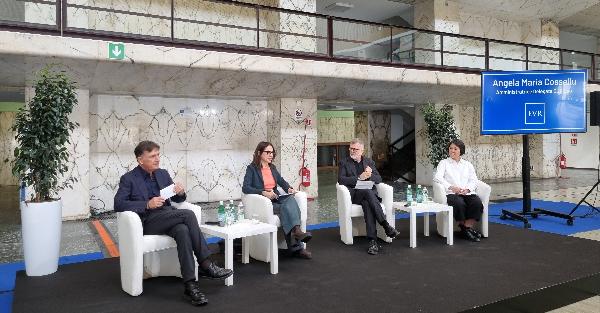
The Palazzo dei Congressi in Rome is changing its skin. With an investment of EUR 8 million, Eur spa (90% owned by the Ministry of the Economy and 10% by the Municipality of Rome) presented on 22 April the project to renovate and re-functionalize the building designed by architect Adalberto Libera at the end of the 1930s for the Universal Exhibition in Rome in '42 (which never took place, due to the war), which today, together with La Nuvola (also owned by Eur spa), constitutes Rome's most important conference centre. The work should be completed in two years, without closing the Palazzo dei Congressi to the public. The presentation was attended by Eur spa president Enrico Gasbarra and Eur spa CEO Angela Maria Cossellu, together with architects Junko Kirimoto and Massimo Alvisi, founders of Studio Alvisi Kirimoto.
The Alvisi Kirimoto Studio
.The project, signed by the Alvisi Kirimoto Architectural Studio and now being examined by the Special Superintendency of Rome for Archaeology, Fine Arts and Landscape, is the first renovation and re-functionalisation project that has involved the entire complex since its opening in 1953, and aims not only to restructure the building in its entirety to ensure its preservation, but also to increase its functionality by allowing it to host several events at the same time (in theory even four at the same time, while now only one event is possible)
Restoration and Adaptation
.The architectural intervention is divided into two macro actions: recovery and restoration of the existing architectural elements and functional adaptation through the insertion of new elements capable of modifying the flows and expansion of the technical equipment. Among the interventions related to the management of visitor flows on the ground floor, the central atrium will be transformed into a dynamic vestibule capable of dividing the Palazzo in half and guaranteeing a vertical distribution adaptable to the different space configuration needs.
Sound insulation
.To support the management of the routes, devices such as opaque movable walls and glazed partitions will ensure the correct orientation of visitors towards the different events and will also provide excellent acoustic insulation. For both types of partitions, their positioning will follow the compositional logic of the building, and for the most part, the new elements will stick to the original positions of the glass doors designed by architect Libera.

Loading and unloading routes
.In addition to the management of visitor flows, integrations have also been devised with regard to the flexibility of the loading and unloading routes, making it possible to manage loading and unloading in a totally autonomous and independent manner during separate events. The existing staircases within the cloisters, on the other hand, will fulfil the role of connectors capable of managing vertical flows, distributing users between the basement and first floor, and guaranteeing access to the terrace and the roof theatre in an autonomous manner.


