
Europe ready to respond to SpaceX with the launch of the Vega rocket, Italy in the front row
On 3 December, European industry will launch a Copernicus satellite into space for the European Commission

2' min read
Key points
2' min read
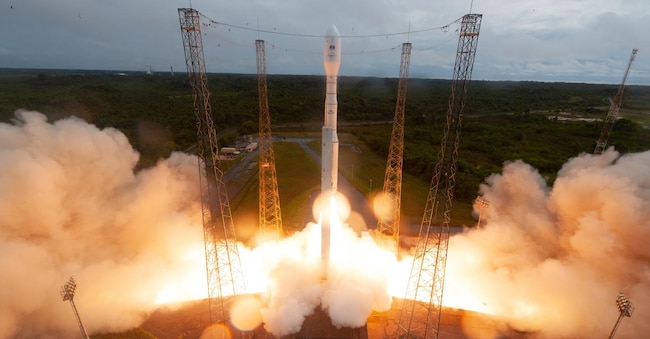
On 3 December, European industry will launch a Copernicus satellite into space for the European Commission. The satellite is called Sentinel-1C, and will be launched by the Vega C rocket, the most advanced version of the Italian launchers produced by Avio Spa. This is an important sign of the awakening of European industry, which is subject to the hammer blows of SpaceX, the American company of Elon Musk, which is facilitated in the commercial market by the rich contracts obtained from the Pentagon and Nasa.
Departure from Kourou and Copernicus services
The flight of Vega C will depart from the Kourou base in French Guiana and will be organised by Arianespace, the French agency that has hitherto had a monopoly in the sale of launches made with Avio's launchers, as well as those produced in France by ArianeGroup, an equal joint venture between Airbus and Safran. Sentinel-1C ago was built by Thales Alenia Space as prime contractor and is part of Copernicus, the earth observation component of the EU space programme. "The world's most advanced earth observation system, Copernicus," reports a note from Arianespace, "provides continuous, free and reliable earth observation data and services to public authorities, companies and citizens worldwide.
IAC conference in Milan and the revival of funding
The new milestone for Italian industry is part of a revival of investment in space. The theme will be the focus of the Iac, the International Astronautics Congress taking place in Milan from 14 to 18 October. It will be attended by numerous companies, bodies, and space realities, including the Italian Space Agency (Asi), industries with the Leonardo group, Avio, Sitael, and others, and foreign industries including the American Vast, founded and financed by Jed McCaleb. In the period 2023-2027, public funding for the national space ecosystem will amount to over 7 billion: this was highlighted in the report Space Economy, Space Industry, Space Law by the See Lab - Space Economy Evolution of Sda Bocconi - School of management. Of these investments, about 4.4 billion are public funding (including 1.5 billion from the NRP) and 3.1 billion are funds allocated to European Space Agency (ESA) programmes.
The Italian space economy: figures and role in Esa
With public funding of this magnitude, the goal for Italy is to grow further in the space economy sector, on which the country has always relied heavily. Italy is now the third largest funder of Esa, with 3.1 billion a year, after Germany and France. According to See LAb data, there are 415 companies active in the space economy sector in Italy. In economic terms, taking into account public funding and the turnover generated by companies focused on the production of goods and services based on space technologies, the sector reached a total value of EUR 2.9 billion in 2021.


