
Cars, registrations in Europe down 3.5% in January. For Stellantis +6.7% on the market
Automotive starts the year on an upward trend, with sales in Germany and France declining while Italia and the UK hold up

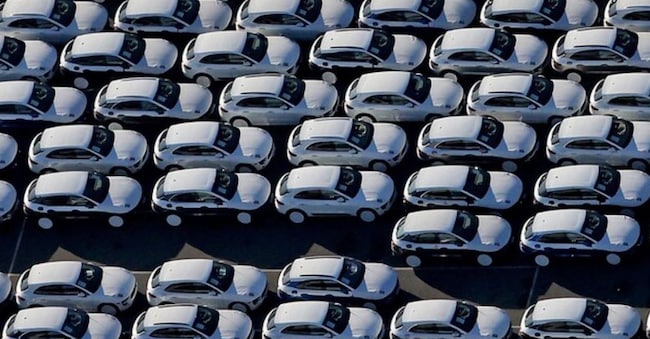
The year 2026 starts on an upward slope for the European car market, after ending 2025 with a 2.4 per cent growth in registrations over the previous year. In the area (EU+Efta+UK), registrations in January were 961,382, down 3.5% compared to January 2025 and 21.6% compared to January 2019, the year before the pandemic.
Among the area's five largest markets, Germany and France recorded a drop on January 2025, while Italia, Spain and the United Kingdom posted modest growth, as highlighted by Centro Studi Promotor. In particular, Germany is down 6.6% on January 2025 and a whopping 27% on January 2019. France is also down 6.6% on 2025, but the comparison with January 2019 is even worse than in Germany (-30.9%). Slightly better results, on the other hand, for Italia (+6.2% on January 2025 and -14.1% on January 2019), the United Kingdom (+3.4% on January 2025 and -10.5% on January 2019) and Spain (+1.1% on January 2025 and -21.8% on January 2019).
Against this backdrop, Volkswagen suffered a setback in the month with 3.8% fewer sales than last year, while Stellantis recorded a volume recovery of 6.7% thanks to the performance of Fiat (+24.6%), Opel, Citroen and Lancia. The Renault, Hyundai and Toyota groups set the pace, with contractions in the month of more than 10%, and BMW sales were also down. Among the emerging Asian companies, MG, which delivered its one millionth car in Europe, lost 1.8% in volume and stopped at a market share of 2%, just a whisker away from Byd, which continued its run in the European market. Finally Tesla, which lost 17% of registrations in the month and dropped below 1% market share.
'The most serious aspect of this situation,' explains the chairman of Centro Studi Promotor, Gian Primo Quagliano, 'is of course the fact that for Western European markets a return to pre-pandemic levels is a goal that is certainly not within reach. To pursue it would require a decisive change of course in the European Union's policy for the energy transition in the automotive sector'.


