
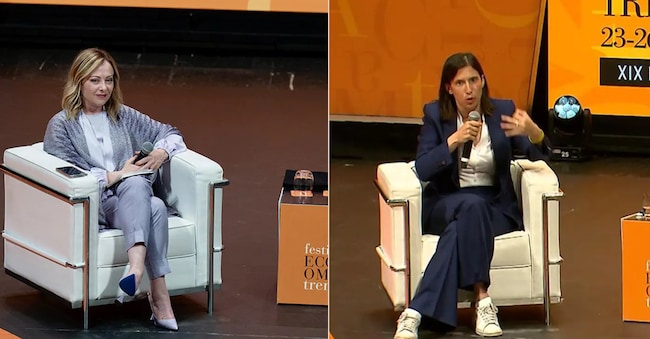
European elections, from the Meloni-Schlein preference contest to party percentages: who can say they won?
The leader of Fdi is standing as a chief candidate in all constituencies. Unlike the Pd secretary, who is only a candidate (leader) in the Centre and Islands constituencies

4' min read
Key points
4' min read
The exploit of Giorgia Meloni as the most voted in the European elections is taken for granted by everyone. Not only because of the premier's popularity, but also because of an arithmetical factor, since the Fdi leader is standing as the leading candidate in all constituencies. Unlike the Pd secretary Elly Schlein who is only a candidate (leader) in the Centre and Islands constituencies. The bar set by Meloni on a cautious 26% (the same percentage as in the general election) appears, however, with the passage of time quite realistic. Although the most optimistic are convinced that the party will manage to score a few more points.
Meloni the only really prominent name on the Fdi list
The point is that with her 'vote Giorgia' the premier has catalysed the vote onto herself, turning it into a sort of plebiscite on the government. And hers is the only truly prominent name on the Fdi lists. Among the outgoing MEPs, the only familiar faces are Carlo Fidanza and Nicola Procaccini. And then there is the joker Vittorio Sgarbi. Not much else.
For the PD the bar is set at 20%
.For the PD, the 20% threshold is the minimum required of the new secretary Elly Schlein to avoid psychodrama in the party. It is a sort of survival bar: overcoming it would at least mean improving on the 19% of the political elections (even if at the last European elections the party reached 22.7%). The gap with the M5s will then be crucial. A narrow gap for a secretary elected to move further to the left and contend with the 5-Star 'outgoing' votes would be considered a failure. And it would give more breathing space to Giuseppe Conte to contest Schlein for the premiership in the progressive camp. Conte, who, in the absence of any known faces among the M5s candidates in the European elections, has personally campaigned, even though he is not running for a seat in Brussels. Minimum threshold: 15% in 2022.
The many bigwigs on the PD lists
.But Schlein's campaign, which began quietly, is ending better than expected. And after all, the composition of the lists was made to give voice to the various souls of the party, lining up heavyweights capable of bringing in thousands of votes. From the former governor of Lazio Nicola Zingaretti, to the outgoing mayors of Bergamo, Florence and Bari (Giorgio Gori, Dario Nardella and Antonio Decaro) to the governor of Emilia Romagna and president of the PD, Stefano Bonaccini (leader of the reformist area and main candidate in the North East); up to the autonomous candidates put forward in the field to widen the consensus perimeter: well-known faces such as Cecilia Strada (leader in the North West), Marco Tarquinio and Lucia Annunziata (leader in the South).
The League lined up on the right
.The League led by Matteo Salvini, which has set the minimum bar at 10% (in any case a step forward compared to the 8.8% of the 2022 policies (given that the exploit of 34.3% at the 2019 European elections now belongs to prehistory) has set its entire electoral campaign looking to the right, with the intention of eroding votes to Fdi in its historical galaxy. There is not only Senator Claudio Borghi's recent attack on the head of state, with an attached request for his resignation for talking about European sovereignty. Above all, there is the candidature of the general-writer Roberto Vannacci, who has led the entire electoral campaign by winking at the post-fascist area. Not forgetting Salvini's skilful electoral move of bringing to the Cdm on the eve of the vote the home-saving plan to bring windows, balconies, verandas, lofts, walls or entire rooms into line.


