
Former Ilva: final hearing today at the Court of Cassation, with a decision to be made on the hot area
The Joint Civil Chambers are due to rule on the decree of the Milan Court of Appeal ordering the detention to end by 25 October. A long legal battle

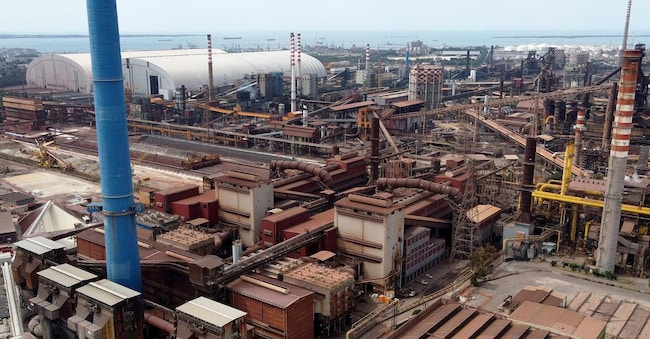
Today marks the final chapter for the hot area of the former Ilva site in Taranto, the central part of the steelworks. Whether it will have to shut down permanently, as ordered by the decree of the Milan Court of Appeal or not, the decision will be made by the Joint Civil Chambers of the Court of Cassation, which will hold the hearing from 10.00. However, the Supreme Court’s ruling is not expected today. It is, however, expected shortly, given the significance of the case and considering that the Court of Cassation itself scheduled the hearing within a month of the companies under special administration, Ilva and Acciaierie d’Italia, challenging the Milan judges’ decree with extraordinary appeals. The two companies also sought to have the decree suspended, but were unsuccessful. The Milan Court consistently upheld the decree following the hearings on 9 and 30 September, even – as in the latter case – in the face of the imminent ruling by the Court of Cassation.
The Milan judges: asbestos and fine particulate matter
The decree ordering the shutdown of the hot end was issued on 27 July; it is enforceable, and the 90-day period granted to the company to shut down the blast furnaces and steelworks ends on 25 October. A halt due to health risks: this was the reasoning given by the Milan judges, who highlighted two factors in particular. Namely, the emission of fine particulate matter, PM 2.5 and PM 10, and the presence of asbestos inside the blast furnaces, ordering that the former be reduced and the latter removed from the plants.
Plants on standby until 15 December
Pending the Supreme Court’s ruling, and to prevent any judgement in favour of the company from being handed down after 25 October, the Government, in the latest decree-law approved in recent days, has stipulated that the commissioners of Ilva and AdI are authorised to keep the plants in pre-heating mode – this is a technical minimum without production – until 15 December. In view of the 25 October deadline, Acciaierie, the plant operator, had in fact prepared well in advance: since the summer, it had halted the purchase of raw materials, then halted production – which was already significantly reduced – and placed the plants in pre-heating mode; finally, it arranged for a massive extraordinary redundancy scheme covering 8,622 employees out of a workforce of 9,626, of whom 6,964 out of 7,875 are based in Taranto. However, as the Ministry of Labour and the company have clarified, this scheme has not yet come into effect, and this has also brought an end to the protest that broke out yesterday in Genoa, which saw the airport blocked for several hours. The new scheme will only be discussed after the summit at Palazzo Chigi on 27 October. For the time being, therefore, the current redundancy scheme remains in place with the figures already authorised: a maximum of 4,450 employees, of whom 3,800 are in Taranto.
A possible restart, though not in the near future
The Court of Cassation, with regard to the Court of Appeal’s ruling, may uphold it, set it aside, or set it aside and refer the case back to the Court of Appeal itself. In any case, even if the Supreme Court were to overturn the Milan ruling, the hot section cannot restart immediately, as there are no longer any raw materials in Taranto, nor is there the money to order them. It may be necessary to set the whole process in motion again: placing purchase orders, securing resources – even though, in the latest decree-law, the Government has allocated to AdI the remaining 40 million from the 390 ceiling authorised by the EU Commission – the arrival in Taranto of ships from abroad carrying the raw materials, and the reactivation of the plants. These steps will take around three months. However, even if the Court of Cassation were to deliver a favourable ruling, it is by no means certain that a decision would be taken to restart the hot area. It will depend on a series of assessments.
The legal proceedings: Milan, Luxembourg and Rome
The hearing before the Court of Cassation in Rome marks the culmination of a legal battle that a group of citizens from Taranto embarked upon several years ago. The first step was an injunction against the company filed at the Court of Milan, where the company has its registered office. The Court then referred the case to the European Court of Justice, based in Luxembourg. The latter handed down its ruling in June 2024, stipulating that if an industrial installation is harmful to health and the environment, it must be shut down. The Court of Milan therefore took up the matter again and, last February, issued an order partially suspending the Integrated Environmental Authorisation granted to Acciaierie in the summer of 2025, on the grounds that it lacked certain requirements, and gave the company until 24 August 2026 to bring the permit into line; otherwise, operations would have been halted. However, the Court’s order was challenged in the Court of Appeal by the companies Ilva and AdI, as well as by the citizens of Taranto themselves, and on 27 July the Court of Appeal partially overturned the Court’s order; recognising the dangers posed by asbestos and fine particulate matter, it ordered the plant to be shut down within 90 days. The suspension, as stated in the decree, is to remain in force until ‘all asbestos still present in the plant has been completely removed’ and ‘the necessary measures have been adopted to bring particulate matter emissions back within safety limits, with reference to the authorised production scenario of 6 million tonnes per year’.

