
Former Ilva site: temporary shutdown of the hot zone. A 125 million decree on temporary lay-offs is ready
Measures ahead of the Council of Ministers meeting. Extraordinary redundancy fund in the pipeline for a further 4,200 AdI staff

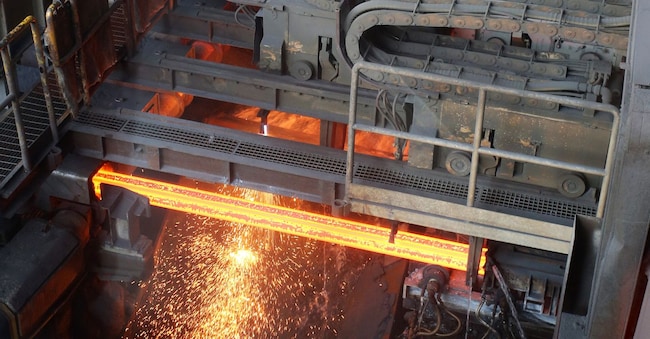
Acciaierie d’Italia has carried out the final cast of pig iron from Blast Furnace 2 in Taranto; the furnace has subsequently been placed in pre-heating mode, that is, operating at the technical minimum without production. Furthermore, the company has written to the authorities in Taranto, informing them that, as of today, all production activities at the hot-end facilities are suspended; and to those in Liguria (Genoa and Novi), it has stated that a general temporary shutdown of the plants will take place by 15 November. These are the concrete repercussions of a two-fold situation: the approaching expiry (90 days from 27 July) of the decree issued by the Milan Court of Appeal, which obliges the company to shut down the hot-rolling mill in Taranto, and the depletion of raw materials at the Apulian steelworks, which have not been purchased since the court order was issued. The decree issued by the Milan judges is enforceable. It can only be halted by the Court of Cassation – which is due to rule on the appeals lodged by Ilva and AdI at the hearing on 20 October – should it overturn entirely, or overturn and refer the case back, the decision made by the Milan judges, which they did not see fit to suspend during the hearings on 9 and 30 September.
As emerged from last night’s summit at Palazzo Chigi between the Government and the trade unions, chaired by the Under-Secretary to the Prime Minister, Alfredo Mantovano – attended by Ministers Marina Calderone (Labour), Adolfo Urso (Business), Giancarlo Giorgetti (Economy, via video link) and the Under-Secretary with responsibility for the South, Luigi Sbarra – for the time being, the situation will be addressed through the wage supplementation scheme for both direct employees and subcontractors. There will be exceptional redundancy benefits for staff in the supply chain and subcontracting sector (80 million) and supplementary payments from the extraordinary redundancy fund (approximately 45 million) for employees of Acciaierie d’Italia and Ilva. Coverage will last until June. The measure will be included in a new decree-law to be issued shortly. Further measures – both extending the CIGS to other workers (an estimated 4,200 more) and offering voluntary redundancy schemes – are under consideration, but there is currently a funding shortfall.
Mantovano, reviewing the latest legal developments, points out that the opinions of the Attorney General of the Court of Cassation – although not binding on the Joint Divisions – criticise the Milan Court of Appeal’s ruling both on the risks posed by asbestos and on fine particulate matter. However – Mantovano emphasises – the Attorney General’s opinion does not invalidate the Court of Appeal’s decree. And so one of the points ‘we are looking into in greater depth’ – explains Mantovano – is not so much to completely nullify the Court of Appeal’s decree with a new regulation – which would be legally impossible – but rather to avoid the risk that the full and complete enforcement of the order to shut down the blast furnaces might render futile any future decision by the Court of Cassation that might allow the furnaces to remain in operation. We are therefore assessing whether there is scope to avoid a complete shutdown so as not to cause irreparable damage to the plants. ‘This is not a provision to set aside the Court of Appeal’s decree,’ Mantovano explains, ‘but a provision which, should there be scope from a legal and economic perspective, would allow the plants to remain on standby until there is clarity regarding the Court of Cassation’s decision.’
Finally, according to Mantovano, ‘the Government’s intention to focus on the production of green steel using the DRI plant and electric furnaces remains unchanged, provided this is part of a credible industrial plan. The funds for the DRI are in place. Even those that might appear to have been partially diverted (around 800 million, ed.) can in fact be included, as they are earmarked for decarbonisation – and therefore essentially for the Taranto area, which is the only one involved in this process’.
Everything will depend on the outcome of the tender to acquire the assets. The deadline for final bids has been extended from 15 October to 8 November. And, depending on the business plan to be presented by the winning consortium, the government could put a further 400 million on the table for the Dri plant, bringing the total to 1.2 billion.


