
Expo Osaka, Italy Pavilion leads culture according to Esquire Japan
Commissioner Vattani: 'Our mission here is to update the country's image, linking past, present and future'

2' min read
2' min read
The ideal city of the Renaissance, with masterpieces by Caravaggio and Michelangelo, Leonardo da Vinci's manuscripts or the Farnese Atlas, flanked by contemporary works and pieces of technological history, from the structure of Arturo Ferrarin's biplane, which in 1920 was the protagonist of the Rome-Tokyo flight, to the most advanced systems of aerospace, infrastructure and the underwater industry.
The layout of the Italian Pavilion at the Osaka Expo - which encompasses the history, current affairs and future of our country - is enjoying great success, not only with the public but also with critics. The Japanese edition of the fashion magazine 'Esquire' has in fact included, in an article published on its website, the Pavilion of our country among the five most interesting of the Universal Exposition for its cultural content, capable of 'stimulating the intellect', awarding it first place.
A 360-degree experience
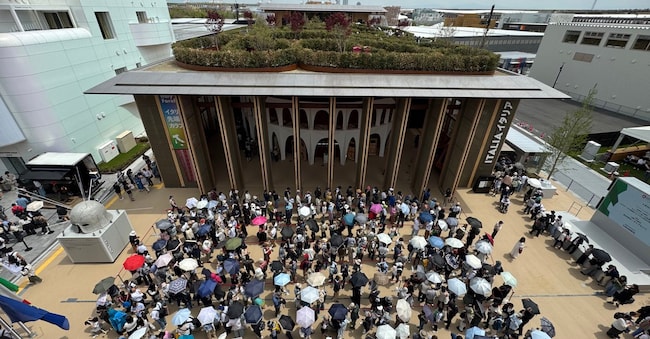
.According to Esquire Japan, the Italian Pavilion 'offers an all-round sensory and artistic experience' in which architecture, art, gastronomy and music come together so harmoniously that 'even the queue almost becomes part of the experience'. And the route is described as 'a true spectacle of the legends of art and science that Italy boasts'.
"We are very pleased with this further recognition, this time from 'Esquire', a magazine known throughout the world and which has always been attentive to the evolution of fashion, costume and society," said Mario Vattani, Commissioner General for Italy at Expo 2025 Osaka. "We are here with a precise mission: to update the image of Italy in Japan and Asia, linking, as the magazine pointed out, the art of the past to the technological innovations that allow us to propose our vision of a society of the future.
As the 'Esquire' article recalls, the architectural project is by Mario Cucinella Architects (Mca), who imagined 'a new idea of society and city: a living organism in which the relationships between man, art, environment and history can materialise'.

