Festival of Economics

Export, Tajani: Made in Italy quality overcomes crisis and tariffs

Foreign Minister: "it is not easy but the target of 700 billion remains"

by Andrea Carli
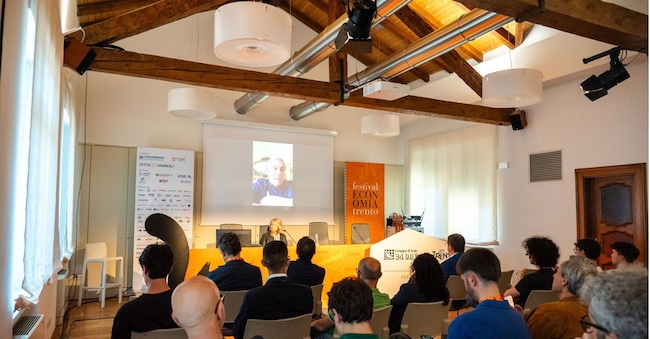
Il vicepremier e ministro degli esteri Antonio Tajani è intervenuto in videocollegamento al Festival dell’Economia di Trento

5' min read

Translated by AI
Versione italiana

5' min read

Translated by AI
Versione italiana

The quality of Made in Italy allows exports to keep running, despite the clouds hovering over international trade, amid tariffs and wars that put freedom of navigation at risk. This is the key to understanding that Antonio Tajani, deputy prime minister and foreign minister, provided during his intervention, in video link-up, at the Trento Festival of Economics on Friday 23 May.

Interviewed by Sole 24 Ore columnist Adriana Cerretelli, he outlined the government's strategy. 'We are doing a lot to support companies,' he said, highlighting the good export results despite the tariffs war. Not only the figures for 2025, 'but also the figures for the first quarter of this year tell us that we have increased by more than 7%,' she added. 'The climate for our exports is very positive and this is also a sign that the action plan put in place by the government is helping companies to strengthen their presence in international markets. There is an overall government strategy that has involved all companies'.

Loading...

Tajani: 'It's not easy but the 700 billion export target remains'

Still referring to exports, the Forza Italia leader clarified that 'the goal is to reach 700 billion by the end of 2027. It will not be easy,' he added, 'but it is a goal that we want to continue to have as a reference point, because it can be done'.

"Israel realises there is a limit"

Among the topics addressed was the lately not easy relationship between Italia and Israel. After the request to impose EU sanctions against Israel's National Security Minister Ben-Gvir, the head of the Farnesina returned to talk about Israel: "we try to give signals to Israel too so that it realises that there is a limit beyond which one cannot go. We are friends of Israel, we have never denied it, but being friends also means being sincere,' he said.

'We must ensure that in Gaza we can proceed with the second phase after the truce: reconstruction, the resumption of normal life, the arrival of humanitarian aid,' he added. And in Lebanon "we believe that Italia can play an important role there too, especially in strengthening the legitimate institutions. It is another very delicate front together with the Syrian one,' the deputy prime minister recalled. "We also try to give signals to Israel so that it realises that there is a limit beyond which one cannot go. We are friends of Israel, we have never denied it, but being friends also means being sincere. Yesterday,' he recalled, 'there was a document signed by the four big European countries: Italia, Germany, France and Great Britain, then other countries joined in, to say enough is enough to the actions of the settlers, occupying the territories of the Palestinian National Authority also compromises the peace strategy to have two peoples, two states. We were very tough, after what happened with the flotilla activists, with Minister Ben-Gvir. And it seems to me that even today the French Foreign Minister supported the Italian position, that is to sanction as soon as possible the Minister of National Security who was responsible for the unworthy acts we witnessed watching television the other day'. In short, Italia wants to have 'an active role of dialogue, of constant presence, both at European and bilateral level. And I insist a lot on the issue of Lebanon, because I believe we could play an important role there'.

"We will take the lead in the defence of Hormuz but after the ceasefire"

The crisis in the Middle East, with the clash between the US and Iran and the blockade of the Strait of Hormuz, is having a negative impact in terms of rising energy costs. "Absolutely yes, Italia will be a protagonist in the defence of free maritime movement in the Strait of Hormuz," the head of the Farnesina confided, "even with its minesweepers, but only by participating in international missions once a stable ceasefire has been reached. We will not participate in any war actions'. "We can participate, thanks also to the great know-how of our Navy and the quality of our minesweepers, in de-mining the Strait of Hormuz, but also in guaranteeing freedom of movement with other types of ships," the minister reiterated, "in international missions that can be under the flag of the United Nations, under the flag of the European Union, or international missions of the 'willing' type. I do not believe,' he confided, 'that there can be a NATO mission because it is too involved with Turkey, which would not be willing to intervene in Iran. It would be better either with the United Nations or the European Union or with a coalition of the willing. And this will also help speed up the supply of oil and gas to our countries, and fertilisers, another not insignificant issue that is not talked about enough'. Now, Tajani concluded, 'it is a question of seeing how long the war will last. Could it be a matter of days? We hope so. And this will allow us to reduce the damage'.

The negotiations with Brussels: 'Optimistic about exemptions to the Stability Pact'

Meanwhile, negotiations continue with Brussels to apply the flexibility currently recognised, in the management of public accounts, to defence spending, also to the resources intended to mitigate the impact of rising energy costs on households and businesses. "It seems to me that, despite some rigidities, people are starting to talk about this issue in Brussels, so I am quite optimistic," said the deputy prime minister, speaking of Italy's request to Europe to loosen the constraints of the stability pact for expenditure related to the energy cost emergency. After the no from the Eurogroup, is this still negotiable? 'I think so, I think so, because some signals have come,' he replied. "Some signals came from Dombrovskis himself, some signals also came from Weber. Let's see in what form. Even von der Leyen has said she will respond, that she needs a few days. If it was an outright no, they would not need to think about it."

According to Tajani, solutions are needed 'to help economies that have problems, from the point of view of compliance with the stability pact because, it is like the issue of inflation, when it is an exogenous factor you cannot burden a state with the responsibility of respecting public debt limits. We all want to reduce public debt,' he continued, 'but when there is an intervention to be made to protect businesses and families, in the event of an emergency, we certainly cannot wait for the situation to deteriorate further to intervene. Just as I think the European Central Bank did well not to raise the cost of money at this time: for once I agree with the choices being made. I have always been against raising the cost of money, this time that the decision has been made not to raise it, I think the European Central Bank is to be commended'.

Copyright reserved ©
Loading...

Brand connect

Loading...

Newsletter

Notizie e approfondimenti sugli avvenimenti politici, economici e finanziari.

Iscriviti