Formula 1

Antonelli, historic victory in China: Mercedes one-two. Ferrari solid in third and fourth place

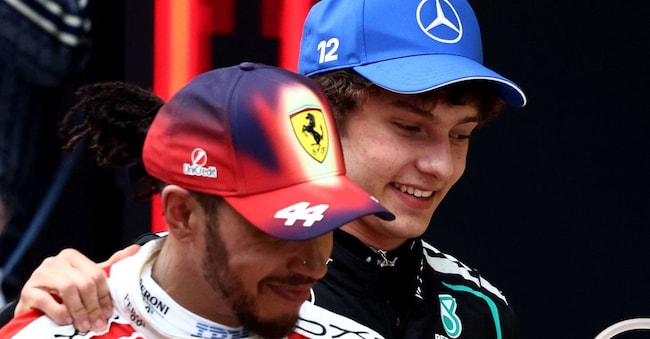
Kimi took his first Formula 1 victory, turning his first podium finish into a feat of historic value. Hamilton finished third, taking his first podium finish as a Ferrarista

by Alex D'Agosta

Kimi Antonelli e Lewis Hamilton sul podio in Cina (REUTERS/Jakub Porzycki)

7' min read

Translated by AI
Versione italiana

7' min read

Translated by AI
Versione italiana

Shanghai gives Formula 1 a day that for Italia has a historic weight: Andrea Kimi Antonelli wins the Heineken Chinese Grand Prix 2026, crowning the weekend that began with a record pole position on Saturday and taking the tricolour back to the top step of the podium for the first time since Giancarlo Fisichella. Behind him George Russell completes the Mercedes one-two, confirming a technical superiority that at this stage of the championship already appears very clear. If the Saturday in Shanghai had already recounted Antonelli's irruption into the great statistics of Formula 1, today's test consigns him to an even heavier dimension: that of the winners, i.e. those drivers capable of withstanding pressure, strategy and leadership throughout the entire arc of a Grand Prix.

On a rare occasion when the weather did not play a major role in the Chinese Grand Prix, this second round without any serious incidents in 2026, however, began with the bitter news that the World Championship would be reduced to twenty-two rounds due to the notorious tensions in the Middle East. Thanks to the absence of rain and an unusually favourable asphalt in terms of grip, over a distance of 56 laps, with four zones in which active aerodynamics could be activated, the race looked on paper like a possible one-stop race, although reality immediately showed that the reliability variable will still be with us for a long time in the debut phase of this new generation of single-seaters.

Loading...

The spotlight was inevitably already on Saturday on Andrea Kimi Antonelli, who started from pole position at 19 years and 202 days. But at the start the specific weight of Lewis Hamilton, author of a more convincing start, immediately emerged. Antonelli initially manages to stay ahead of his team-mate: however Hamilton, with a craftsmanship that no one has really inherited yet, manages within a couple of corners to take the lead with great character. Behind them Charles Leclerc then squeezes in between Antonelli and Russell, but the balance changes almost immediately. The red dream only lasted two laps: first Antonelli took the lead again and, as lap three came around, Russell passed Leclerc to take third place. And with the start of lap four Russell also passes Hamilton. The Mercedes are simply no longer hiding: in energy management they confirm they have no rivals; the whole technical package seems to be working at a level unattainable today for the others.

In this picture, on the negative side, another very difficult start for Red Bull stands out, once again unable to really get into the fight for the top spot in the very early stages, with Verstappen's sad retirement and Hadjar nibbling away at the few points of eighth place. But it went even worse for the four who did not even see the lights go out regularly: the two McLarens, Bortoleto and Albon were forced to start from the pit lane or were immediately cut off by electronic problems, after an already disappointing qualifying. The third row collected on Saturday had in fact been less than honourable for the reigning world champions, both in the drivers' standings with Norris, and among the constructors.

For Oscar Piastri the balance is particularly heavy: two zeros in the first two Grands Prix of the year hurt, and the Australian has to cling at least to the three points picked up in Saturday's Sprint, dominated by Russell, not to see the season immediately complicated. It is a start that also weighs on a psychological level, because McLaren was expected to confirm at the highest level and instead finds itself immediately in hot pursuit.

There was even an almost grotesque moment at the start, with the contact between the two Cadillacs of Perez and Bottas, an episode that ended up giving the race an almost comical interlude in an already very agitated start. An internal clash that clashes with the ambitions of a team called above all to build credibility and solidity, even if until 2028 it will be in a learning phase and with engines purchased from competitors.

A quarter of the way through the race, the first important movements begin: the gaps are neutralised by a long safety car caused by the retirement of Lance Stroll's Aston Martin (Alonso will end up the same way, but will return to the pits like Verstappen). The neutralisation brings everything into question and opens up a strategically delicate phase. At the very mixed restart, Antonelli finds himself still in the lead and is the only one of the top teams not to take advantage of the slowdown to stop and change tyres. It is a leader's choice, almost from another era, reminiscent of the seasons of the great dominators capable of building their superiority also through a ferocious sequence of very fast laps at the decisive moment: it is natural to think of Michael Schumacher, when he transformed stretches of the race into a kind of prolonged qualifying.

At halfway through the race, therefore, the strongest data is twofold: on the one hand the impressive confirmation of Mercedes' strength, and on the other the feeling that Antonelli is already learning to manage not only pure speed, but also the weight of the leadership. And it is from here, with the group recompacted and the strategies still open, that the Chinese Grand Prix enters its most delicate phase.

Worthy of note and future replays from social media were in fact a few laps of pure red show, with wheel-to-wheel without excess of Hamilton and Leclerc, still contending for second and third place. But between the two quarrels, the third one inexorably took advantage: Russell sweated a lot, but came back second, behind Kimi.

Unfortunately, even these overtaking moves, as we have already seen in Melbourne, lend themselves to practically endless controversy: with few exceptions, their vertical increase compared to past seasons does not stem from the driver's skill, risk or hazard, but above all from differences in energy management and the goodness of the technical design. It is an anomaly that must be corrected, because if this drift is not stopped quickly it will end up severely affecting the respect and reputation of Formula 1 itself.

For Antonelli, however, the figure that remains goes far beyond the technical issue and beyond Saturday's pole. His victory brings Italia back into one of the heaviest chapters of the championship statistics: to find a success by an Italian driver we have to go back to Giancarlo Fisichella, and since then the tricolour had continued to chase signals, isolated exploits, promising flashes but never a full return to the top. No tricolour has ever again had real opportunities or competitive cars: after Fisichella and Trulli, the last to make the podium, there has never been Liuzzi, active only in second-rate teams, nor Luca Badoer. In the second decade of this century, Davide Valsecchi, as reigning Gp2 champion, was on the bench in Formula 1 for a year and at the time of Raikkonen's early retirement in Lotus he was preferred to the other Finn, with the heavier suitcase. Years later, Antonio Giovinazzi had more time in Ferrari than Giancarlo but in years not much better: he did better with the Wec.

For Antonelli it is different. The pole conquered on 14 March 2026 had already returned to Italia a record of enormous importance, that of the youngest pole sitter of all time, but Sunday's success completely changes the scale of the Shanghai weekend: no longer just an age record or a clue to the future, but concrete proof of the arrival of a new Italian protagonist in the stable fight for the top positions. The young Bolognese is not just the right guy in the right place in the best car of the moment, but a driver who has been able to withstand the pressure, manage the most delicate moments of the race and transform a favourable condition into a historic result. This is why Shanghai, even more than Melbourne, tells us that 2026 could really become the year in which Italia returns to the top ranks of Formula 1.

War cancels two GPs and over 100 million in lost revenue

The cancellation of the Bahrain and Saudi Arabian GPs has provoked reactions abroad that are less neutral than one might think when reading the official Formula One bulletins. Many Anglo-Saxon commentators speak of an inevitable decision, but also a revealing one: for years the championship has shown that it wants to race almost anywhere and in any conditions, so the fact that this time it has given up two of the most profitable races on the calendar is read as a sign that the regional situation has exceeded the threshold of risk considered manageable. Several British columnists argue that continuing to race in the Gulf at this time would have been simply irresponsible: not so much for political or moral reasons, but because no global sporting organisation can ignore a potentially expanding military crisis by putting teams, drivers and hundreds of technicians to work in an area under tension. Other commentators insist instead on the economic side of the decision: Bahrain and especially Saudi Arabia pay some of the highest hosting fees in the world championship and the cancellation is worth over a hundred million dollars in lost revenue, but Formula 1 today is solid enough to absorb the blow without structural consequences.

Many also remember the precedent of 2022, when the Saudi Grand Prix was held despite a missile attack a few kilometres from the circuit on an Aramco oil depot, right during the first free practice session. After a long night meeting between drivers, teams and organisers, that night left its mark on the security management of the championship. During the Covid, it was 13 March 2020, everyone had arrived in Melbourne but the first free practice was cancelled, even though a few lower categories had started running the day before. This time Formula One preferred to stop before again being faced with a dramatic decision taken at the last minute, with the teams already in place and the world watching.

Copyright reserved ©
Loading...

Brand connect

Loading...

Newsletter

Notizie e approfondimenti sugli avvenimenti politici, economici e finanziari.

Iscriviti

Tutto mercato WEB