Fabergé, it's a world record for the Winter Egg: $30.2 million
Christie's sold one of the St Petersburg jeweller's magnificent 'eggs' on 2 December. The most valuable ever at public auction

Key points
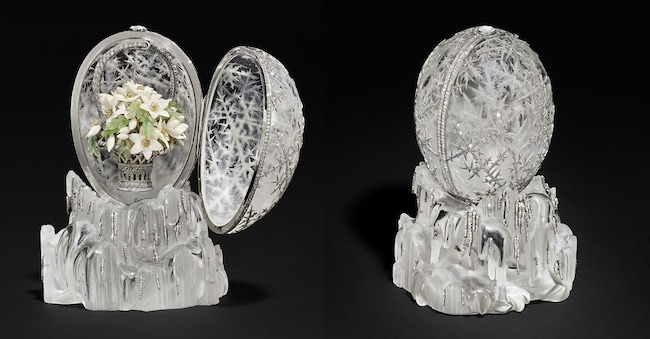
Russian magnificence is also dressed in the crystal of the tsars. And carved in rock crystal is the WinterEgg, Fabergé's 1913 egg fresh off a world record at public auction: someone paid $30.2 million (£22.9 million, including commission) for it on the evening of Tuesday 2 December 2025 at Christie's London, during the monographic sale "The Winter Egg and Important Works by Fabergé from a Princely Collection".
The 'Winter Egg', a Fabergé with a triple record
It therefore eclipsed the previous record in public auction, even considering the parity of buying power: £8.9m in 2007 at Christie's for the Rothschild Egg (in pink enamel, with external clock). A lot with an enviable pedigree: in fact, this is the third time that the Winter Egg has gone through auction (again at Christie's) setting a record. The first time was in 1994, immediately after its discovery; the second time was in 2002, when it fetched £6.6 million. It is also one of the only ones of collector interest, i.e. dating from 1885-1916 (there are about fifty of these eggs). Margo Oganesian, head of Christie's Fabergé and Russian Works of Art department, calls it "a masterpiece, one of Fabergé's most exquisite creations, both technically and artistically".
Lot's ID
Commissioned from Peter Carl Fabergé by the Emperor Nicholas II (1868-1918) as an Easter gift for his mother - the dowager Empress Maria Feodorovna (1847-1928) - the Winter Egg is one of the very few Fabergé pieces remaining in private hands. Wartski, a specialised jeweller in London, acquired it in the Soviet Union between 1929 and 1933 (£450), then it changed hands in 1934 to Napier Sturt, 3rd Baron Alington (1896-1940) for £1,500 and ended up again in the collection of Sir Bernard Eckstein (1894-1948) and finally brought to auction by his heirs at Sotheby's on 8 February 1949 for £1,870. Owned by the collection of Arthur Bryan Ledbrook (1895-1974) it then had, as described, subsequent auction passages.
On the inside, the object is engraved with a frost motif; on the outside, snow crystal decorations in platinum, set with rose-cut diamonds. The edges are in platinum, with diamonds set to conceal a hinge on the side. The base, also in rock crystal, represents a block of melting ice: the rivulets are in platinum with rose-cut diamonds. A central platinum pin supports the egg, whose 'surprise' is a platinum basket with a double handle, decorated with diamonds and filled with finely carved white quartz wood anemones with nephrite leaves. The stem and stamens are made of gold wire. The base of the basket bears the engraving 'FABERGÉ 1913'. With the base, the egg is 14.2 cm high; the surprise is 8.2 cm high.
The most expensive Fabergé egg ever is actually...
However, the Winter Egg missed out - though not by too much - on the absolute price record. The most expensive Fabergé sceptre in history still belongs to the so-called third imperial egg, fortunately discovered in the Midwest just over a decade ago: it was the year 2014 and a scrap metal dealer bought it from an antique dealer for $14,000, intending to melt it down. Fortunately, he did not and turned to Wartski, a specialist jeweller in London, who recognised the treasure and bought it on behalf of a client for $33 million.