

Farmindustria: soaring costs with war, drugs also at risk
President Cattani: aluminium and active ingredient prices fly and the phenomenon is set to last. 'Europe accelerates on competitiveness'
Key points
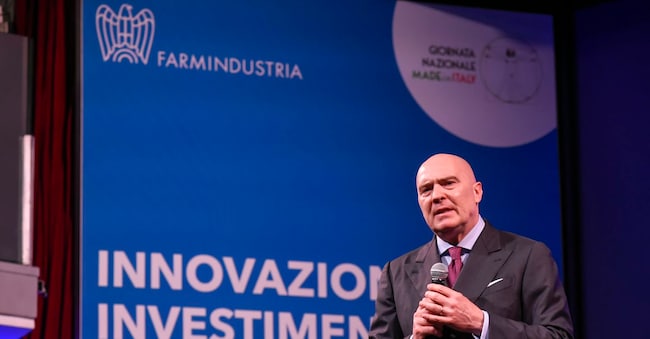
The war in Iran is bringing about the third shock in four years (after Ukraine and the Red Sea crisis) that simultaneously affects logistics, energy and the costs of all inputs. With projected total increases of more than 20% to be borne by industry, to be added to the 30% increase from 2021 to date that, in a system of administered prices, fall entirely on companies. It is the president of Farmindustria, Marcello Cattani, who draws the first conclusions from the gulf crisis that is also jeopardising the sustainability of pharmaceutical production. "The costs of aluminium," he said during an event organised in Rome on the occasion of Made in Italy Day, "have risen by 25% and can only be found in China, India and Australia. But the costs of active ingredients (+15%), glass and paper (+20%) are also on the rise. "These phenomena are destined to last,' Cattani continues, 'and while the USA, China, the Arab Emirates, Singapore and Saudi Arabia have focused on innovation and are running fast, Europe continues to lose ground.
Cattani: Italy's government good, Brussels rejected
'Focusing on innovation has never been optional, and even less so now,' Cattani continues, 'Farmindustria has launched a Manifesto for Research based on the assumption that where research is done, we cure better. The aim is to propose concrete actions to strengthen preclinical and clinical research in Italia in a sector in which Europe is unfortunately losing ground to competitors such as the USA and China'.
The Italian government, on the other hand, according to Cattani, 'is doing well, both at EU level, where it has long been in the front line against choices that sink the industry, and in Italia, where it has developed a path towards competitiveness, which we hope will be completed with the Consolidated Text on pharmaceutical legislation, which represents a great opportunity'. Now it is necessary to overcome 'definitively the payback, accelerate and improve access to treatment, also with a new early access mechanism'.
Urso: pharmaceutical pillar of Made in Italy
The pharmaceutical industry drives the Italian economy and employs 72,200 people, an increase of 2% over the previous year. In 2025, pharmaceutical exports exceeded 69 billion euros and production 74 billion euros, while over 4 billion euros are invested in high-tech plants and research and development. Of these, more than 800 million are earmarked for clinical research at National Health Service facilities. The speech by the Minister for Industry and Made in Italy, Adolfo Urso, starts from these figures. "The pharmaceutical industry is a pillar of Made in Italy and in the annus horribilis of trade wars it has sustained exports with a growth of 7.2% in the United States and allowed us to engage Japan as the fourth exporting country," said the minister, recalling the importance of the table convened at Mimit for pharmaceutical and biomedical "to identify strategies to maintain solid growth and intervene on critical issues such as payback. "We have already intervened at the European level," Urso added, "to revise the directives on waste water and intellectual property. For Urso, in such a complex global context, with the main competitors growing, 'it is necessary to protect the European market from unfair competition and to implement a sustainable industry policy capable of stimulating innovation, research and the competitiveness of our companies'.
Aleotti: price increases a bomb for industry
For Lucia Aleotti, vice-president of Confindustria for the Study Centre, shareholder and member of the board of Menarini, "the data of the Confindustria Study Centre project a very serious situation for the European economy in the light of the Gulf crisis. Growth, which was already lacklustre, will go from 1.5% in 2025 to 1.1%, I am talking about Europe, and only 0.4% if the crisis continues'. Italia, on the other hand, which is more exposed, risks going from a growth that would have been 0.7% this year without the Gulf crisis, to an even reversed recession scenario of minus 0.7% if the Gulf crisis continues until the end of the year'. And with the explosion of energy, transport, raw material and material costs, 'a real bombshell for the industrial system in Italia, pharmaceutical supplies are also at risk from the summer onwards'.

