
Fed leaves rates unchanged between 3.50 % and 3.75 %. Powell: I'm staying on the board
The decision was taken with 8 votes in favour and 4 against, the highest dissent since October 1992, just after the lira and sterling crisis

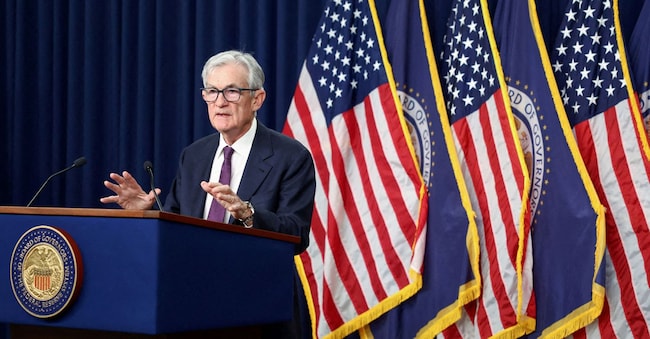
Firm rates, and a divided board. The Federal reserve maintained the Fed Funds Rates corridor at 3.5-3.75%, with Stephen I. voting against. Miran, close to President Donald Trump who, as on previous occasions, would have preferred a cut of 0.25 basis points. On this occasion, however, the decision also met with a 'no' vote from three other members of the monetary policy committee, the FOMC (Federal Open Market Committee).
Three 'hawks' in the Fomc
Beth M. Hammack (Cleveland Fed), Neel Kashkari (Minneapolis), and Lorie K. Logan (Dallas) were in agreement with keeping rates at the current level, but asked for a step further: 'They did not see fit to include an indication in the statement that monetary policy should be loosened for the time being'. Almost unchanged from March - apart from a more explicit reference to 'high uncertainty' over events in the Middle East and 'high inflation' - yesterday's statement continued to indicate that in considering 'further adjustments' the Committee would 'carefully review incoming data, the evolving outlook and the balance of risks'. That 'further', after a long period of cuts ended in December, leaves the door open to further reductions in the cost of credit: a message the three FOMC members wanted to avoid.
Powell remains on the Monetary Policy Committee
President Jerome Powell thus ends his term of office with a level of "no" votes never recorded since 6 October 1992, immediately after the crisis of the lira and the pound: it was his last meeting as president and the Senate's go-ahead has also arrived for his successor Kevin Warsh, to whom Powell has wished best wishes. However, the outgoing president, whose term as governor expires on 31 January 2028, will remain on the FOMC, 'with a low profile', until the investigation into the seat reconstruction is concluded: the District of Columbia prosecutor has closed the investigation without indictment but 'will not hesitate' to reopen it should the Inspector General report. The practice to date has been for the president to also resign as a member of the FOMC at the end of his term of office.
Independence "at risk"
Powell made it clear that the Fed's independence 'is at risk': 'I think these legal attacks are putting pressure on the institution. We are forced to go to the courts to enforce our rights. It is not so much a question of independence per se: it is about the ability to make monetary policy without political considerations'. "The matter is not closed. None of this is concluded,' he added. the decision to remain in the Fomc is also linked to this situation: 'I will stay until I feel it is appropriate to leave. That, in essence, is what guides my choice. I am not aiming to become a leading critical voice or anything like that. Rather, I am interested in seeing that the situation calms down and that we return to a more traditional model: working with the people in office, building consensus and respecting it. That is what I hope for'.
"No rush to make decisions"
On today's decision, 'there was no rush to make a decision,' Powell commented, also referring to the change in language requested by the three naysayers: 'Monetary policy is well positioned for us to wait and assess developments. We are at the upper end of neutral, or perhaps in slightly restrictive territory'.


