
Fed leaves rates unchanged at 3.5%-3.75%. Powell: I will not leave the board immediately
The FOMC decision with 11 votes in favour and 1 against. Planned one cut in 2026 and one in 2027. The president awaiting the end of the investigation into the works at the headquarters

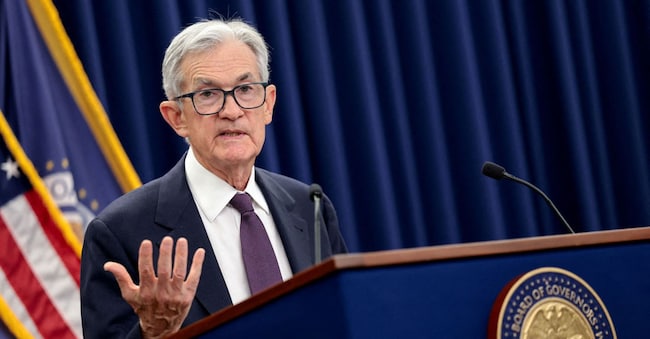
Firm rates. The Federal Open Market Committee (FOMC), the Federal Reserve body responsible for US monetary policy, decided to hold interest rates at 3.50-3.75 per cent, as analysts had expected. There was only one dissenting vote (there were two on 28 January): that of Stephen J. Miran, who would have preferred a quarter-point cut. Christoph J. Walter, who had voted for a reduction in the official cost of very short-term credit at the previous meeting, converged on the majority vote.
Little change in the diagnosis of the economy, in the official communiqué. The FOMC simply noted that inflation was little changed, whereas in January it had preferred to emphasise that it had shown signs of stabilisation. The reference to the war was inevitable: 'The implications of developments in the Middle East for the US economy are uncertain'.
Macroeconomic projections show faster growth, compared to December, for this year (2.4% from 2.3%), next year (2.3% from 2%) and 2028 (2.1% from 1.9%). Long-term growth, which can be regarded as an implicit target, was raised to 2.0% from 1.8%. Inflation is also now expected to rise: 2.7% (from 2.4% in December) for this year, 2.2% for 2027 (from 2.1%) and 2% unchanged for 2028. On the monetary policy horizon, therefore, the target would be reached, a sign that the current stance appears appropriate, as Chairman Jerome Powell confirmed at a press conference. Core inflation also rose slightly: 2.7 % (from 2.5 %) for this year; 2.2 % (from 2.1 %) for next year, and 2.0 % unchanged for 2028.
Powell pointed out, however, that the high values recorded in recent months "reflect inflation in the goods sector, which has been boosted by the effects of tariffs. Short-term measures of inflation expectations have risen in recent weeks, probably reflecting the disruptions in the oil market; longer-term expectations remain consistent with the 2 per cent target'.
'In the near term,' he added, 'higher energy prices will push up overall inflation; it is still too early to know the magnitude and duration of the potential effects on the economy'. The upward revision of the projections, on the other hand, "is certainly linked to events in the Middle East and the price of oil". "I want to emphasise this," he was quick to comment, "Nobody knows, the economic effects could be smaller or much larger. We simply do not know'.
Almost unchanged is the forecast for unemployment, revised only to 4.3 per cent from 4.2 per cent next year. The decline from 4.4 per cent this year to the long-run figure of 4.2 per cent in 2028 is confirmed. "Employment growth," Powell explained, however, "remained subdued. A significant part of the slowdown in the pace of job growth over the past year reflects a decline in labour force growth, due to lower immigration and reduced labour market participation, even as demand for labour has weakened in turn".


