United States

Warsh: ‘Inflation is too high; the Fed still has work to do’

The Federal Reserve Chair’s speech at Jackson Hole appears to pave the way for an interest rate rise as early as September

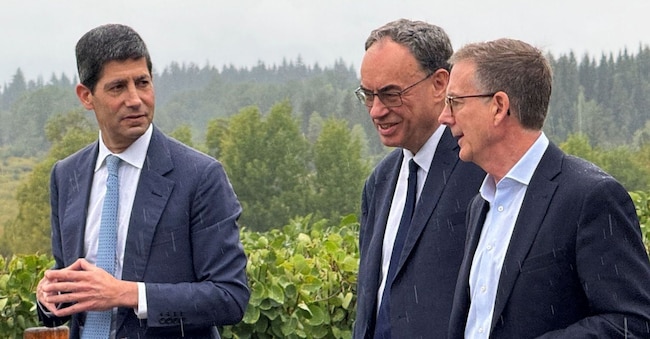
Kevin Warsh (a sinistra) a Jackson Hole con Tiff Mackleme e Andrew Bailey, governatori di Canada e Inghilterra REUTERS

4' min read

Translated by AI
Versione italiana

4' min read

Translated by AI
Versione italiana

‘High and persistent inflation is a growing cause for concern’, ‘the price data released this summer were better than expected, but do not indicate a significant improvement in underlying trends’. And furthermore: ‘We must be certain that we are making progress towards our objective, clearly and with sufficient speed. Otherwise, when it comes to inflation, we have work to do: this is our task, our mandate and our responsibility.”

In Jackson Hole – during his debut as Fed chairman at the prestigious central bankers’ summit – Kevin Warsh said perhaps more than even his colleagues on the US central bank’s board had expected. However, the remarks by the chairman appointed by Donald Trump did not entirely convince analysts and only partially reassured the markets.

Loading...

“Warsh is giving the market what it wants. He acknowledges that inflation remains an unresolved issue, but – as Oliver Pursche of Wealthspire explains – he isn’t giving too much away about the Fed’s future moves. That’s the best we could have hoped for from him.” “We’ll see how the situation develops; I get the impression I’ve heard the same line from Warsh for the fourth, perhaps even the fifth time. He reiterates that they will focus on inflation, whilst refraining from providing any forward-looking guidance, but then says to let the market take its course, that it’s fine as it is,” says Eugene Epstein of Moneycorp.

The markets had been completely taken by surprise by Warsh’s lack of explanation after the FOMC had decided, at its last meeting in July, to leave interest rates unchanged within a range of 3.5 per cent to 3.75 per cent. At Jackson Hole, during the annual gathering held in Wyoming, Warsh appeared to offer further insight. Inflation is still ‘too high’ and ‘current financial conditions can hardly be considered “restrictive”’, he explained, suggesting that a rise in key interest rates, starting at the September meeting or in any case by the end of the year, might already be on the cards. However, he also said he could confirm “a commitment to a rigorous approach, but not to a specific decision”.

He also hedged his bets, in a passage that was as vague as it was close to the populist base of the Trumpian right. ‘If the Fed gets it wrong on inflation and misjudges the economy, who stands to lose the most? Not the financial elite. It is working Americans who have to cope with excessively high inflation or jobs that suddenly become less secure.’

The Fed Chair also provided some clarifications, which were only seemingly obvious: ‘The Fed’s 2 per cent price stability target, as measured by the PCE index, is firm and fixed; there should be no misunderstanding,’ he stated in response to the latest July figures, according to which the PCE index still stands at 3.7 per cent year-on-year. “Short-term interest rates,” he went on to emphasise, “are the primary tool for achieving the Fed’s dual mandate of inflation and full employment, whilst unconventional policies to stimulate economic activity may only be appropriate in the event of genuine crises.”

Warsh said he was “impressed by the overall performance of the US economy, which appears to have strengthened and shown considerable resilience to shocks”: “On the employment front, our country is doing well,” he said, noting that the current unemployment rate of 4.1 per cent is “consistent with full employment”. He also referred to AI as “a new variable and a turning point in history”.

Then, in his wide-ranging speech, the Fed Chair outlined his strategy. ‘The Fed should be humble and never naive. We are the ones who determine the path of short-term interest rates, and market participants will always try to anticipate our next move; we should not encourage a situation in which market participants look primarily to the Fed to decide on their next move: this is the ‘hall of mirrors’ phenomenon, which risks making us vulnerable to sudden events and causing us to make mistakes’. This is another reason why Warsh has emphasised the need for “a limited and circumscribed role for forward guidance, to prevent statements and announcements from restricting our ability to make the right decisions at the right time”.

The pressure on Warsh’s new Fed policy remains immense. It stems from the markets, the war in Iran and energy prices, the artificial intelligence boom that is overheating the economy, and record yields on public debt, which has soared past $40,000 billion. But his political counterparts could complicate the ‘job at hand’. The Fed’s credibility remains at risk. The controversial buyback of longer-dated T-bonds recently decided upon by the Treasury could also land Warsh in hot water. ‘He is trying to strike a balance between the various positions. He has to satisfy the markets, but – says Peter Cardillo, chief economist at Spartan Capital Securities, speaking from New York – he also has to satisfy President Trump.’

Copyright reserved ©
Loading...

Brand connect

Loading...

Newsletter

Notizie e approfondimenti sugli avvenimenti politici, economici e finanziari.

Iscriviti