Auctions

Ferrari Luce sets a record: the first model sold for $40 million at Sotheby’s

The first production electric Ferrari was sold at RM Sotheby’s for 40 million dollars. This is a world record for a new car, driven by the uniqueness of the vehicle and the fact that the proceeds went to charity. But the result also illustrates how the classic car market is changing.

4' min read

Translated by AI
Versione italiana

4' min read

Translated by AI
Versione italiana

Ferrari Luce, $40 million for Chassis 0

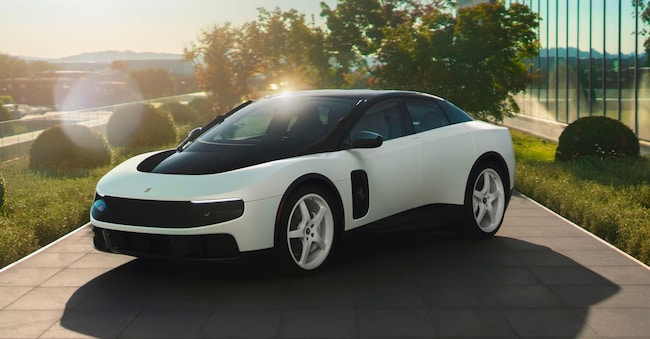
Forty million dollars for an electric Ferrari. Not a 250 GTO with sixty years of history behind it, nor even a Le Mans-winning sports prototype, but the first production Ferrari Luce. The most surprising result of the 2026 Monterey Car Week auctions thus comes from ‘Chassis 0’, a Tailor Made example of Maranello’s first electric car, sold without reserve by RM Sotheby’s.

This figure sets a new record for a new car sold at auction and significantly exceeds Ferrari’s previous record: the $26 million achieved in 2025 by a Daytona SP3 Tailor Made. This result takes on even greater significance when one considers that the pre-auction estimate for Chassis 0 was over $1.1 million.

Loading...

This is not, however, a Luce like any other: the model, unveiled at the end of May, sparked huge controversy, particularly because its design was not created by Ferrari’s in-house design centre but by the LoveFrom collective led by former Apple designer Jony Ive. It is the first production model of Ferrari’s first electric car, with chassis number zero, created in a unique configuration through the Tailor Made programme. Most importantly, the entire proceeds from the auction will go to the Ferrari Foundation to fund initiatives in the field of education.

Ferrari Luce, l’esemplare Chassis 0

Photogallery11 foto

An electric Ferrari transformed into a collector’s item

The customisation of Chassis 0 centres on the theme of light. The Madreperla Semi-Gloss bodywork features a finish developed specifically for this model, paired with an interior upholstered in Perla Le Mans metallic leather with Grigio Corvara accents. The wheels and numerous details have also been specially crafted.

It is a one-of-a-kind model for a Ferrari that already marks a turning point in Maranello’s history. The Luce is, in fact, the first fully electric Ferrari: four permanent-magnet synchronous motors, one per wheel, a total of 1,050 cavalli, a 122 kWh battery with an 800-volt architecture, a claimed range of 530 km and DC charging up to 350 kW. It is also a five-door model approved for five passengers, 5.26 metres long and weighing 2,260 kg: characteristics that place it far removed from the traditional image of a Ferrari berlinetta.

The 40 million is not the price of the Ferrari Luce

Of course, it would be wrong to interpret the sale as an indication of the market value of *La Luce*, which has a starting price of 550,000 euros. The chassis number, its unique configuration and, above all, the fact that the proceeds go to charity completely alter the usual mechanisms of price formation.

However, the move has a significant impact on the brand’s image. Ferrari has managed to turn its most talked-about car of recent years into a collector’s item even before a proper second-hand market has had a chance to emerge.

And the initial indications regarding demand appear positive. According to a report in the Financial Times at the end of July, Ferrari is said to have reached its sales target for 2026 – set at just under 500 Luce – in less than two months, thanks in particular to demand from China. At the time, Ferrari declined to comment directly on the rumours.

Monterey: the McLaren F1 GTR sells for 34.655 million

The result achieved by the Luce ended up overshadowing even one of the most significant cars at Monterey Car Week 2026. Also at RM Sotheby’s, the 1996 McLaren F1 GTR was sold for $34.655 million.

The fact that a brand-new electric Ferrari has outperformed an F1 GTR is primarily down to the exceptional nature of the charity auction. Nevertheless, this figure clearly illustrates the transformation currently taking place in the world of high-end car collecting.

Loading...

Alongside historic Ferraris, racing cars and the great classics, there is growing interest in contemporary hypercars, limited editions, early production models and one-off configurations. Production history, provenance and specifications are becoming almost as important as the car’s age.

Modern hypercars are becoming collector’s items

Ferrari is at the heart of this phenomenon. The F40, F50, Enzo and LaFerrari have now firmly established their place on the international market, whilst more recent, limited-production models such as the Daytona SP3 and F80 have immediately caught the attention of major collectors.

This does not, of course, mean that every modern supercar is bound to increase in value. On the contrary, the Monterey auctions demonstrate just how well the market can distinguish between cars that are simply very expensive and those that boast true rarity, provenance, history and truly exceptional specifications.

Chassis 0 brings all these elements together and adds a new one: it marks Ferrari’s entry into the era of electric cars.

The real test will come on the second-hand market

That is why the hammer price of 40 million dollars says a great deal about the strength of the Ferrari brand, but still little about the future value of the Luce. The most significant test will come when the first standard models eventually begin to appear on the second-hand market.

It will therefore be the ratio between the second-hand price and the list price, resale times and demand in the markets most receptive to luxury electric cars — starting with China and California — that will indicate the extent to which customers have truly embraced the most radical transformation in Maranello’s recent history.

Chassis 0, meanwhile, has already achieved a feat that will be hard to replicate: it has turned the debut of Ferrari’s battery-powered car into a record-breaking event. And with $40 million earmarked for educational initiatives through the Ferrari Foundation, the value of this project far exceeds that of the car itself.

The luxury of doing good is priceless

The buyer remains anonymous for the time being, although rumours are rife that it is Herbert “Herbie” Wertheim, who last year secured the Ferrari Daytona SP3 “599+1” Tailor Made for $26 million at the same RM Sotheby’s auction. Herbie is a well-known billionaire and philanthropist, a passionate collector of Ferraris, who continues to grow his fortune thanks to the patent rights to the photochromic lenses he invented. At the age of 78, he is in enviable shape and sports an outfit with red accents, such as his straw hat and, of course, the lenses of his glasses, and spends his time selecting charitable projects to support. But this year has not been easy for him: there were around ten active bidders at the auction, but their numbers dwindled towards the end, leaving just two as the bid had already exceeded 35 million dollars.

Copyright reserved ©
Loading...

Brand connect

Loading...

Newsletter

Notizie e approfondimenti sugli avvenimenti politici, economici e finanziari.

Iscriviti