
Fewer and better days: English schooling makes parents and pupils happy
In Great Britain, the school year started last week and will close at the end of July 2026. British students will do fewer days than Italians (net of strikes and occupations), but with more breaks and fewer summer holidays

3' min read
3' min read
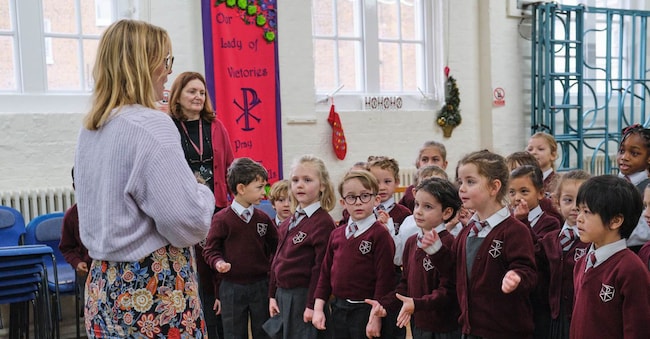
On the morning of 3 September, a Wednesday, in front of the Our Lady of Victories primary school in South Kensington in London, there was a commotion of passing cars, hordes of parents conversing and hordes of children, all wearing the same uniform (straw hat, amaranth jacket and flowered dress for the girls; baseball cap, amaranth jacket and short shorts for the boys) in front of a door: the pupils of theEnglish Public Primary School waited to return to the school desks. They had "only" 37 days of summer holidays, because their school had finished classes on 19 July, a Friday. They were lucky: the pupils in the rest of theUK restarted school on 1 September, according to an unwritten rule that in England we start again on the first Monday in September; others on 2 September. In the institute, Catholic, in London, the teachers took refresher courses and the schoolchildren were able to enjoy two extra days of holiday. Their Italian peers started ten days later and had finished school at the beginning of June.
Summer holidays kept to a minimum
.Compared to Italy's almost 100 days of closed schools in the summer, Britain's summer holidays, just over a third, are almost non-existent, the stuff of cruel jailers. Instead, it is a system that works: parents are happy about it, who in no country in the world can enjoy 100 days of summer holidays, but it is above all useful to the pupils themselves: fewer days off means fewer problems for the organisation of families, but, above all, less educational dispersion: in the United Kingdom, at the beginning of September pupils return to class still fresh from their last lessons, without a huge gap in education. The Italian three months, on the other hand, damage learning: children's brains suffer from the prolonged gap. How does the English school year work?
The English calendar
.In the UK, the school year is generally divided into four terms, called Terms: it starts with the Autumn Term, the autumn term, from September to December. Then in January, begins the Winter Term, the winter quarter, which extends until March-April, depending on Easter. After returning from the Easter holidays, theSpring Term begins, which ends at the end of May. TheSummer Term, the summer quarter, begins in June and ends mid-to-late July.
Each term has a break of about one week in the middle of each term, called Half Term. The summer holidays last precisely about 5-6 weeks, much less than in Italy, but they are still the longest period of absence from school in the year.The autumn term is the longest because it covers more than 100 days until the Christmas holidays, around the 20th of December; the shortest is the summer term, which in fact lasts half as long, only a month and a half ends. There is no fixed number of school days that applies to the whole of the UK, as the calendar may vary between England, Wales, Scotland and Northern Ireland. However, it is estimated that the average is around 186 lesson days per year. In Italy, the Ministry of Education sets 200 days as the minimum number of school lessons (with the regions then deciding the calendar).
Fewer days but more efficiency
.The UK's school paradox is that with its 186 school days, that is14 less than Italy. Yet the calendar is longer: it starts earlier and ends later.In fact, the actual days in Italy, match those in the UK, between bridges of holidays, strikes, occupations and student demonstrations, phenomena that do not exist in the UK.

