Weekend films

'The Shrouds', an eerie, highly personal dystopia

David Cronenberg's new feature film starring Vincent Cassel has arrived in cinemas: an autobiographical work of great depth

by Andrea Chimento

3' min read

3' min read

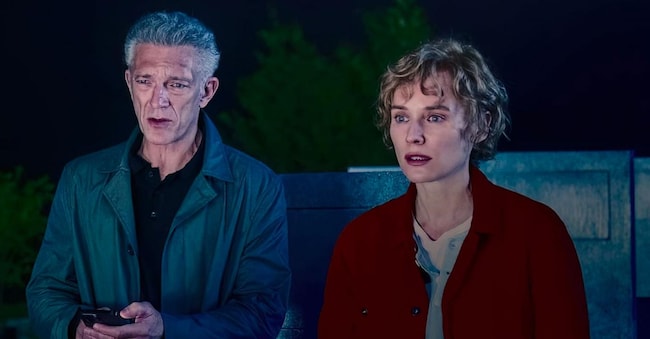
Filming what happens after death in order to maintain contact with those who are no longer there: this is how 'The Shrouds', one of the darkest and most melancholic titles of David Cronenberg's career, can be summarised. Among the great directors of contemporary cinema, Cronenberg signs an extremely personal film that can be linked to the death of his wife, Carolyn, who died of cancer in 2017.

Vincent Cassel is undoubtedly an alter ego of the Canadian auteur - as much for his hairstyle as for his outfit choices - in this film in which he plays Karsh, a widowed businessman who invents a controversial and revolutionary technology that allows the living to observe their loved ones after death, while they are inside special shrouds (hence the film's title).

Loading...

One night, however, the graves of this strange cemetery are destroyed and desecrated: Karsh will then start investigating to find out who is behind such an extreme act.

In 'The Shrouds', the absolute star of the weekend in theatres, one feels a very strong connection with the director's previous film, 'Crimes of the Future', recalled right from the opening credits.

“The Shrouds” e gli altri film della settimana

Photogallery4 foto

Cronenberg recounts a 'credible dystopia' with this film, which reasons about the increasingly extreme contemporary obsession with wanting to film and archive every image available to us, but also about artificial intelligence and its increasingly humanising forms.

Technological prophecies of which the director has always been a master - one thinks of 'Videodrome' (1983) or 'eXistenZ' (1999) - and which here are linked to possible global conspiracies and paranoia that can also make us think back to 'The Naked Lunch'.

A self-analysis session

.

Between hints of Hitchcockian flavour and moments of extreme formal elegance, Cronenberg signs a sort of self-analysis session, painful and capable of delving deep into his own mind and that of us spectators.

It is a film that many have rejected (even the critics have been cold, ever since its screening at last year's Cannes Film Festival) but, if you go and carefully analyse what the director is trying to tell us, you will discover not only a dark and touching melodrama that unites life and death, but also a truly melancholic operation, a constant and endless elaboration of a mourning from which the protagonist - and perhaps the director - can no longer get out. Love and death are nothing new in the author's cinema (think, among the many possible, of "Inseparable", a film that often comes to mind during viewing), as does the presence of food - the cemetery stands next to a restaurant - and sex as a form of liberation but also of guilt: it is as if "The Shrouds" were a summa of Cronenberg's cinema and, despite an ending that is not as incisive as the rest of the film, the result is a powerful and shaking feature film, a journey into darkness made by a director who is over eighty years old and who always confirms himself as one of the youngest minds in world cinema.

The Critic - Crimes between the lines

Also playing on some mystery dynamics is 'The Critic - Crime Between the Lines', a film by Anand Tucker set in 1934 London.

Within a ruthless and competitive theatrical environment, the fates of actress Nina Land and critic Jimmy Erskine, who crushed her in the pages of The Daily Chronicle, edited by David Brooke, intertwine. The latter has inherited the newspaper empire from his father and immediately begins to reform the structure of the paper.

Adapted from Anthony Quinn's 2015 novel 'Curatin Call', the film is about blackmail and mysteries within a theatrical context that is well reconstructed by an effective and detail-oriented staging. It is a pity, however, that the narrative lacks the right salt and risks being too tasteless to entertain as it would have liked. A few more flashes would have helped to make a feature film more effervescent, one that suffers from too many moments of tiredness.

Excellent, however, was Ian McKellen's performance as the protagonist.

Copyright reserved ©
Loading...

Brand connect

Loading...

Newsletter

Notizie e approfondimenti sugli avvenimenti politici, economici e finanziari.

Iscriviti