Weekend films

'Nouvelle Vague', Linklater's brilliant homage to Jean-Luc Godard

In cinemas there is a real love letter to the history of cinema: a film about the making of 'Breathless'

by Andrea Chimento

Nouvelle Vague

4' min read

Translated by AI
Versione italiana

4' min read

Translated by AI
Versione italiana

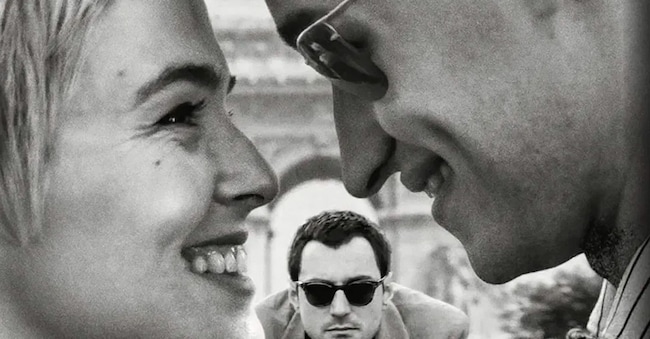
A profound and amusing love letter to the history of cinema: 'Nouvelle Vague', an unmissable film recounting the production of Jean-Luc Godard's 'To the Last Breath', one of the most important manifestos of the advent of modernity on the big screen, has been released in cinemas.

Directed by Richard Linklater, a director going through a splendid career moment after the equally successful 'Hit Man' and 'Blue Moon', 'Nouvelle Vague' opens in Paris in 1959, at a time when Godard realises that all his fellow Cahiers du Cinéma colleagues have moved on from criticism to directing a feature film. After Claude Chabrol, François Truffaut, Eric Rohmer and Jacques Rivette, the time had also come for him to take the plunge.

Loading...

Capable of intriguing the uninitiated and of being a real treat for any self-respecting cinephile, 'Nouvelle Vague' may appear at first glance to be a toy designed for aficionados, but as the minutes pass one perceives a dramaturgical strength of writing that removes any doubts about the value of the operation.

Linklater takes the viewer into that miraculous process, in which everything revolves - for better or worse - around Jean-Luc Godard, an author who is celebrated in an intelligent and unconventional manner.

“Nouvelle Vague” e gli altri film della settimana

Photogallery4 foto

A film about the creative act

If already 'Blue Moon', which focused on the lyricist Lorenz Hart, was a feature film dedicated to an artist, here too Linklater focuses on the creative act, showing the making of 'Till the Last Breath' with an extremely philological rigour on the (re)creation of shots that made Godard's film immortal and with a truly impressive attention to casting.

Undoubtedly, this is first and foremost a tribute to a filmmaker who changed the history of cinema, but what is even more important is how lightly Linklater has managed to narrate such a profound period in the evolution of the Seventh Art.

As engagingly as perhaps with a hint of envy, Linklater recounts the years of the Nouvelle Vague as a veritable factory of creative inspiration, ready to revolutionise the language of filmmaking regardless of the rules that had dominated it until then.

There is also room for several amusing passages in this film, which flows by quickly and smoothly, making even those who were not there nostalgic for a time they never experienced.

It is a practically perfect screenplay (one could perhaps have avoided the final captions on the subsequent fortunes of the 1960 film) that of 'Nouvelle Vague', a film with truly brilliant dialogue and an exciting rhythm from the first to the last frame.

If only I could kick you

Also among the new releases is 'If only I could kick you', a film directed by Mary Bronstein, in which the hand of A24 is very much felt in the production.

At the centre of the plot is Linda, a mother in her forties, perpetually on the verge of a nervous breakdown. Life, in fact, seems to give her no respite: from her daughter's mysterious illness to her husband's painful absence and an increasingly hostile relationship with her therapist, Linda finds herself facing a crescendo of difficulties from which there seems to be no way out.

It opens as a veritable declaration of intent "If only I could kick you", the second feature film by director and actress Mary Bronstein, after "Yeast" in 2008: the camera is very close to the protagonist's face, it follows her changes of expression, her psychological complexity and seems to study her reactions during a not too relaxed conversation.

The whole film is like a psychological study of the character, who is subjected to ups and downs, a bit like the whole film, between moments of reconciliation with herself and constant setbacks that plunge her back into a vortex of endless chaos.

Undoubtedly striking is the performance of Rose Byrne, an actress we have often seen in light roles and who in this case plays a very complicated character, who struggles to react to life's unexpected events: the most obvious of these is a chasm created in her ceiling that seems to turn into a sort of passage to another dimension.

Byrne holds the film on his shoulders, but at times goes too far over the top and makes a figure that could have been written and portrayed in a less studied manner lose credibility.

Between drama and black comedy, with some fantasy veins, "If Only I Could Kick You" constantly changes register - in a manner consistent with the mental situation experienced by the protagonist - but the doses are not always in balance and there is a strong disparity between the central part and the conclusion: Bronstein tries to surprise with twists, but succeeds only in part due to an overall structure that is too calculated and incapable of making us really empathise with the character on stage. A few suggestions remain, but it is little enough to be able to call this film successful: the feeling is that of a wasted opportunity and a decidedly unresolved work.

Copyright reserved ©
Loading...

Brand connect

Loading...

Newsletter

Notizie e approfondimenti sugli avvenimenti politici, economici e finanziari.

Iscriviti