
Floating photovoltaics, potential for 25 GW in Italy
Authorisation procedures for 3 GW started today. Triple-digit growth is estimated. Meanwhile, the Fer2 decree envisages 50 MW of incentives: auctions by the end of the year

3' min read
Key points
3' min read
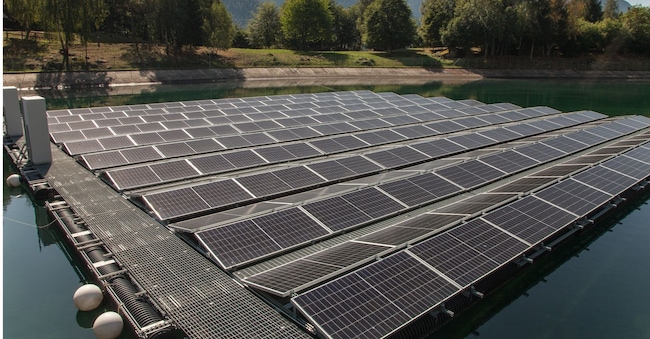
In Italy, floating photovoltaics, solar panels installed on mirrors of water, could have a potential of 25 GW considering only reservoirs. This is an estimate that emerged during the conference 'Floating Photovoltaics: innovation at the service of the energy transition' promoted by the Institute for Competitiveness (I-Com) in collaboration with Elettricità Futura and Green Ideal Holding. There is no reference mapping yet, but from the discussion between institutions, administrations, companies and associations to take stock of potential and prospects, interest is unanimous and everyone agrees on a significant growth of the technology. In Italy, authorisation procedures have already been started for about 3 GW of plants distributed in all regions, using reservoirs on former quarries, irrigated farms, and state-owned farms for water or industrial use, and three-figure growth rates are expected.
The numbers
.Giorgio Boneschi, general director of Elettricità Futura, highlighting the technology's potential in countries like Italy, which have a large water surface and strong solar radiation, recalled the 450 MW surveyed in 2023 in Europe, the second global market after Asia, by Solarpower Europe, of which 280 in the Netherlands.Laketricity Italia (Ciel & Terre) estimates a potential of 4.044 GW in the world and 200 GW in Europe with only 10% of the basins surveyed: for Italy the estimate is 25 GW, considering only artificial basins, while at the moment the installed capacity is around 10-15 MW and development is concentrated in the North, on private basins, former quarries, agricultural basins, while the South, which has much larger but public basins, will be affected by a second wave. Green Ideal Holding, which has 850 MW of projects on state-owned areas for which a concession is required, forecasts a target of 7-8 GW of authorised power by 2030.
Benefits
.Thanks to the positioning of panels on floating structures, floating photovoltaic plants can achieve important benefits: they do not consume soil, they ensure rapid installation and decommissioning, they increase the efficiency of the modules, they can contribute to the economic valorisation of state-owned areas thanks to the contributions generated in favour of the state, and they reduce evaporation in water basins, the latter point being particularly important in times of climate change and dry summers like the last, especially in southern Italy. Enel estimates that floating can increase efficiency by 5-10% more than ground-mounted photovoltaics and a 1 MW plant, such as the company's pilot plant in Venaus (Turin) - recently doubled - can save 10,000 cubic metres in a year.
The regulations
.The regulatory framework recognises this: the Consolidated Renewable Energy Act, in force since this year, includes floating photovoltaic applications among those affected by the now imminent identification of acceleration zones, considered a key step towards achieving the 2030 Pniec renewable energy targets. The technology is also included in the architecture of the FerX and Fer2 decrees. For the latter, the incentive quota is 50 MW: after the first auction dedicated to biogas and biomass, Paolo Arrigoni, president of the Gse, indicates a second one in the summer 'perhaps in July or September', while for the transitional FerX, in force since 28 February, the first competitive procedure is expected between late spring and early summer.
Minister for the Environment and Energy Security Gilberto Pichetto Fratin reiterated the need for all technologies to achieve the 2030 decarbonisation targets. "In the Fer2 for the pure float is foreseen in a quantity that is not huge, 50 MW. But there is a space: I believe we can have a discussion about the numbers and change them if there is demand. And from the regulatory point of view, the government's interest is to be able to give certainty'.


