
Floating photovoltaics, after Catania tests Enel evaluates a development plan
Estimated potential of a few hundred MW. Among the advantages of the technology: it does not consume land, it reduces evaporation in reservoirs, it complements hydropower

3' min read
Key points
3' min read
Floating photovoltaics, after the experimentation begun a few years ago in the Innovation Lab in Catania, Enel has a few dozen MW under evaluation in Italy, at various sites, and estimates a potential of a few hundred MW. The tests in Catania were useful for setting up a 1 MW pilot plant in the hydroelectric power plant in Venaus (Turin) on a catchment tank, which now, given the good results, is preparing to double its capacity.
The Advantages
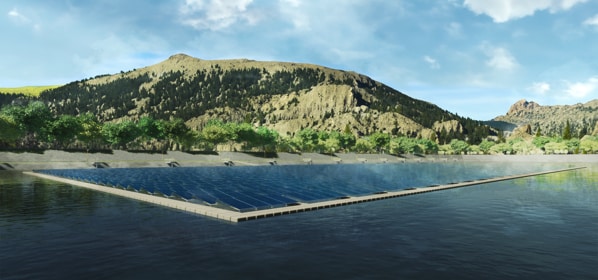
.The technology involves installing photovoltaic panels on water by means of floating structures: ponds, hydroelectric reservoirs, disused quarries or those with a water mirror. There are several advantages: it practically eliminates the occupation of land, allows fast installation and dismantling, improves the cleanliness of the modules and increases their yield, as the cooling of the water leads to an increase in production of even more than 5%. Not to mention the possibility of tracking mechanisms with an energy gain of up to 25%. It can also bring environmental benefits such as the containment of algae blooms or help solve the problem of sediment in reservoirs: Enel, for example, is studying desedimentation systems linked precisely to floating solar power. Lastly, it reduces evaporation: on the basin of Enel's power plant in the Anapo river valley (Syracuse), a 6 MW floating photovoltaic system occupying about 15-20% of the basin's surface area could reduce evaporation by 20-30%, equal to 100,000 cubic metres of water gained in a year. A relevant issue especially in times of drought.
L’ibridizzazione
In general, floating photovoltaics represent a technology hybridisation model that the renewables sector is increasingly evaluating with a view to optimising production. Enel's experimentation is in the integration with hydroelectricity. The group has 13 GW of installed hydroelectric capacity in Italy: the potential can be seen. A classic example: pumped storage power plants, where energy from the sun can be used to bring water up to power the turbine. But that's not all: at the plant, also hydroelectric, in Montelupone (Macerata), Enel has instead installed solar panels above a branch canal. The same project for Narzole (Cuneo). Both are now active.
Although it is still in its infancy and still has relatively high costs - as economies of scale are not possible - floating solar represents a promising technology and the sector is looking forward to a technological evolution in the next few years, mainly related to floating structures, which will lower prices. There is no shortage of supply chain in Italy, and Enel itself has collaborated with Italian companies to study and build pilot plants.
The Fer 2 decree
.In the Fer 2 decree signed by the Minister of the Environment at the beginning of the summer to promote production from innovative renewable sources, 'floating photovoltaics on inland waters' (in addition to 'offshore floating') is included in the incentive scheme for a quota of 50 MW and a reference tariff for plants with a power output greater than 1 MW of 75 euros per MWh (90 for those with less power). The trade association Italia Solare had called for higher numbers given the ferment surrounding projects of this type, with plants in development and authorisation requests in progress. It now hopes that floating photovoltaics on inland waters will be included in the next Fer X decree with a tariff level close to 100 euros per MWh.


