
Renewables, Recurrent invests 1 billion in Italy over the next 3 years
The international operator controlled by Canadian Solar and Blackrock plans to realise 1 GW between solar and storage. It has in our country a pipeline in development of over 5 GW

3' min read
3' min read
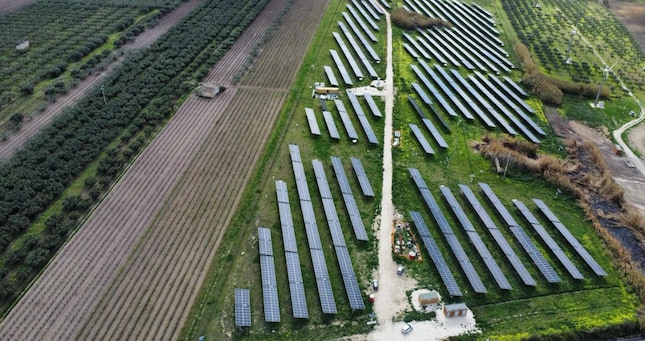
Recurrent Energy is investing EUR 1 billion in Italy and receiving a EUR 50 million loan from the EIB, the European Investment Bank, to develop its solar portfolio in Italy. Says Filippo Ricci, general manager Italy of the international company controlled by Canadian Solar and Blackrock: "In Italy we have photovoltaic projects for about 2.5 GW and storage projects for about 2.7 GW. Of these we expect to connect 1 GW in the next three years: this is a business plan worth one billion. This is where the financing of 50 million from the EIB comes in, which we will dedicate to development and construction activities'.
Italy Key Country
.Globally, Recurrent has realised around 10 GW of solar and over 3 GWh of storage projects. It currently has a 27 GW solar and 55 GWh storage pipeline in development on six continents. Italy is at the centre of the company's plans in Europe: 'Italy is a key country, which we have been focusing on for some time: since 2016 we have had an office in Milan. Today we are a reality of 70 people and in recent years we have invested around 200 million euros in the development and construction of plants,' Ricci continues: 'At the moment in Italy we have plants for 125 MW, 90 of which are already operational and the others are nearing completion. The largest has a capacity of 50 MW and the smallest 3. They are located in Sicily, Sardinia and Lazio. We will soon open a construction site in Piedmont for an 8 MW park: it is our first plant in a northern region. It is an interesting shift of focus and represents the big challenge in the Italian market.
What are Recurrent's reasons for focusing on our country? "Italy is a mature market, with an experienced supply chain, particularly for solar. It is also one of the markets with the highest electricity prices in Europe, so there is room for penetration of photovoltaics, the least expensive technology at the moment, with an attractive risk/return ratio compared to markets with lower prices. In addition to the experience in development, construction and project management, the company has made a strong commitment to operations and maintenance, with a recent acquisition: there is the will to remain long-term,' he replies.
The critical issues of the dm Eligible Areas
.In the short term, there is no shortage of critical issues: 'We come up against the difficulties of the industry,' Ricci confirms: 'Right now, in particular, with the lack of visibility of what the rules of the game are. It is important to have a certain regulatory framework, especially for a company that globally allocates capital to different markets on the basis of risk and return. With the dm Eligible Areas, discretion has passed to the regions. The concern is no longer just not having certain rules, but also understanding the impact on investments made until now, which were regulated by other logics: projects with a positive Via at the national level could be rejected by new regional laws. We hope this is not the case, but it is complex to plan at the moment. We are waiting to understand what the final picture of the sector will be, and then work in the medium to long term'.
Agriculture and plant costs
In general, the manager continues, 'we see a bit of a lack of strategic planning. Photovoltaics is the source that costs the least, the numbers say so: it cuts the cost of the bill. But if a regulation, such as the dl Agricoltura, requires panels to be built 2 metres above the ground, the costs of the plants will increase and consequently those of electricity'.


