
IMF: 'Recession risk for the EU with inflation at 5%'
Preliminary data indicate a weakening of private investment and consumption

Key points
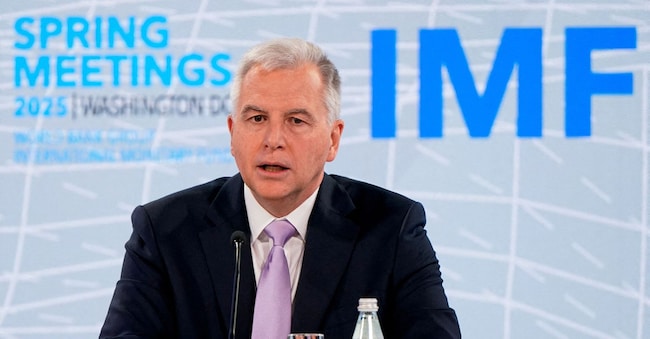
The EU could "come close to recession, with inflation approaching the 5% threshold. No European country is immune". So writes the head of the International Monetary Fund's European Department Alfred Kammer, in an analysis on the Imf Blog. The region 'must respond to energy shocks with disciplined policies that protect the vulnerable and strengthen resilience,' Kammer notes. The energy shock, smaller in magnitude than in 2022 and now rooted in the Middle East conflict, "is weighing on growth and pushing up inflation". The IMF estimates 2026 inflation at 2.8% from 2.5% in 2025.
Before the outbreak of the Middle East war, Kammer notes, 'our forecasts would have been revised upwards: now, however, we are observing a slowdown in growth'. Preliminary data already indicate a weakening of private investment and consumption. Growth prospects for the euro area are estimated at just 1.1 per cent in 2026 and 1.3 per cent for the European Union: these forecasts are 'accompanied by a high degree of uncertainty'. In a more severe scenario, as described in theWorld economic outlook, characterised by a persistent supply shock and exacerbated by tightening financial conditions, inflation at 5% would approach recession. Economic policymakers face intense pressures to "act quickly, visibly and for the benefit of all. This often results in the adoption of policies with long-term disadvantages that outweigh the immediate benefits. Targeted support is, on the contrary, much more effective,' adds Kammer.
Europe's response should be guided by two imperatives: "the adoption of a solid macroeconomic policy, appropriate to a global context characterised by frequent and unpredictable shocks", and "the construction of a resilience that does not entail waste of budgetary resources nor interference with the free functioning of markets". Central banks, as far as monetary policy is concerned, must maintain an 'absolute focus on keeping inflationary expectations anchored'. In the euro area - where inflation is close to the target level and medium-term expectations appear to be broadly anchored - the ECB has some leeway to adopt a wait-and-see attitude, observing the evolution of the shock before intervening. "Currently, we anticipate a cumulative increase of50 basis points in the key policy rate by the end of this year, while maintaining a broadly neutral monetary stance in light of higher short-term inflation expectations."
Looking to the future: 'Under pressure we need reforms'
"Europe must reform under pressure. The current shock is not a reason to postpone: on the contrary, it is an extra reason to push ahead with the reform agenda,' Kammer continues. "Crises create pressure to postpone difficult choices," he says. "Europe has already succumbed to this temptation in the past. Delaying reforms risks resulting in slower growth, higher debt and a lower ability to react when the next shock arrives. In a world where shocks are becoming more frequent and overlapping, from geopolitical tensions to climate events to financial volatility, resilience is in itself a strategic asset. It is built through sound macroeconomic management, disciplined fiscal policy and structural reforms that reduce underlying vulnerabilities, particularly to energy price shocks. Right now, Europe needs to stay the course in the transformation of the energy sector, increasing the share of renewable energies and further integrating the energy system at continental level,' Kammer suggests.
The warning: 'No to fuel excise cuts, they benefit high incomes'
And he warns European countries against supporting manoeuvres against the energy shock due to the conflict in the Middle East. "Some countries, such as Denmark or Sweden, with comparatively low debt levels, have the space to implement counter-cyclical fiscal policies, unlike France and Italia," notes the head of the IMF's European department. The temptation is "to simply block price increases, resorting to price caps, generalised subsidies or cuts to fuel excise duties": these are, however, "imprudent measures". The 'untargeted support disproportionately benefits higher-income households', which consume more energy, the analysis goes on to say. During the 2022 crisis, European governments allocated an average of 2.5 per cent of gross domestic product to energy support packages, more than two-thirds of which were untargeted. An IMF analysis shows that fully compensating the 40% of lower income households for the entire increase in energy costs would have required just 0.9% of GDP. The tax cost is only part of the problem,' Kammer adds.

