

Following on from the Salesians, Danieli is now working with 10 ATS schools specialising in mechatronics
The Udine-based group is expanding the scope of its training programme and its target student intake: up to 500 per year. The Academy’s president, Perabò, said: “In Tunisia, students study shipbuilding. We are also focusing on Tashkent.”

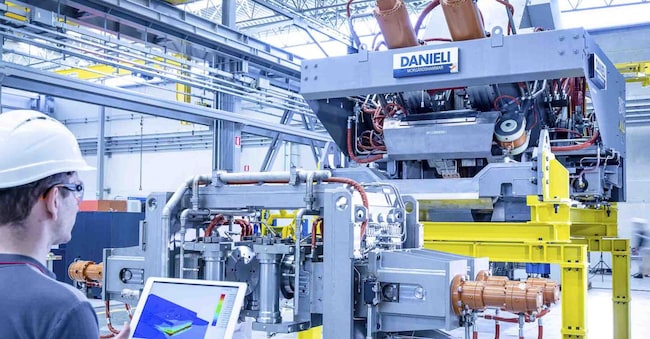
International training as an industrial, strategic and geopolitical lever. Not only to address the growing shortage of technical skills in Italia and across Europe, but also to build a stable model of partnership with countries characterised by strong population growth and millions of young people seeking skilled employment. The Danieli steel group, a leader in the long products sector, is increasingly consolidating its training network by integrating it with the Udine region and its other overseas sites. ‘The model starts in Egypt,’ explains Paola Perabò, president of Danieli Academy and a key figure in the Friuli-based group’s educational projects, ‘but is already looking towards Tunisia, Uzbekistan, Turkey and other countries in the Mediterranean and Central Asia. It is a system that brings together businesses, technical colleges, universities, technical schools and local governments, with the aim of creating training pathways directly linked to industrial needs. The programme in Cairo began in 2021.’ The relationship between Danieli and the North African country, however, dates back further. ‘Danieli has been present in Egypt since before the year 2000. Over all these years, we have collaborated on the construction of large steelworks, ranging from rolling mills for long products to those for flat products. Now, the project is underpinned by the realisation that the skills gap has become a structural issue,” adds Perabò.
Mechatronics
On the one hand, Europe is facing a growing shortage of skilled technicians; on the other, countries such as Egypt have to manage huge numbers of young people. “Egypt has 25 million young people it needs to place,” he comments. “When, in 2021, Engineer Benedetti met the Egyptian president and said to him, ‘Send us some young people to study in Udine’, the reply was, ‘How many do you want? A thousand? Two thousand?’ We started with twenty.” That pilot project has given rise to a model that is now more structured. Danieli and ITS Academy Udine have begun hosting young people from the Italian Salesian schools in Cairo and Alexandria – institutions that award a diploma recognised by the Italian system and where teaching is also conducted in Italian.
“In 2022, we brought the first two Egyptian students to Italia: they were the trailblazers,” says Perabò. “Since then, we have brought around seventy young people to study in Italia.” Employment is a direct consequence of this. “Everyone who wanted to stay in Italia has been successfully placed,” he emphasises. “These are young people who have been studying Italian for five years, are highly motivated both socially and professionally, and see Europe as a real opportunity for growth.”
A further initiative has been developed in collaboration with the Egyptian entrepreneur Ahmed Elsewedy, described by the president of the Danieli Academy as ‘a visionary for his country’. In partnership with the Udine-based group, Elsewedy is establishing ten mechatronics schools modelled on Italian technical colleges. “We are talking about Applied Technological Schools that will train young people for the Egyptian manufacturing sector but also, through specific courses, for European industry,” adds Perabò. “This project alone is expected to involve between 250 and 500 students.”
Mechatronics is a key field as it is directly linked to advanced industrial needs. However, the system is expanding into other sectors. In Tunisia, for example, Danieli and ITS Academy are working on a project focused on the construction sector and the management of complex building sites. At the same time, international university collaboration is also growing. ITS Academy Udine recently secured first place in a ministerial call for proposals on internationalisation thanks to a project developed in collaboration with New Technology Cairo University.

