
Fontanfredda withstands the crisis thanks to organic farming, links with the land and differentiation
Turnover up 6.8% to 70 million, plus 5 million from hospitality. Andrea Farinetti: in our range vibi with high quality at a lower than average price

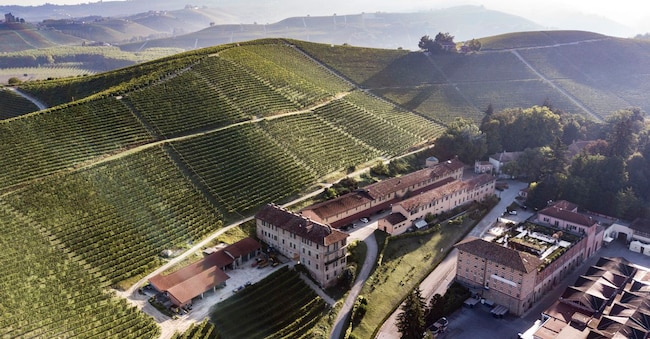
There are many ways to enhance a wine through its link with its terroir. The prerequisite is undoubtedly to respect its peculiarities and the environment that hosts the vineyards. This is a goal that the Farinetti family's management of the historic Fontanafredda estates has been pursuing for some time, but now the identity aspect is becoming increasingly important in a context of declining wine consumption (and reputation).
The Strategy of Tenacity
"The crisis is powerful," says Oscar Farinetti, "with consumption dropping from 250 million hectolitres to 200 million from 2019 to date. The reasons? Firstly, we have all gone a bit overboard because good wine has become too expensive, especially in restaurants. The second is that while 30% of the world's citizens considered wine harmful in 2019, now they have become 60%. We always complain in life but we want to live 120 years. Third reason: Many young people consider wine an old man's stuff'.
How do we get out of this? "We must react with Tenacity". This explains the word - Tenacity - associated this year with the fifth edition of 'Renaissance, Illustrious Words for a New Humanity', linked to the 2022 vintage of Barolo del Comune di Serralunga d'Alba. Oscar Farinetti declines it in a strategy: "To be able to make wines from 20, 30, 40 euro, as good as those from a hundred or a thousand"; to make a move "to go and conquer the markets of 200 countries in the world"; and, above all, "to build a strong identity of Italian beverages", which must reflect "our ability to live well and for a long time all over the world".
Identity and Territory
The way to pursue these goals for Fontanafredda cannot be separated from a very careful approach to sustainability, which passes first of all with the conversion to organic farming: "Many thought it impossible to convert 12o hectares, but here we are proving the contrary," reiterates Andrea, Oscar's son, who is more closely involved with the historic estates. And sustainability also involves many other aspects, ranging from reforestation of the land to the production and use of clean energy. Or from cultural projects such as "Lost to be found", which places Monumental sculptures by Giuseppe Carta between the rows of vines as an appeal to safeguard the biodiversity of the Langhe.
And also from the rediscovery of the peculiarities of the single vineyards: "Back to the single vineyards", the return to the single interpretations of Nebbiolo initiated with the rebirth, in the 2019 vintage, of the historic vineyards Vigna La Villa (Mga Paiagallo) and Vigna La Delizia (Mga Lazzarito) that join the always-produced Vigna La Rosa, and that from this year is expanded with three new "cru" from the 2022 vintage: Vigna Bianca and Vigna San Pietro in Mga Fontanafredda and Proprietà in Gallaretto, "expressions of different terroirs within the same geographical area; each with unique characteristics of soil, climate, altitude and exposure".


