
The Ris in Garlasco to reconstruct the crime scene in 3D by triangulating the traces
Specialists from the Ris in Cagliari use advanced technology to map the murder house in Garlasco in detail.

4' min read
Key points
4' min read
Garlasco, triangulation of all 2007 tracks
Three-dimensional mapping of the cottage, repositioning of the photos of the time and reinterpretation of the dynamics of the crime based on the results obtained and the new technologies. These are the three aspects on which the carabinieri of the Ris of Cagliari have been working and will work over the next two months. Yesterday, from around 9am to 4pm, they made a new inspection in Garlasco to survey the interior and exterior of the cottage where Chiara Poggi was killed in 2007.
Using a drone, lasers and scanners, the Arma specialists mapped every corner of the house to carry out a detailed three-dimensional reconstruction.
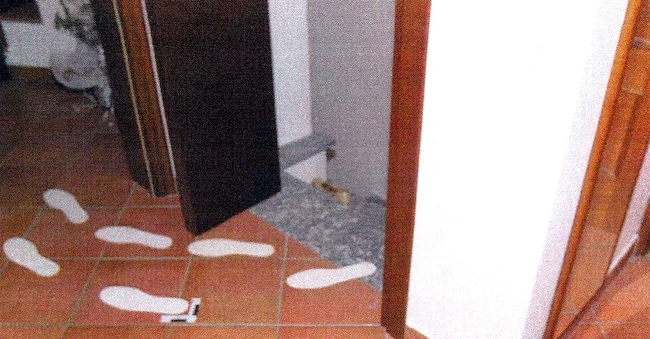
The specialists carried out the 'triangulation', i.e. they used a specific method provided for in the 'Bloodstain pattern analysis' (Bpa), of all the traces found and retrieved in 2007 at the time of Chiara Poggi's murder, in Garlasco, the carabinieri who carried out the inspection in the Poggi's cottage yesterday 9 June for 7 hours, using laser scanners, drones and photographic surveys.
In particular, from what we have heard, the so-called 'triangulation' was carried out on all the traces found at the time on the ground floor of the house, i.e. on the crime scene, which includes various parts of the house, including also the stairs leading to the cellar, where Chiara's body was found at the bottom, and the walls.
All traces, including footprints, had been analysed at the time, but, as far as was known, triangulation, a technique that allows the dynamics of the murder to be reconstructed through the study of blood drops and the resulting stains, had not been carried out.


