Industry

Formec Biffi: 60 years of innovation in a corporate museum. And growth continues in the fresh sauce sector

A 10 per cent increase in sales against a flat market, thanks to innovative recipes and a variety of formats. In addition to Spazio Biffi 3.0, a 10 million investment is on the way for a new production line, following the 10 million spent on a logistics centre and energy efficiency measures

5' min read

Translated by AI
Versione italiana

5' min read

Translated by AI
Versione italiana

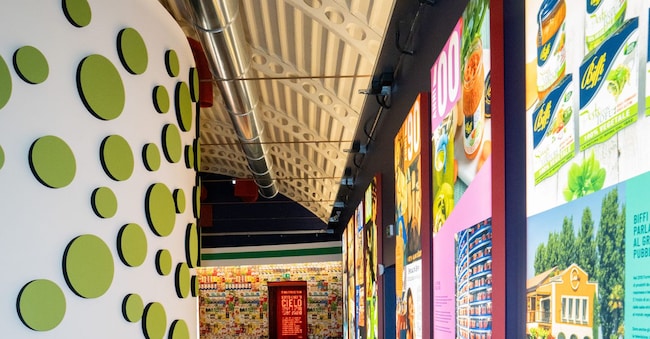
Innovative products offering a high level of service and extreme flexibility, enabling a rapid response to changing tastes and the needs of customers and retail chains. Just like those in its pasta sauces and other sauces, it is the ingredients that enable Formec Biffi to celebrate the company’s 60th anniversary whilst continuing to grow – Formec was founded in 1966, whilst the historic Milanese brand Biffi was acquired in the 1990s – and the 90th birthday of founder Pietro Casella, who remains at the helm, continuing the innovative approach that has always characterised the company’s history. As recalled and recounted by Spazio Biffi 3.0, a corporate museum due to be inaugurated on Friday 11 September at the San Rocco al Porto site (in the province of Lodi, opposite Piacenza, in whose historic centre, 10 years ago, Galleria Biffi was established – a centre dedicated to contemporary art, now a cultural landmark for the city).

A story of innovation

In 2025, Formec Biffi generated a turnover of 154 million, with around 60 per cent coming from Biffi-branded products (sauces and ready-made sauces, of which 60 per cent is accounted for by pesto alone) and 40 per cent from products packaged for major retailers’ brands (private label). A ratio that, as recently as 10 years ago, was almost the reverse, with 70 per cent coming from private label. Formec was one of the pioneers in this market within the sauces segment – where it remains the market leader for mayonnaise with a 27 per cent market share split between private label (-2.3 per cent) and the Biffi brand (+9 per cent) – alongside its contract manufacturing operations.

Loading...

Casella realised before anyone else just how successful supermarket own-brand products would become; today, they account for well over 30 per cent of Italians’ shopping baskets. For example, when Giovanni Rana decided to produce ready-made sauces, he turned to Formec Biffi to test the market, and now Biffi is the second-largest brand in the 200-million fresh food market, with a 12 per cent share, just behind Rana, though it is closing the gap.

A journey that demonstrates how the company has been able to capitalise on changes in consumer trends ever since it introduced mayonnaise in a tube in Italia, at a time when not using glass seemed almost heretical. Today, investment is focused on fresh sauces, where Biffi has increased volumes by 9.5 per cent year-on-year (and by 18 per cent over the last 12 weeks), in a segment that, following the growth of recent years, is now stable.

The future lies in the cold

A trend that enables the company to forecast 10 per cent growth for the second half of 2026. How? Thanks to an increasingly varied range of recipes and different pack sizes: a significant industrial strategy for a company that historically owes its success in part to the ‘formula’ that enabled it to stabilise the recipe for Genoese pesto in long-life jars. The market for long-life sauces and condiments is still worth twice as much as that for fresh products, with a turnover of around 400 million, and Biffi is also growing by between 8 and 10 per cent in this segment.

More generally, there are 437 private-label products manufactured in Italia and abroad, comprising over 310 sauce recipes and around 100 gourmet specialities across 36 production lines, which produce over 410 million units a year. And although the fresh produce segment is the most dynamic, it still accounts for only 18 per cent of Formec Biffi’s total business, compared with 82 per cent for the ‘ambient’ segment.

Pietro Casella, fondatore e presidente di Formec Biffi, in una foto d’archivio

“We remain very closely linked to the large-scale retail sector; we have excellent working relationships with virtually all the major chains (Formec Biffi does not, however, work with discount stores, whose requirements are more focused on quantity than on ‘bespoke’ solutions, ed.) – says Stefano Bartoletti, commercial director of Formec Biffi –. Large-scale retail remains an important channel for us, but I believe that following years of strong growth in this segment in the post-Covid period and after the outbreak of the war in Ukraine, a period of consolidation is to be expected. So at the moment, for mayonnaise and sauces – which are a mature market – growth has levelled off, whilst we are focusing our efforts on fresh products, with results that clearly outperform the market. For example, we were the first to launch ‘cacio e pepe’, and then everyone else followed suit; or, to give just a few examples, last year we launched a saffron-based sauce and now we have a tuna sauce. As for packaging, we also offer the 90-gram size. This is not only to cater for the single-person market, small households or the ageing population, but also to allow members of the same family to use different condiments.” There is also the issue of reducing food waste, which is sometimes linked to packaging that is too large.

Investment and growth abroad

“We are about to approve a 10 million investment in a new production line , again dedicated to fresh sauces,” Bartoletti tells *Il Sole 24 Ore* – a decision that comes after we have, with a similar allocation, nearly completed a new logistics facility and energy efficiency measures: thanks in part to a gas-fired cogeneration plant, we will be able to independently cover 100 per cent of our energy requirements”.

These investments will also be useful for expanding abroad, which currently accounts for around 10 per cent of our business. “For prescription-only products like ours, it’s not exactly easy to expand beyond European borders, but we operate in 51 countries and are making good progress in the US, South Korea and Japan. I can reveal that we have finalised an agreement with a major partner in China, where we therefore hope to expand,” concludes the sales director.

The corporate museum

Meanwhile, Spazio Biffi 3.0 is opening – the new exhibition and multimedia centre where a video tour traces the key milestones in the company’s history, whilst a 360-degree immersive projection takes visitors on a virtual tour of the production facility, recreating the sounds of the factory. An educational space, with seating in front of a large panoramic screen, hosts screenings for groups and schools. Among the first exhibits on display is a mosaic depicting the production plant. ‘The ambition,’ explains a company statement, ‘is to make it a fully-fledged multimedia cultural centre: a venue for seminars, a space open to artists, and a hub for the visual arts, alongside – and not as a replacement for – the Biffi Arte Gallery’.

Copyright reserved ©
Loading...
Loading...

Brand connect

Loading...

Newsletter

Notizie e approfondimenti sugli avvenimenti politici, economici e finanziari.

Iscriviti