
Former Ilva site: strike in Taranto. Protesters also on the main road
Today’s work stoppage is for eight hours. The situation has become complicated following the ruling by the Milan Court of Appeal, which ordered the closure of the hot zone within 90 days on the grounds that it causes pollution

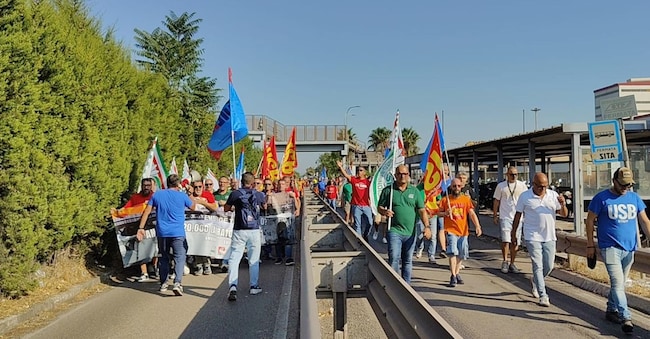
Former Ilva workers are holding an eight-hour strike today in Taranto, alongside a protest on the SS7 road – the one running alongside the steelworks – where workers and trade union representatives staged a sit-in for around an hour. The strike has been called by the trade unions Fim Cisl, Fiom Cgil, Uilm and Usb. Although it has been ongoing for 14 years – that is, since 2012 when the hot area was seized by the Taranto judiciary – the former Ilva issue has now become much more complicated following the decree issued last Monday by the Milan Court of Appeal, which ruled that the entire complex comprising ore yards, coking plants, blast furnaces, steelworks and continuous casting lines must be shut down within 90 days due to pollution caused by fine particulate matter and asbestos. And the 90-day period is already underway. This represents an abrupt halt to a plant that was already operating at reduced capacity – with only one blast furnace out of three and one steelworks out of two – but which will now no longer be able to produce steel and therefore cannot supply the downstream facilities (cold-rolling mills) in Taranto, Genoa, Novi Ligure and Racconigi.
A series of round-table discussions at Mimit starts tomorrow
Meanwhile, starting tomorrow at the Mimit – and scheduled to run until 6 August – a series of round-table discussions will be held, convened by the Minister for Enterprise, Adolfo Urso, to explore how to draw up an extraordinary plan that also includes support measures for workers who are currently at risk. There are just under 10,000 direct employees of the Acciaierie d’Italia group, which is currently under special administration, not to mention subcontractors and businesses in related sectors throughout Italia. The Mimit round-table discussions will involve not only the trade unions, but also the local authorities of Taranto and Puglia, Confindustria (both the national and Taranto branches), Federmeccanica, Federacciai, the commissioners of Ilva and AdI, Cassa Depositi e Prestiti and the various local business associations.
Business associations: a government decree is needed
At a meeting, the latter called on the Government to issue “a decree to avert a socio-economic disaster”. They add: we need to “try to identify a viable solution to save an industrial asset which, by leveraging new technologies that do not impact the environment, can still contribute greatly to the whole country. The closure of the hot zone, without a remediation plan or a defined industrial project, raises enormous questions – the associations point out –: what kind of developments are envisaged? For what purpose? Over what timeframe and with what level of investment? First a project must be defined, then a plant can be closed. There are always potential investors in the background, but there is still a lack of clarity, and this does not help. What is needed is a credible, sustainable and feasible industrial plan with clear timelines, defined investments and identifiable responsibilities.”
Trade unions: extraordinary national plan
“Making the former Ilva site environmentally sustainable through a production cycle that balances environmental and health considerations, whilst safeguarding jobs and with the State acting as guarantor of the transition” has always been the trade unions’ demand in all meetings – according to the national branches of Fim, Fiom and Uilm – and now “the decree of the Milan Court of Appeal, which provides for the closure of the hot area within 90 days of notification, highlights how these last two years have passed without addressing the key issues raised by the trade unions and workers through protests, strikes, negotiations and complaints”. The unions have declared a “permanent national mobilisation” and are calling for “an extraordinary national plan to revitalise and secure the former Ilva site”.
For the metalworking organisations, “maintaining production continuity does not in any way mean sidelining environmental issues and workers’ health. The Government must reaffirm its commitment to a comprehensive industrial project for the Taranto area and all other territories involved, which views the steel industry as a central and strategic element, to be accompanied by a social project and plan (compensation schemes for recognised exposure to risks, early retirement, voluntary redundancy schemes, etc.) capable of providing solutions for all employees of the former Ilva”.

