The point

Fourth heatwave: on Sunday, almost the whole country will be under a red alert

The wildfire crisis in Europe is worsening. According to ISPRA, there have been over a thousand major forest fires in Italia over the last seven months: Sicily is the region worst affected

4' min read

Translated by AI
Versione italiana

4' min read

Translated by AI
Versione italiana

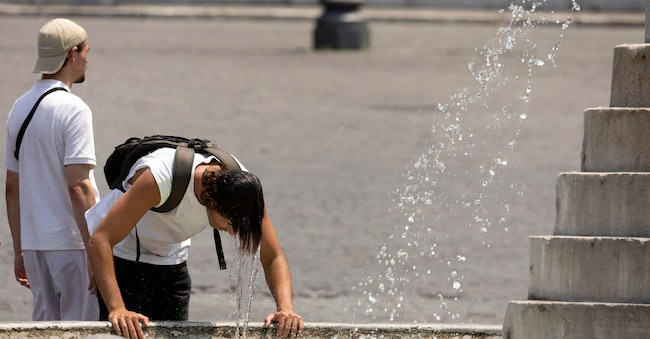
Temperatures have soared to over 40 degrees in Florence, Modena and Terni, with ‘super-tropical’ nights where the minimum temperature does not drop below 25 degrees. The fourth heatwave of the year – which began this week following those that hit the country in late May, the second half of June and mid-July – shows no sign of letting up in Italia, but the situation is set to worsen further. Over the weekend, according to forecasts by Lorenzo Tedici of iLMeteo.it, ‘temperatures of 41 degrees are expected in Terni and 40 degrees in Ferrara, Mantua, Modena and Parma, with these levels set to persist at least until Monday’.

Highest alert

The Ministry of Health’s daily bulletin on heatwaves shows an exponential rise in the number of cities on ‘red alert’ – the highest alert level – which indicates emergency conditions with potential adverse effects even on the health of healthy, active people, and not just the most vulnerable groups. Yesterday there were 11; today there are 19; and tomorrow that figure will rise to 23. Of the 27 urban centres being monitored, therefore, on Sunday 2 August, only Ancona, Bari, Messina (which will be on ‘orange’) and Reggio Calabria (on ‘yellow’) will not be on ‘red’.

Loading...

According to the opposition, the government is not doing enough to mitigate the effects of climate change. In a video posted on her social media pages, PD leader Elly Schlein emphasised that ‘cities cannot be left to the inaction and inertia of a government that is underestimating just how real and, unfortunately, tangible the impact of the climate emergency is’.

According to Schlein, the heatwave currently affecting Italia “is not normal. And no, we must not get used to it, as those on the right are saying. We must prepare ourselves. There have already been 12,000 deaths in Europe due to this latest heatwave and, sadly, the climate emergency continues to claim lives in our country too. Think, above all, of the elderly who are afraid to leave their homes in this heat: this, too, is urban safety.”

Forest fires

The wildfire crisis is also intensifying. According to data released by ISPRA, the Higher Institute for Environmental Protection and Research, during the second ten-day period of July, the areas of Europe affected by wildfires increased significantly: the figure is around 225 square kilometres a day, as if an area roughly twice the size of Paris were burning every day.

The southern part of the continent has been most affected by this phenomenon. France, Spain and Italia are the countries hardest hit. In less than seven months – from early January 2026 to 28 July – just over 1,070 major forest fires were recorded in Italia, and the total area affected by the fires amounted to approximately 741 square kilometres, an area similar to that of the entire province of Lodi.

Almost 14 per cent of the total area burnt was covered by forest ecosystems, including 37 square kilometres of evergreen broadleaf woodland (oak forests and Mediterranean scrub) and 24 square kilometres of coniferous woodland (pine and fir forests). However, in addition to forested areas, the fires also affected 119 square kilometres of agricultural land (16 per cent of the total area burnt) and 451 square kilometres of permanent grassland (61 per cent of the total).

The south of the country and the islands are the areas most affected by the wildfires. Sicily, Calabria and Puglia are the regions most affected by the phenomenon, accounting for 73 per cent of the area burnt in Italia, with 510, 78 and 48 square kilometres respectively. The most significant incidents to date have taken place in Sicily, and in particular in the province of Agrigento.

“To combat forest fires, which pose one of the main threats to our natural heritage, it is essential to continue investing in research and monitoring,” explains Maria Alessandra Gallone, President of ISPRA and SNPA.

“Prevention,” concludes Gallone, “remains the most effective weapon: it means adopting responsible behaviour, raising awareness amongst citizens and local communities, and promoting ever closer cooperation between all those involved.”

Loading...

Wildfires across the rest of the continent

As for the rest of Europe, the largest wildfire – which is still burning today – occurred in Spain, in the province of Ávila, north-west of Madrid. Here, the flames have already engulfed over 440 square kilometres of land, an area larger than that of Barcelona and Valencia combined. The province of Guadalajara, north-east of the capital, has also been hit by a vast wildfire which, as ISPRa notes, has already spread across some 330 square kilometres, equivalent to roughly half the area of the municipality of Madrid.

The other country affected by major wildfires is France. A large wildfire is currently raging in the Gironde department, having burnt over 400 square kilometres of land – an area larger than cities such as Marseille or Lyon – and is now threatening the areas around Bordeaux.

Copyright reserved ©
Loading...

Brand connect

Loading...

Newsletter

Notizie e approfondimenti sugli avvenimenti politici, economici e finanziari.

Iscriviti