
France, government falls: Bayro challenged by 364 votes. Today the resignation
The outcome of the confidence vote: 194 votes in favour, 364 against. Bayrou will appear this morning at the Elysée Palace to present his resignation to the head of state, Emmanuel Macron.

4' min read
4' min read
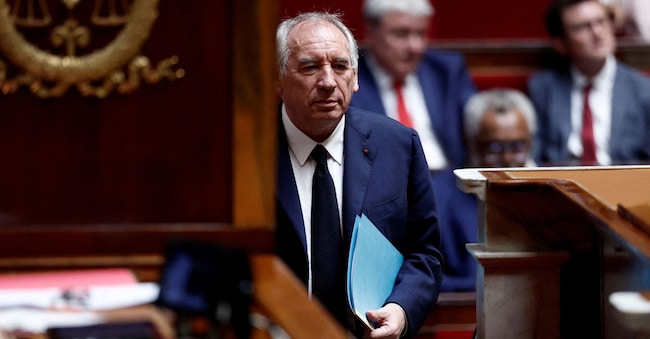
The National Assembly voted no confidence in Francois Bayrou, decreeing the fall of his government. 364 deputies voted against the prime minister while 194 voted in favour. Bayrou will appear this morning (Tuesday 9 September) at the Elysée Palace to submit his resignation to the head of state, Emmanuel Macron, who will begin consultations to form a new government. Macron has already declared on several occasions that he has no intention of calling new elections.
The difference between yes and no votes to the Bayrou government was much wider than expected. The votes of the majority coalition had been calculated on the eve of the vote at 220, while only 194 of those expected were deposited in the ballot box. On the other hand, the oppositions of the entire gauche and the extreme right filled up, and more.
"I will not respond to polemics and offensive statements. I want to tell the members of the government that these nine months have been one of profound happiness because we managed to form a team in which there were many heavyweights, solidarity and no tension." This was stated by French Prime Minister Francois Bayrou in his reply at the end of the debate in the Parliamentary Assembly, just before the vote.
The debate
"This test of truth, with the consent of the president of the republic, I wanted it," Bayrou stressed as he opened his speech before the National Assembly gathered in extraordinary session to vote on the confidence on the budget law. "The biggest risk was not to take any, to play politics as always", he added, citing 'the historical issue' of state debt. Debt reduction is a 'matter of vital urgency' for France, the French premier warned. Before the deputies, the premier evoked the colossal debt weighing on the eurozone's second-largest economy as well as the 'vital urgency' of restoring the country's public finances.
'Submission to debt is like submission to military force: submitted by arms or by creditors, in both cases we lose our freedom,' Bayrou continued in his speech to the Assemblée nationale. The premier, in his heartfelt appeal to national representation, then called for an 'awareness' against the 'inexorable tide of debt that engulfs' France. He then proposed a plan to bring the deficit down to 3% of GDP by 2029.
"Ladies and gentlemen deputies, you have the power to overthrow the government, but you do not have the power to erase reality", he went on to explain in another passage of his speech in the chamber: "Expenditure will continue to increase even more and the burden of debt, already unbearable, will become ever heavier and more expensive. Referring as much to General de Gaulle as to Pierre Mende's France, Prime Minister in 1954-1955, Bayrou stressed that 'a country that cannot balance its public finances is a country that has given up governing itself'. 'I refuse to believe that the balancing of public finances can only be achieved through the chronic increase of debt'.

