Education

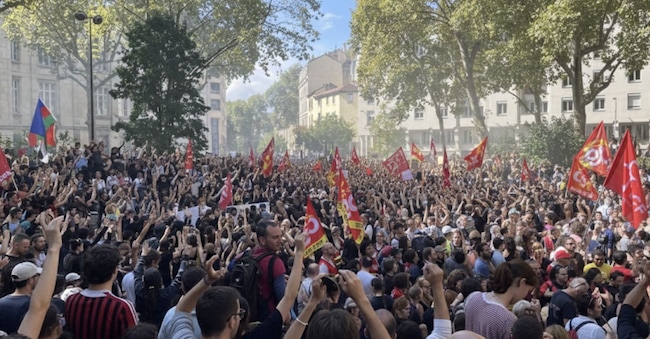
France: High school pupils speak out in protest against a school system that fuels inequality

From overcrowded classrooms and a shortage of teachers to protests against Parcoursup: students are calling for more resources and equal opportunities. The mobilisation also centres on the gap between state and private schools and suspicions of political manipulation

by Silvia Martelli (Il Sole 24 Ore) and Francesca Barca (Voxeurop, France)

Aggiungi Il Sole 24 Ore
ai preferiti su Google
6' min read

Translated by AI
Versione italiana

6' min read

Translated by AI
Versione italiana

‘We don’t have the same opportunities from the outset.’ This is the starting point for the protests by French sixth-formers, who have taken to the streets to denounce the state of their schools and the inequalities which, according to the students, are shaping their future even before they enter university. Their demands centre on the shortage of teachers, dilapidated school buildings, overcrowded classrooms and the functioning of Parcoursup, the platform through which students apply for places in higher education.

Behind the mobilisation lies, above all, the criticism of a system that struggles to guarantee equal opportunities for all. This is an issue that cuts across both the most disadvantaged suburbs and the debate on access to university education and the state’s responsibilities regarding the funding of education.

Loading...

This is also echoed by students attending private schools who have chosen to support the protests of their peers in state schools. “We are well aware that we are privileged because we come from private schools,” explain Lya and Blanche, both aged 16, during a demonstration outside their Parisian sixth-form college. The two girls criticise the distribution of public resources which, in their view, fails to ensure comparable learning conditions. “We’d like our peers in state schools to have the same opportunities as us.”

The disparity is particularly evident in the suburbs, where some schools have to contend with poor infrastructure and the difficulty of replacing absent teachers. ‘There are pupils who can’t study because the teachers aren’t there or because the ceiling is leaking,’ say the two sixth-formers. This situation makes it even harder to sit exams and compete for university places.

The influence of social background

The issue of inequality is one of the central themes of the protest movement. According to a 2023 report by France Stratégie, 94 per cent of the children of middle managers and executives go on to obtain the baccalauréat, the diploma marking the end of French secondary education, compared with 62 per cent of the children of unskilled manual workers. Among the latter, only 34 per cent obtain their qualifications in general and technological streams.

The family background therefore continues to have a significant impact on educational pathways. The problem, the students argue, is not limited to academic results, but also concerns the material conditions in which they study and their opportunities to access the most sought-after courses.

Sylvie Shenouda, aged 17, is in her final year at a state secondary school in Paris’s 19th arrondissement. She had previously studied in Seine-Saint-Denis, one of France’s poorest departments, where in 2023 the poverty rate stood at 39 per cent, compared with 17 per cent in the centre of the capital, according to data cited in the reference material.

Her experience has given her an insight into a wide variety of school environments. At the secondary school she attends now, there are 35 pupils per class, computers that are out of order and projectors that do not always work. But, she says, the situation in schools on the outskirts can be even more difficult.

“The system literally ranks us according to social class,” she says, referring to Parcoursup. According to the student, the platform ends up penalising those from certain schools or regions, making it harder to gain entry to the Grandes Écoles, France’s most selective higher education institutions. For this reason, one of the demands of the protest movement is the abolition of the system.

The criticism is not limited to the selection criteria. Students are calling for more funding for infrastructure and staff, highlighting a vicious circle in which class closures and cuts to teaching posts increase pupil numbers per teacher and make it more difficult to manage lessons.

Loading...

Absent teachers and inadequate schools

The difficulties are not limited to students. Teachers, too, report increasingly demanding working conditions, salaries that are struggling to keep pace with inflation, and growing difficulties in recruiting staff.

Bettina, a 50-year-old Spanish teacher at a private state-subsidised secondary school, supports the protests and acknowledges the differences between her school and many state schools. ‘I am aware that I work in rather favourable conditions compared to my colleagues in the state sector,’ she says. At her school, she explains, the buildings are in good condition and, when a teacher is absent, they are quickly replaced. ‘My pupils do not have to put up with all the shortcomings and problems reported by pupils at state schools.’

That is precisely why, he adds, his pupils have decided to block access to the school in solidarity with their peers who do not enjoy the same conditions. But the difficulties are also beginning to be felt in the private sector, with class closures and a gradual increase in pupil numbers.

When it comes to pay, Bettina does not mince her words: ‘Teachers’ salaries are almost scandalous when you consider inflation. They haven’t risen for some time, and today a teacher earns just a little more than the minimum wage, struggling to make ends meet.’

The problem, he emphasises, is not just about purchasing power. “It’s a profession that is no longer attractive.” Low pay, combined with difficult working conditions, contributes to staff shortages and makes it more difficult to replace absent teachers. “It often happens that teachers have to take sick leave and are not replaced because there are no supply teachers available.”

Added to this is the condition of school buildings: French sixth-form colleges are on average 61 years old, a figure that rises to 71 years for vocational colleges. Only 15 per cent of school buildings are reported to have been built or refurbished since 2015, whilst more than a third of schools are said to have reached or exceeded their maximum capacity.

Climate change is also among the demands. Schools, Bettina notes, are not adequately equipped to cope with heatwaves. ‘Last year we found ourselves with classes of 35 pupils, windows that barely opened or wouldn’t open at all, and temperatures of 40 degrees in the classrooms.’ Conditions which, she concludes, ‘are starting to become a real cause for concern’.

The protest and allegations of political exploitation

Alongside the demands relating to education, the protests have come up against another issue: allegations that the students are being manipulated by the far left.

The sixth-formers reject this interpretation and insist on the movement’s autonomy. “Our protests are neither influenced nor directed by any political party. We’re demonstrating for our rights,” says Sylvie. The student also takes issue with the way the protests are portrayed: “The government and the media simply see us as people who want to cause chaos. In reality, this is the result of discontent that has been building up for more than ten years.”

According to Sylvie, focusing on the violence risks overshadowing the reasons behind the protest and the widespread feeling amongst students that they are not being listened to. ‘What we are seeing today is the result of the fact that they are not listening to us,’ she argues. The student does not deny that incidents of violence may occur, but urges people not to reduce the entire protest movement to these incidents.

The same stance is evident amongst private school pupils who have joined the blockades. “We’re not here to destroy everything, but to demand our rights,” explain Lya and Blanche, urging people to consider both the incidents of violence and the protesters’ reasons, without reducing the movement to a simple clash between students and the police.

According to the testimonies gathered, the protest movement also has a generational dimension. Sylvie challenges the image of young people as individualists with no interest in politics. On the contrary, she argues that the protests have prompted many of her peers to take a greater interest in public life and that the solidarity between secondary schools in different areas demonstrates the students’ ability to organise themselves around common goals.

The message to the authorities is clear: school cannot be seen merely as an individual journey to be undertaken with a view to obtaining a qualification. For French pupils, guaranteeing the right to education also means ensuring that the place where they are born, the family they come from and the school they attend do not predetermine their chances of success.

It is in this regard that the protest seeks to shift the debate: from the maintenance of public order to the state’s ability to guarantee suitable learning conditions and fairer opportunities. The sixth-formers emphasise that this demand concerns not only their present, but also the country’s future.

*This article is part of the European collaborative journalism project “Pulse”

Copyright reserved ©

Brand connect

Loading...

Newsletter

Notizie e approfondimenti sugli avvenimenti politici, economici e finanziari.

Iscriviti