

France arrives in Tripoli and wants a stronger Libyan navy
Paris is deploying the minesweeper Pluton, the commander of the southern zone and the new ambassador, and has reached an agreement with the Chief of Staff of the current government. This strategy does not appear to be in line with the EU model, nor does it seem aimed at tackling immigration

Key points
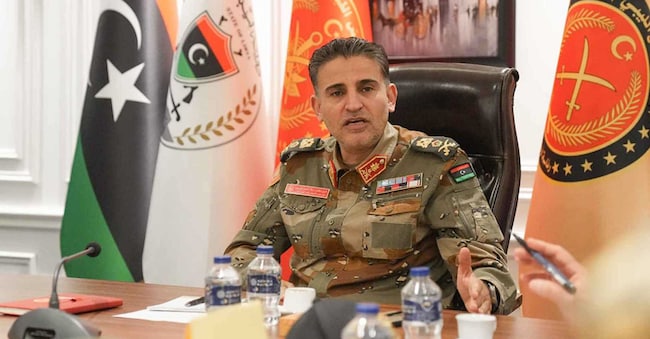
The French warship Pluton called at Tripoli; at the same time, Vice-Admiral Christophe Lucas, commander of the French Mediterranean maritime zone, made his first official visit to Libya. The following day, 11 June, the Chief of Staff of the Libyan Army, Lieutenant General Salah al-Din al-Namroush, and the French Ambassador, Thierry Vallat, met at the naval base in Tripoli. The former has been serving in an interim capacity since his predecessor, Mohammed al-Haddad, died in a plane crash in Turkey. Al-Namroush has also served as Minister of Defence and has first-hand knowledge of naval matters, as well as ensuring continuity with the establishment. The French ambassador was appointed in August 2025, and his CV highlights his knowledge of Arabic. This was no coincidence on the part of Paris, which is seeking, in some way, to move beyond the events it itself helped to bring about in 2011.
The Ambassador
Since taking up his post, Vallat has been engaged in intensive diplomatic activity. In late October 2025, he met General Mohammed al-Haddad in Tripoli and, during a visit to Benghazi, met Khalifa Haftar to discuss Libyan-French relations, with a focus on economic cooperation. The visit to Haftar was particularly significant: it indicates that France is seeking to maintain open channels of communication with both the main factions in the Libyan conflict. The Chief of Staff and the ambassador met on board the minesweeper. According to the Libyan news agency Lana, the two sides discussed ‘ways to develop the capabilities of the Libyan naval forces’, with cooperation centred on ‘exchanges of military visits, training, qualification and the sharing of expertise, and, more broadly, maritime stability in the Mediterranean’. Al-Namroush is also reported to have reviewed the progress of work at the naval base in Tripoli, enquiring about the specialised activities of the Underwater Research Centre for naval operations.
Cooperation
Tripoli’s infrastructure is capable of carrying out repairs on vessels with a gross tonnage of up to 6,000 tonnes and features a floating dock with a lifting capacity of 3,200 tonnes; floating docks are also available in Benghazi and Tobruk. However, following the destruction of most of the Gaddafi-era fleet during the 2011 civil war, the Navy had to start almost from scratch, acquiring new fast patrol boats and MRTP-20 attack patrol boats from May 2012 onwards. The force once numbered around 15,000. Today, the figure stands at just a few thousand, including Coast Guard personnel, despite the country having 1,770 kilometres of coastline exposed to irregular migration, smuggling and human trafficking. Since 2011, France has maintained an ambivalent relationship with Libya: diplomatic support for the UN political process, but also accusations of having favoured rival factions. The meeting in the port of Tripoli represents a concrete step towards attempting to combine diplomacy with operational military cooperation. From a strategic perspective, this move is certainly not to be underestimated.
The effects
The case of Franco-Libyan naval cooperation bears a significant resemblance to the Italian approach. Italy has historically played the most prominent role in the formation of the Libyan Coastguard, but a series of targeted, politically motivated controversies, coupled with shifts in Germany’s position, have slowed down progress on security matters. It should also be borne in mind that Brussels’ position is multilateral and based primarily on the control of migration flows. France, with the deployment of the Pluton and Lucas’s visit, is pursuing a broader objective of influence in the southern Mediterranean, which includes but in a sense transcends the migration issue. As is often the case, Paris is acting independently. The question is: will the strengthening of the Navy come at the expense of the other branches of the armed forces? It is difficult to say. It is interesting to note that, a few days later, a response on the issue of immigration emerged. Italia, Qatar and Turkey have signed an agreement to launch a joint operations centre in Tripoli.

