France

Deranque murder, what happened and what we know

Witnesses and the French government accuse an extreme left-wing group and in particular the assistant of a deputy of France Insoumise, the party of Jean-Luc Mélenchon, of the death of the young right-winger

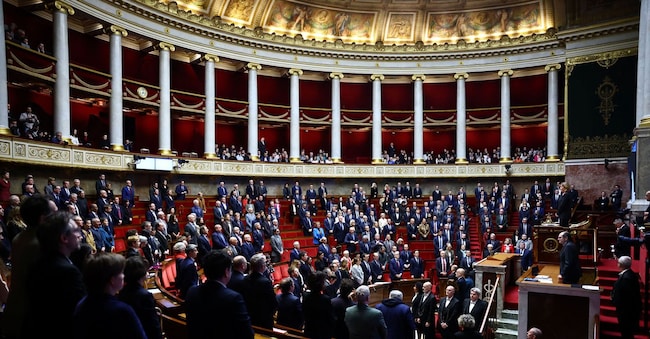
I membri del parlamento e del governo francese osservano un minuto di silenzio in omaggio a Quentin Deranque, un giovane attivista di estrema destra morto a causa delle ferite riportate in seguito a una violenta aggressione a Lione, prima della sessione di domande al governo presso l'Assemblea Nazionale a Parigi, Francia, 17 febbraio 2026. REUTERS/Sarah Meyssonnier

4' min read

Translated by AI
Versione italiana

4' min read

Translated by AI
Versione italiana

France is shaken by a politically motivated murder. In Lyon, on 14 February, Quentin Deranque, a far-right militant, died at the age of 23 after being beaten up two days earlier by members of the far-left movement 'La Jeune Garde'. A political storm broke out in France, with the government openly accusing the attackers, close to La France Insoumise (LFI). Very harsh was the reaction of Jean-Luc Mélenchon, who rejected any responsibility of his party, counter-attacking and calling the accusers a 'gang of slanderers'.

Quentin was thrown to the ground and beaten up by 'at least six individuals' masked and wearing balaclavas, on the sidelines of a conference at Sciences Po Lyon by LFI MEP Rima Hassan, reconstructed the Lyon prosecutor. When he was handed over to the rescuers, the boy 'presented mainly head injuries', including 'a serious head injury'. The investigators relied for their reconstruction on the testimony of more than fifteen people, but at the moment 'there have been no arrests', said the Lyon prosecutor, Thierry Dran, who is leading an investigation for 'murder' and 'aggravated violence', as well as for 'criminal association'.

Loading...

After initial investigations, the public prosecutor's office in Lyon announced the widening of the investigation and proceeded with the crime of 'voluntary manslaughter'. The investigation had previously been opened for aggravated fatal beatings, but was requalified after the autopsy and analysis of the elements collected. Prosecutor Dran pointed out that the police have already heard more than fifteen witnesses and are examining footage of the attack, but 'at the moment there have been no interrogations', also refuting earlier reports of possible stab wounds: 'No, absolutely not'.

Tension between left and right collectives

The prosecutor said nothing about the group of attackers, which the government has instead openly referred to as 'La Jeune Garde', a group of the antifa galaxy, founded in Lyon in 2018 and disbanded on authority last June. The far-left 'collective' under indictment was created by Raphaël Arnault, now a deputy of La France Insoumise, who expressed on X "horror and disgust" after the death of the far-right youth. On 16 February, 'La Jeune Garde' contested - in a statement - any responsibility in the 'tragic events' in Lyon, having 'suspended all activity' after disbanding.

But according to some witnesses, Jacques-Elie Favrot, Raphael Arnault's parliamentary assistant, took part in the Lyon clashes in which Deranque, who later died in hospital, was attacked. According to French media, two people close to the nationalist collective 'Némésis" claimed to have been attacked by members of the extreme left-wing group 'Jeune Garde Antifasciste', including Favrot. It is not clear whether the parliamentary assistant was part of the group of hooded assailants - at least six according to prosecutors - who attacked the young man.

Sources close to the investigation quoted by Agence France Presse later reported that the police had identified a group of suspects, some of them linked to radical ultra-left movements, who might be involved in the death of the young nationalist militant. The suspects belonging to ''ultra-left movements'' are not listed under the letter S of persons at risk, the source specified.

New Youth of the Far Right

As for the young victim, he was part of a 'revolutionary nationalist' movement in Lyons and he, along with others, had been used by the extreme right-wing feminist group 'Némésis', which was near the university to demonstrate against the presence and lecture of Rima Hassan, a naturalised French Palestinian politician, jurist and activist, elected as a member of the European Parliament in 2024. It was the members and adherents of the far-right group who identified the attackers as anti-fascist militants, some of them from Jeune Garde. It was Alice Cordier, president of Némésis, who identified Favrot, Arnault's parliamentary assistant, as one of the attackers.

Deranque's relatives describe him as a pious, modest and hard-working student, dedicated to helping the poor and far from any radicalisation. He was the representative of the new extreme right-wing youth and of a fundamentalist Catholicism attracted by 'self-defence'. A student of Data Science at the University of Lyon II, Quentin Deranque was a regular at the traditionalist church of Saint-Georges, in the Vieux Lyon district, where mass is celebrated in Latin. According to friends, he had converted 'a few years ago'. The family lawyer said that the young man practised 'tennis and philosophy', 'always defended his convictions in a non-violent manner', 'advocated peaceful activism' and 'had never been implicated in any case in the past'.

The impact on French politics

The deadly attack has deeply shaken French politics. The president of the Assemblée nationale, Yaël Braun-Pivet, suspended Favrot's 'right of access' to the parliamentary chamber. The latter 'formally denied' being involved in the attack and said he was 'threatened with death by the extreme right'. For government spokeswoman Maud Brégeon, LFI bears 'moral responsibility' in the 'climate of violence' in the political debate. Mélenchon's party, according to her, 'has been encouraging a climate of violence for years now. France Insoumise has confirmed if unacknowledged links with extremely violent ultra-left groups'.

In a post on social X, the president of the Rassemblement National (Rn) Jordan Bardella intervened on the matter: "The prosecutor's conclusions are unequivocal: by evoking the violence of the blows to the victim's head and prosecuting the attackers for voluntary murder, he proves that Quentin's death was not an 'accident', but a deliberate act. The extreme left has killed'.

The French government sent a circular to university rectors and prefects, calling on them to be 'more vigilant' in the face of the 'resurgence, in and around higher education institutions, of very serious public order disturbances during events organised by student associations'.

Copyright reserved ©
Loading...

Brand connect

Loading...

Newsletter

Notizie e approfondimenti sugli avvenimenti politici, economici e finanziari.

Iscriviti