The Executive

France, the new government: Retailleau confirmed at Interior, Lombard at Economy

The premier announced in a letter to the ministers of the outgoing government that he had 'tried to find new balances'.

by Riccardo Sorrentino

Aggiornato il 23 dicembre 2024 alle 22:30

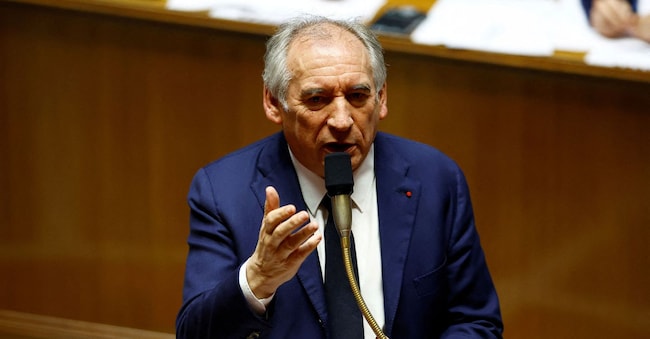
Il primo ministro francese Francois Bayrou all’Assemblea nazionale. REUTERS/Sarah Meyssonnier/File Photo

6' min read

6' min read

A government with personalities of weight. This was the objective of François Bayrou, who yesterday presented an executive in which some well-known names certainly stand out, but for reasons that often make them divisive. The prime minister explained in a letter to the ministers of the outgoing government that he had 'tried to find new balances', and that he wanted a government 'more compact' than the previous one. "This government will not be able to reproduce the previous one. I have tried to find a new balance,' he wrote. It is 'a collective of experience to reconcile and restore trust with all the French,' he added on X.

The budget node

The difficulties are enormous. The government's first task remains the budget, which has not yet been approved, with a 2025 deficit that - the prime minister explained in a lengthy interview with BfmTv - "will have to be around 5%, a little more than 5%", thus not straying very far from the Barnier government's objectives, which are to be achieved "without burdening businesses": "It is necessary for everyone to know that the nation's treasure is business, it is businesses that create wealth. I am here to protect enterprise'. However, he argued that as little tax burden as possible should be imposed on households 'because we must first work on public finances, which are disorganised'.

Loading...

Retailleau's confirmation

The doubts are then many. Even President Emmanuel Macron had some: 'He thought I was not the best person for the job,' the prime minister admitted. Now the duration of the government is the central issue. The confirmation of Bruno Retailleau at the interior ministry was one of Bayrou's 'difficult' choices. It is a wink to the Rassemblement national, which sees many similarities between its nationalist and plebiscite orientation and the policies of the left, but also a punch to the even moderate left: 'It's not a government, it's a provocation', Ps first secretary Olivier Faure immediately said: 'The extreme right in power under the watchful eye of the extreme right'.

"Integration through work"

.

However, Bayrou distanced himself somewhat, in front of BfmTv cameras, from Retailleau's positions. 'It is not my roadmap, it is what Bruno Retailleau wants,' the prime minister said in response to a question on immigration policy. 'There are many French people who believe that immigrants are responsible for the country's problems (...) I am for tackling this problem directly and, in particular, for considering a fundamental aspect, which is the question of work,' continued Bayrou for whom integration passes through 'work, language and the transmission of the values that constitute France'.

The controversy over the Ministry of Justice

Similarly, the choice of Elisabeth Borne, former Macronian prime minister and author of the pension reform, now Minister of Education, University and Research, may not be appreciated by the Left, while the appointment of another iron Macronian, Gérald Darmanin, former Minister of the Interior, to Justice has already created controversy. Darmanin has taken the post intended - claimed, according to Bayrou - for Xavier Bertrand, the neo-Gollist arch-enemy of Marine Le Pen: the duellists are engaged in the same region, the Hauts-de-France of which the républicain is president, and according to the polls in a possible presidential runoff Bertrand could easily win against his rival. 'The prime minister,' Bertrand wrote on X, 'informed me this morning, contrary to what he had proposed to me yesterday, that he was no longer able to entrust me with the responsibility of the Justice Ministry due to the opposition of the Rassemblement National,' he reports. Despite his new proposals, I refuse to participate in a government of France formed with the consent of Marine Le Pen. To accept under these conditions would have been a betrayal of my values, my commitment and my battles'. In the morning, Rn had explained that the appointment of Bertrand would be 'a very bad signal for the political line that the prime minister will follow'.

'Political disagreements'

Bayrou, in the interview on BmfTv, explained that there were instead political differences between him and the neo-Gollist. 'Xavier Bertrand,' he said, 'was proposing an approach that I found violent: he was suggesting that fines should be directly charged and paid through a salary deduction. This has nothing to do with a distrust on Marine Le Pen's part, but with a distrust on my part,' he said. 'The Ministry of Justice is not a ministry of war, of divisions, of aggression between parties,' he added. The fact remains that Darmanin, in his preselection, criticised the trial in which Marine Le Pen and several Rn representatives are accused of using EU funds to pay salaries of officials not involved in EU institutions.

Valls and Rebsamen, the two (former) socialists

The government also includes some former socialist personalities, but in non-strategic, though not secondary, positions. Manuel Valls, former Prime Minister under François Hollande but considered too far to the right by many on the left, has been appointed Minister of Overseas Territories, while François Rebsamen, who was Minister of Labour and number 2 in the Ps (whose membership card he retains), has been entrusted with Spatial Planning and Decentralisation, as he wished. He will be joined by the minister delegated to the Cities, Juliette Méadel, also a Socialist.

A (left-wing?) technician at the Economy

A 'left-wing' technician also becomes Minister of the Economy. He is Éric Lombard, director general of the Caisse des Dépôts et Consignations, the French Deposit and Loan Fund, and former director general of Generali France. In the past he was advisor to two socialist ministers, Louis Le Pensec (Departments and Overseas Territories) and Michel Sapin (Justice). 'He is considered a man of the left,' Bayrou confirmed, even though he is 'highly respected by businesses'. His appointment to the Cdc was actually one of the first made in 2017 by President Emmanuel Macron, himself a former economy minister. The Public Accounts delegation was also given to Amélie de Montchalin, an early Macronian.

Criticism from the moderate left

Moreover, the position of the socialists was already critical before the formation of the government, but for programme issues. "One can see that François Bayrou (...) is working in the same perimeter as his predecessor, from the right to the centre-right, and therefore the same causes produce the same effects," has the general secretary (basically number two) of the Ps, Pierre Jouvet. "I actually think that Mr Bayrou is completely wrong in what he is doing, he failed his first steps and is now failing in the composition of his government. The socialists had demanded, in order to ensure non-censure, the suspension of the reform of the social security system - but Bayrou refused, even though he was willing to discuss the issue, for example by dusting off the idea of a points pension - and, in any case, immediate measures for the purchasing power of middle-class and working-class families.

The risk of censorship

.

Bayrou's choices do not seem able to prevent the government from running the risk of having to rely, like its predecessor, only on the interested benevolence of the Rassemblement national, which, after the mistake of the censure voted with the left, could now regain interdiction power. The far-right party has already restarted its game of keeping the government under constant tension. It has explained that it will not vote a preventive no-confidence, but for President Jordan Bardella the government represents 'the coalition of failure'.

"Responsibility"

.

Bayrou believes that these difficulties - to which is added a less conciliatory attitude of the républicains compared to the Barnier government - can be overcome. In the abstract, censure seems even more likely, but the prime minister is 'persuaded' to avoid it. "I have never uttered the words 'non-censorship agreement'," he told BmfTv, "I think everyone has to take responsibility. I have a duty to present the country with an understandable line. What I will try to impose is that this kind of upheaval among the French finds a response. That this response be given by moderate, balanced personalities who believe in the rule of law. We must get out of this state of impotence'. The French situation, he added, is 'the harshest since the post-war period'.

The other ministers

.

The other ministers confirmed are Jean-Noël Barrot, Minister of Foreign Affairs and Europe, Sébastien Lecornu, Minister of the Armed Forces, Rachida Dati, at Culture, Annie Genevard, at Agriculture, Agnès Pannier-Runacher at Ecological Transition and Catherine Vautrin, at Labour and Health. Sport was entrusted to Marie Barsacq, Executive Director of the 2024 Olympic Games Committee.

Next Appointments

Announcing the list of the new members of the executive after ten days of complex negotiations, Elysée secretary general Alexi Kohler announced that the first council of ministers was set for 3 January at 10 a.m. The handover of power at the Ministry of the Economy between Antoine Armand and Éric Lombard, however, took place on the same evening as the appointment of the government. The presentation of the executive's general policy to the Assemblée is scheduled for 14 January. Bayrou will not ask for a vote of confidence, while La France Insoumise will present a motion of censure.

Copyright reserved ©
Loading...

Brand connect

Loading...

Newsletter

Notizie e approfondimenti sugli avvenimenti politici, economici e finanziari.

Iscriviti