

‘From cable laying to acts of sabotage. A comprehensive and complex insurance process’
Managers at Generali Global Corporate & Commercial describe the entire process of insuring the subsea data and power infrastructure supply chain. “Prior knowledge of the project becomes an integral part of the quality of the cover”
by 24Ore NextMed
 Aggiungi Il Sole 24 Ore
ai preferiti su Google
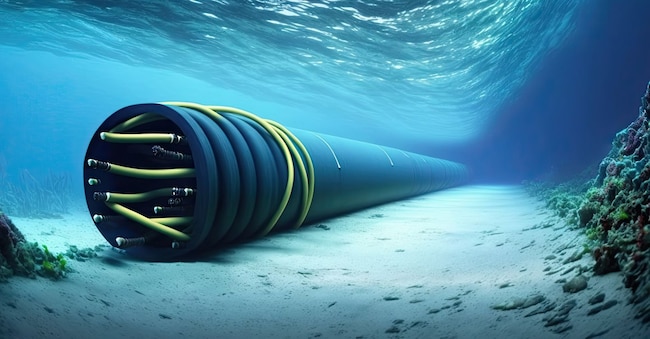
Submarine cables are among the most strategic and least visible pieces of infrastructure of our time. For years, they remained outside the public debate, perceived as a technical element in the background, almost neutral. Today, this is no longer the case. The growth in data traffic, the expansion of data centres, the race towards artificial intelligence and the transformation of energy markets have brought these assets back into the spotlight. Insurance policies and cover play a key role in ensuring their industrial stability and financial security. This is an issue that receives little coverage in the media, yet acts as a lifeline for the subsea and maritime supply chain – from the start of production at the factory through to the laying of the cables, including logistics and both routine and non-routine maintenance. Generali is one of the few global insurers that monitors every stage and serves clients throughout the entire supply chain. As Simone Nava, Global Head of Property, Engineering and Construction at Generali Global Corporate & Commercial, this infrastructure is experiencing “a very strong growth spurt”, driven on the data front by hyperscalers, cloud computing, AI and the need for “massive data transmission more than at any other time in recent history”. Within this galaxy, distinct universes coexist: cables for data transmission and cables for the transmission of electricity. They have different functions, but share one crucial characteristic: they are essential backbones upon which the continuity of our digital and energy economies depends.
Future trends in cables
For his part, Redwan Lkhaoua, Global Head of Marine Underwriting at Generali Global Corporate & Commercial, adds a detail that is by no means insignificant for understanding future trends. ‘With the growth of green energy, a whole sector is developing around the cables that carry electricity’, which are set to become ‘a geopolitical asset just like data cables’. In other words, what we can already clearly see today in digital networks – geopolitical risks and opportunities – is increasingly extending to energy backbones as well. According to Lkhaoua, “since the start of the war between Ukraine and Russia, cables have become a little more visible”: they were already central, but the new international context has highlighted their vulnerability. The reference is to the Baltic region, the Black Sea, the Middle East, and as far as the Taiwan area, where geopolitical competition and infrastructure concentration intertwine. The Mediterranean, in particular, is emerging as a crucial hub precisely because of the high density of connections and its role as a bridge between Europe, Asia, Africa and energy routes.
Risks to be covered
But the vulnerability of cables does not depend solely on international tensions. There are also more commonplace risks – and, for this very reason, often more frequent ones: anchors, fishing nets, installation errors, technical problems, and material or design faults. This gives rise to two different insurance approaches. “Sabotage and terrorism must be viewed primarily in terms of severity,” adds Lkhaoua, “they are complex risks that require specialised expertise and seamless solutions, areas in which Generali can provide practical support to policyholders.” Damage most often results from physical interference or, in some cases, from natural events such as earthquakes and underwater landslides. In this regard, the insurance cover supports the entire engineering process.
The difference between data cables and power cables is also evident when it comes to damage and repairs. “Damage to a data cable can be more difficult to manage in terms of business continuity,” explains Nava. The reason is technical, but it has immediate operational consequences. An electrical cable, despite all the complexities involved, can be repaired and spliced using various technologies depending on its type. However, there are specific challenges, as in the case of fibre optics, where damage has a more severe impact on service continuity. For this reason, the issue of resilience concerns not only the presence of the cable, but also its monitorability, the speed with which faults can be located, and the ability to intervene quickly. Mitigation technology therefore plays a decisive role. This is also relevant for the purposes of assessing insurance premiums and cover. Burying the cable in a trench, rather than simply laying it on the seabed, reduces the risk of interference from anchors and fishing gear. Furthermore, the integration of optical fibres into power cables makes it possible to pinpoint the exact location of the fault, reducing response times and the overall cost of repairs. “This is a key factor, because when a cable runs for hundreds of kilometres along the seabed, knowing exactly where the fault has occurred means minimising the hire of specialised vessels,” adds Nava, “downtime and business interruption.”
The maritime component
The maritime aspect must also be taken into account. “We are not talking about ordinary ships, but highly specialised vessels, built by only a few shipyards and operated by personnel with rare skills. The value chain is long and complex: production, transport, loading, laying, testing, commissioning, operation, maintenance and repair. And this is where the role of insurance comes into play throughout the cable’s entire life cycle,” comments Lkhaoua. In short, it is not an activity that ends with the issuance of a policy. It is a task that requires industrial vision, technical expertise and a deep understanding of contracts, liabilities and the regulatory framework. “The more information we have from the outset, the better we are able to offer comprehensive cover, with terms that are appropriate and consistent with the entire value chain of this sector.” In a market characterised by investments running into billions, global supply chains and risks spread across multiple parties, “prior knowledge of the project becomes an integral part of the quality of the cover,” concludes Lkhaoua. It is clear, in short, that submarine cables are no longer merely a technical issue for industry insiders, but an environment where critical infrastructure, economic interests, geopolitical competition and new models of risk protection intersect. Invisible beneath the sea, yet increasingly decisive on the surface.

