Dried fruit

From California almonds come next-generation creams, cheeses and protein flours

The Almond board of California is working with the University of Palermo to explore 14 alternative uses of almonds

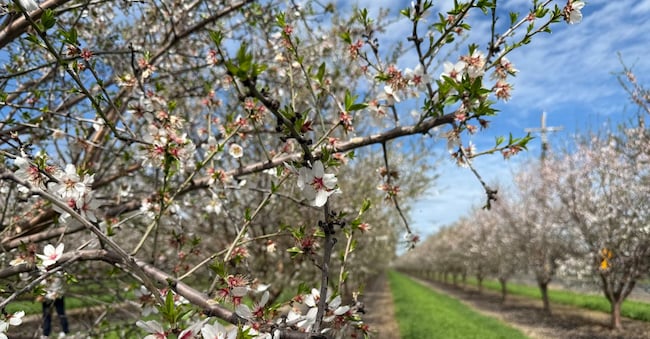
Mandorleti in fiore in California, il maggior produttore al mondo di mandorle

4' min read

Translated by AI
Versione italiana

4' min read

Translated by AI
Versione italiana

The almond has become one of the symbols of the new conscious diet. Doctors and dieticians recommend it for its nutritional profile - vitamin E, magnesium, monounsaturated fats, fibre - and Italians have responded. According to data processed by Ismea based on Nielsen IQ sources for modern distribution, in 2025 purchases of packaged nuts exceeded 1.1 billion euros (+13% compared to 2024) and 89 million kilos in volume (+6%).
The ranking by quantity purchased sees shelled almonds in the lead with 22% of the total, followed by shelled blends (15%) and shelled walnuts (13%); shelled hazelnuts stop at 5%, reflecting their almost entirely industrial rather than domestic use.

Italian only 4 out of 10 almonds

The problem is that Italia does not produce enough. According to the Ismea balance sheet based on Istat data for 2024, national almond production stops at 79 million kilos (in shell product equivalent weight), against imports of 137 million kilos.The domestic supply ratio is 41%: almost six out of ten almonds come from abroad.

Loading...

Yet something is moving. The organic area under almond trees has grown from 18,422 hectares in 2020 to 22,343 in 2024, with an average rate of +5.3% per year (Ismea on Sinab data). Paradoxically, climate change is also making new areas suitable in the Centre-North. Varieties such as Pizzuta d'Avola, Tuono, Genco and Fascionello - resistant and of recognised quality - are the genetic heritage to focus on. In Sicily, the Bioma project for low environmental impact farming practices is active; Coldiretti calls for tenders for new nut plantations offer concrete incentives to those who want to bet on the almond tree.

An emblematic example comes from Maccarese, on the Lazio coast, where Italy's largest almond orchard stands: 140 hectares and 220 thousand plants, started up in 2019 by agronomist Fabiola Fontana with 4.0 agriculture technologies: sensors in the soil, precision fertirrigation, aerial harvesting to avoid contamination of the fruit with the soil. The plant reduces CO₂ emissions by almost 170 tonnes compared to traditional methods.

California leading the world

The structural deficit, however, remains. California is the world's largest producer and its weight in the Italia market is far from marginal. This is confirmed by Charice Grace, manager of trade marketing and stewardship at the Almond Board of California: 'California is the largest producer of almonds in the world and we export 75% of our production'.

After India, the second global market is Europe, and within the European Union, Italia occupies the third position after Spain and Germany. And it is not just a question of volume: 'Italia is also strategic for us because there is a lot of innovation around almonds and a great love for this product, both in daily consumption and use in the kitchen,' Grace emphasises.

The latest frontiers of innovation

It is precisely on that innovation that the most interesting game is being played. The Almond Board of California is working with the University of Palermo to explore the 14 forms of use of the almond - from flour to milk, from butter to oil - with the aim of taking it out of the traditional snack and confectionery realm, and already has a meeting scheduled with the University of Gastronomic Sciences in Pollenzo. 'How can we put it on restaurant menus and in home kitchens? What opportunities does it offer as a flour, as a drink, as almond butter?" wonders Grace, who sees in the Italian savoury cuisine a still largely unexplored terrain.

The most unexpected frontier, however, is that of the hull, the outer husk that surrounds the shell and which until yesterday ended up almost entirely in cattle fodder. Professor Guangwei Huang, director of food research and technology at the Almond Board of California, is working on the development of food ingredients derived from the husk for human consumption: a path that is still experimental, but perfectly consistent with the circular economy logic applied to the entire supply chain. Californian producers already value every part of the fruit: the husk is used as bedding or converted into biomass, while regenerative farming practices increase soil fertility and reduce emissions. The almond's ecological footprint remains small: 1 kg of product generates less than 2 kg of CO₂, compared to 20 kg for beef (source: Almond Board of California). A supply chain that looks ahead, in short, and one that is firmly focussed on Italia.

It is worth mentioning, in closing, that behind this export powerhouse is a production model that is anything but anonymous. According to data from the Almond Board of California, there are more than 7,600almond producers in California: 90% run family farms and 70% work plots of 100 acres or less.

Generations of growers combine tradition and technology, with precision irrigation as the current practice, a tool that has made it possible toreduce water consumption per almond by 33% in recent years. Completing the picture is the close relationship with the world of beekeeping: over 170,000 acres of Californian almond orchards are certified 'Bee Friendly' through the Pollinator Partnership, accounting for 86% of all farmland with this certification in the United States. The almond tree depends almost entirely on pollinators to produce fruit, and Californian growers know this well: their beehive management practices are now considered a model for agriculture worldwide.

Copyright reserved ©

Brand connect

Loading...

Newsletter

Notizie e approfondimenti sugli avvenimenti politici, economici e finanziari.

Iscriviti